
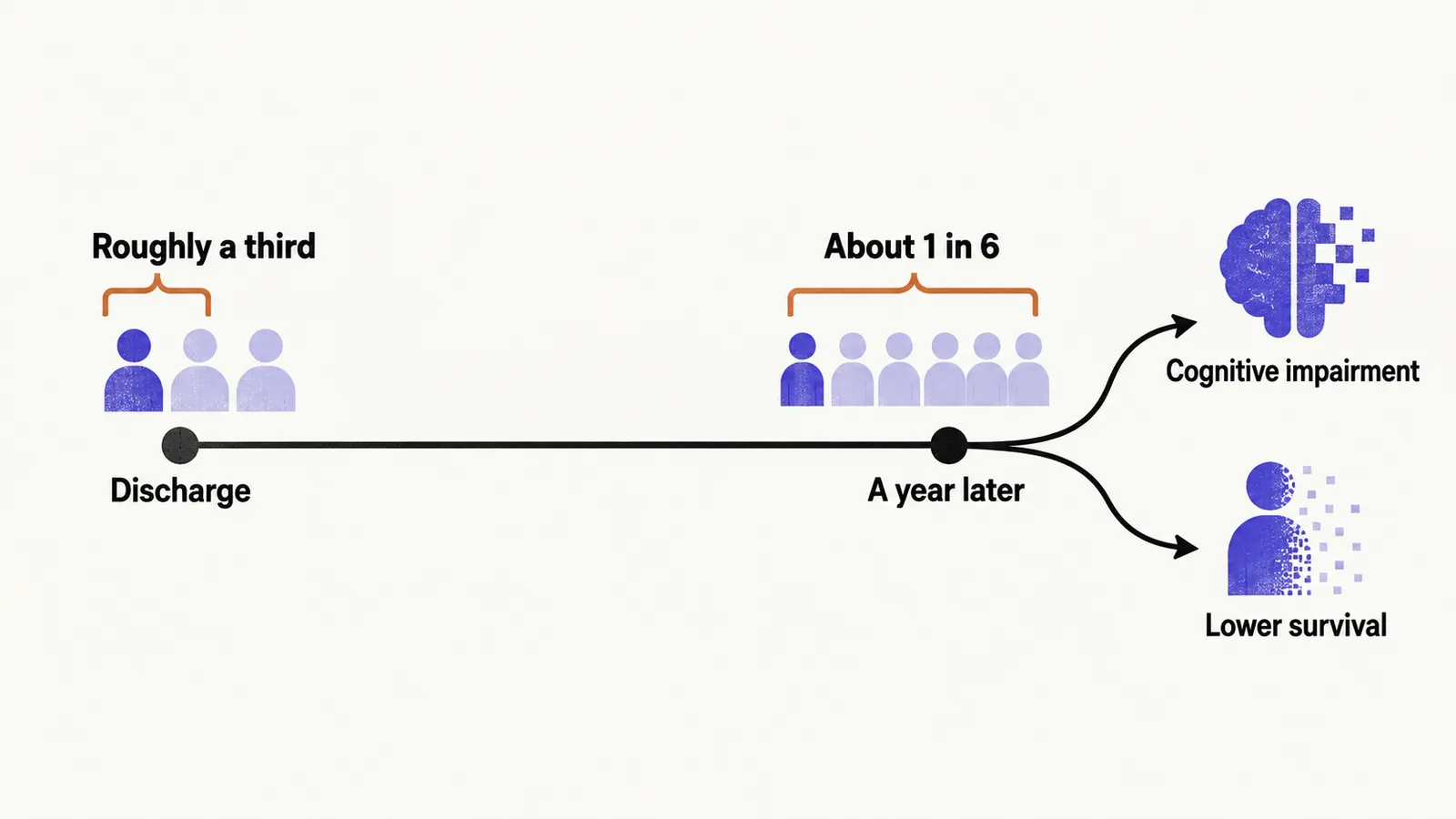
Delirium, an acute change in attention and awareness, often resolves promptly once its cause is treated, but persistence for weeks to months is common. Roughly a third of older hospital patients are still delirious at discharge, and about 1 in 6 remains so a year later. Delirium must therefore be framed as potentially chronic, with follow-up arranged across settings rather than assumed over.
Longer episodes track with lasting cognitive impairment. Across surgical and nonsurgical groups alike, delirium is followed by measurably worse long-term cognition, consistent with delirium itself contributing causally. Patients who survive critical-illness delirium carry the same burden: longer hospital stays and long-term cognitive impairment in survivors.
Survival is also worse. Delirium carries increased risk of dementia and death, longer stays, and new admission to long-term care, and delirious intensive-care patients show lower survival at six months than those without delirium. Patients sent home with unresolved delirium face substantially higher subsequent mortality, though no single figure pins that risk.
These outcomes are why resolution matters more than any single intervention, and why delirium should never be left unaddressed at discharge. Delirium that does not resolve calls for re-evaluation for underlying causes, and every patient who experienced delirium needs follow-up for possible dementia.