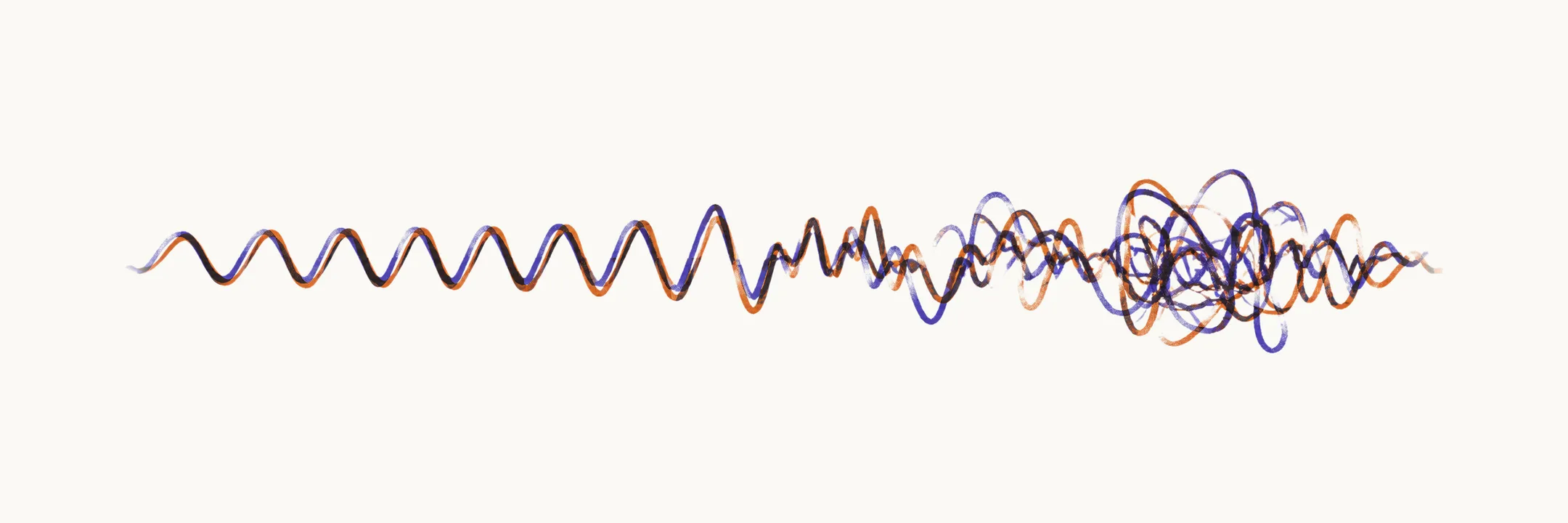
Hyperkinetic movements are excessive involuntary movements. Before naming a cause, the clinician’s first task is to describe the movement accurately, because the pattern itself usually reveals the category. The framework below organizes hyperkinetic movements by predictability: whether the movement repeats in a fixed, anticipatable form or flows unpredictably from moment to moment. This is a bedside heuristic for triage, not a rigid pathophysiologic taxonomy, and a few phenotypes sit between the poles. The three groups below run from the most predictable to the least, and a list of assessment dimensions then shows how to place any new movement.
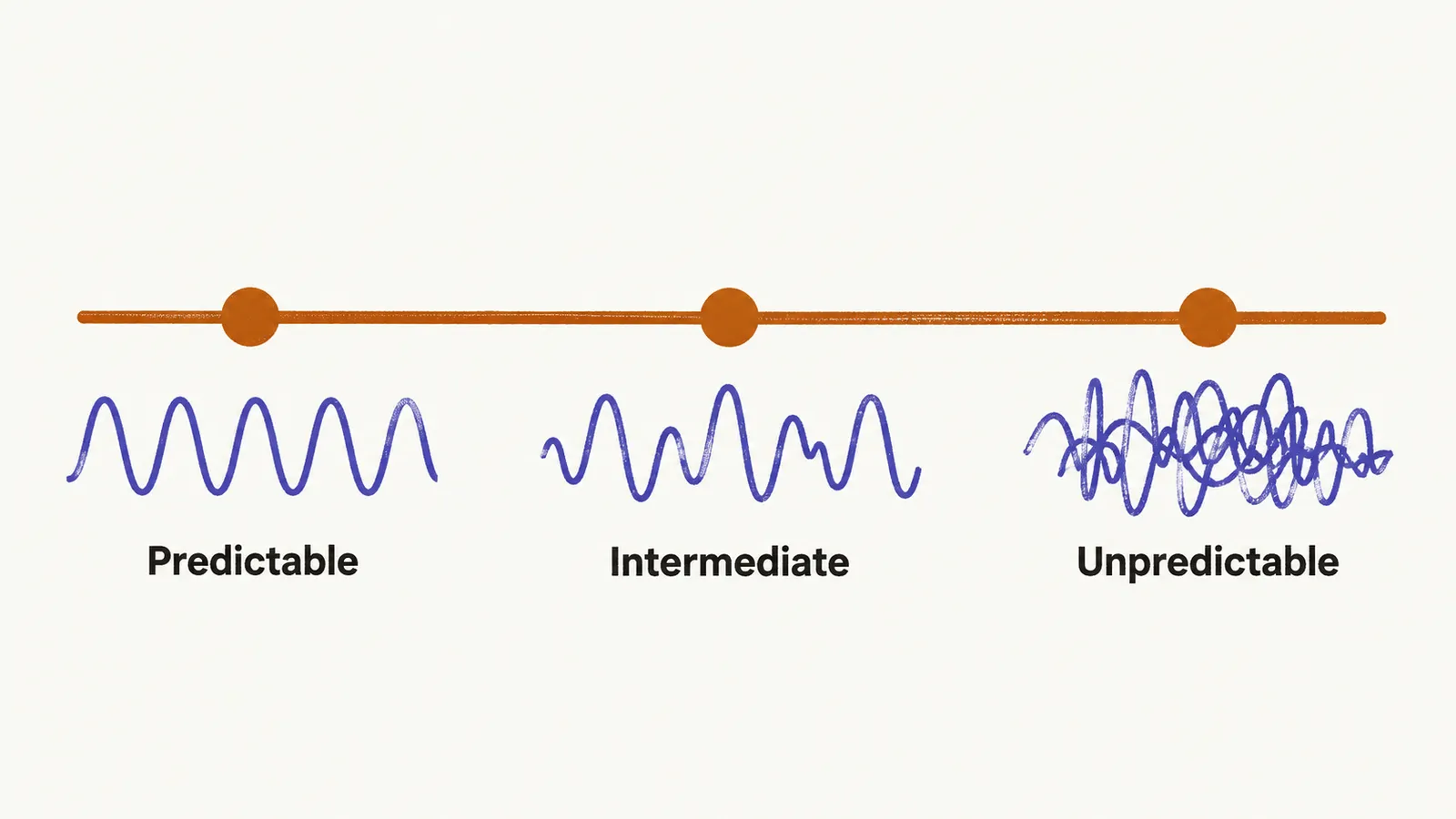
Predictable and regular movements
These repeat in a fixed rhythm or stereotyped form, so the examiner can anticipate how the next movement will look.
- Tremor (rest, postural, kinetic, intention): rhythmic oscillation at a fairly fixed frequency; timing is predictable even as amplitude varies. Covered in detail in /notes/neurology/hyperkinetic-movement-disorders-tremor/
- Palatal myoclonus: regular rhythmic jerking of the palate; myoclonus means brief, shock-like jerks, and this is an atypical form that can persist during sleep
- Tics: the same movement or vocalization repeated in stereotyped fashion; characteristically suppressible for a time, with a building urge and rebound, and usually preceded by a premonitory urge
Intermediate movements
These sit between the poles: they have a recognizable pattern that recurs in the same place but varies in timing or intensity.
- Dystonia: sustained, patterned contractions recurring in the same region; a light touch to the area (sensory trick, or geste antagoniste) can briefly abolish them
- Athetosis: slow writhing distal movements, covered with chorea in /notes/neurology/hyperkinetic-movement-disorders-chorea-ballismus/
- Myokymia: fine continuous undulating contraction confined to one muscle group, such as the eyelid
- Stereotypies: repetitive, seemingly purposeful but non-functional movements
Unpredictable and fleeting movements
At the opposite pole from tremor, these are irregular and constantly changing in location, amplitude, or character.
- Chorea: flowing, dance-like, purposeless movements migrating between body parts. Covered in /notes/neurology/hyperkinetic-movement-disorders-chorea-ballismus/
- Myoclonus: brief shock-like jerks, focal or generalized; some forms are rhythmic and belong with the predictable group, which is why myoclonus appears in both lists
- Fasciculations: fine flickering twitches of muscle fiber bundles visible under the skin; too small to move a joint, which separates them from myoclonus and chorea
- Dyskinesia: a general term for abnormal involuntary movements, often drug-induced (for example peak-dose levodopa dyskinesia)
Assessment dimensions
The groups above give a first impression; a fuller description comes from working through these dimensions for every new movement, in roughly this order.
- Distribution: focal, segmental, multifocal, generalized, unilateral, or bilateral
- Extent: distal versus proximal; which limbs, trunk, face, or vocal tract
- Pattern: rhythmic or arrhythmic; stereotyped or variable
- Course: acute, subacute, chronic, progressive, episodic, or paroxysmal
- Speed: rapid (myoclonus, chorea) versus slow (athetosis, dystonia)
- Amplitude: fine flickering versus large flinging
- Relation to rest and posture: present at rest (parkinsonian tremor) or only on holding a posture (essential tremor)
- Relation to voluntary action: worsening with action, including overflow into the affected part when another limb moves
- Sensory tricks: whether a gentle touch briefly relieves the movement, as in dystonia
- Emotional modulation: anxiety, stress, and self-consciousness amplify nearly all hyperkinetic movements
- Suppressibility and urge: tics are suppressible with a premonitory urge and rebound; brief chorea suppression is reported, with rebound best established in tics; tremor shows no characteristic suppressibility
- Sleep behavior: hyperkinetic movements typically fade or disappear in sleep; persistence through sleep redirects the workup, usually toward EEG
Parakinesia and video documentation
Patients with chorea often fold the involuntary movement into a voluntary gesture, so it looks semi-purposeful, fidgety, or restless. This parakinesia is a common reason chorea is missed: the clue is that the pattern never settles into a completed functional act and keeps changing. When the description stays uncertain, especially with paroxysmal or intermittent movements, record a video (with consent) so a specialist can see the pattern and later visits can be compared.