Tuberculous meningitis is infection of the meninges, the membranes covering the brain and spinal cord, by Mycobacterium tuberculosis. It runs a subacute course over days to weeks, which sets it apart from acute bacterial meningitis evolving over hours to days. Compatible signs are more than 5 days of fever plus any of headache, vomiting, neck stiffness, poor appetite or weight change, cough, or cranial nerve palsy. Cranial nerve involvement reflects basal meningeal exudates (inflammatory deposits) wrapping the nerves at the skull base.
Cerebrospinal fluid supports but never decides
The lumbar fluid is the cerebrospinal fluid (CSF) sampled by lumbar puncture. Its profile is typically a moderate lymphocytic pleocytosis (a raised white cell count dominated by lymphocytes) with elevated protein and low glucose. That signature is supportive, never definitive on its own. It overlaps with other subacute lymphocytic pictures, so the profile alone never confirms or excludes the disease.
Because the fluid profile cannot decide, the diagnosis rests on microbiological tests. Xpert Ultra or Xpert PCR (a molecular test for the organism) plus mycobacterial culture is strongly recommended for diagnosis. Acid-fast smear, microscopy for mycobacteria, has low sensitivity and culture is slow. Xpert Ultra improved sensitivity and shortened diagnostic delay, so it is the step-up test after smear. No single negative test rules tuberculous meningitis out. Many patients must start treatment empirically, on clinical suspicion alone.
Imaging shows the complications. Contrast CT detects hydrocephalus, basal exudates, large infarcts, and tuberculomas (focal tuberculous masses within the brain). MRI is more sensitive for small and brainstem infarcts.
One differential deserves a line: in people living with HIV, cryptococcal meningitis presents similarly as a subacute meningitis with sparse meningeal signs, so serum cryptococcal antigen testing comes first to split them.
A months-long treatment arc with routine steroids
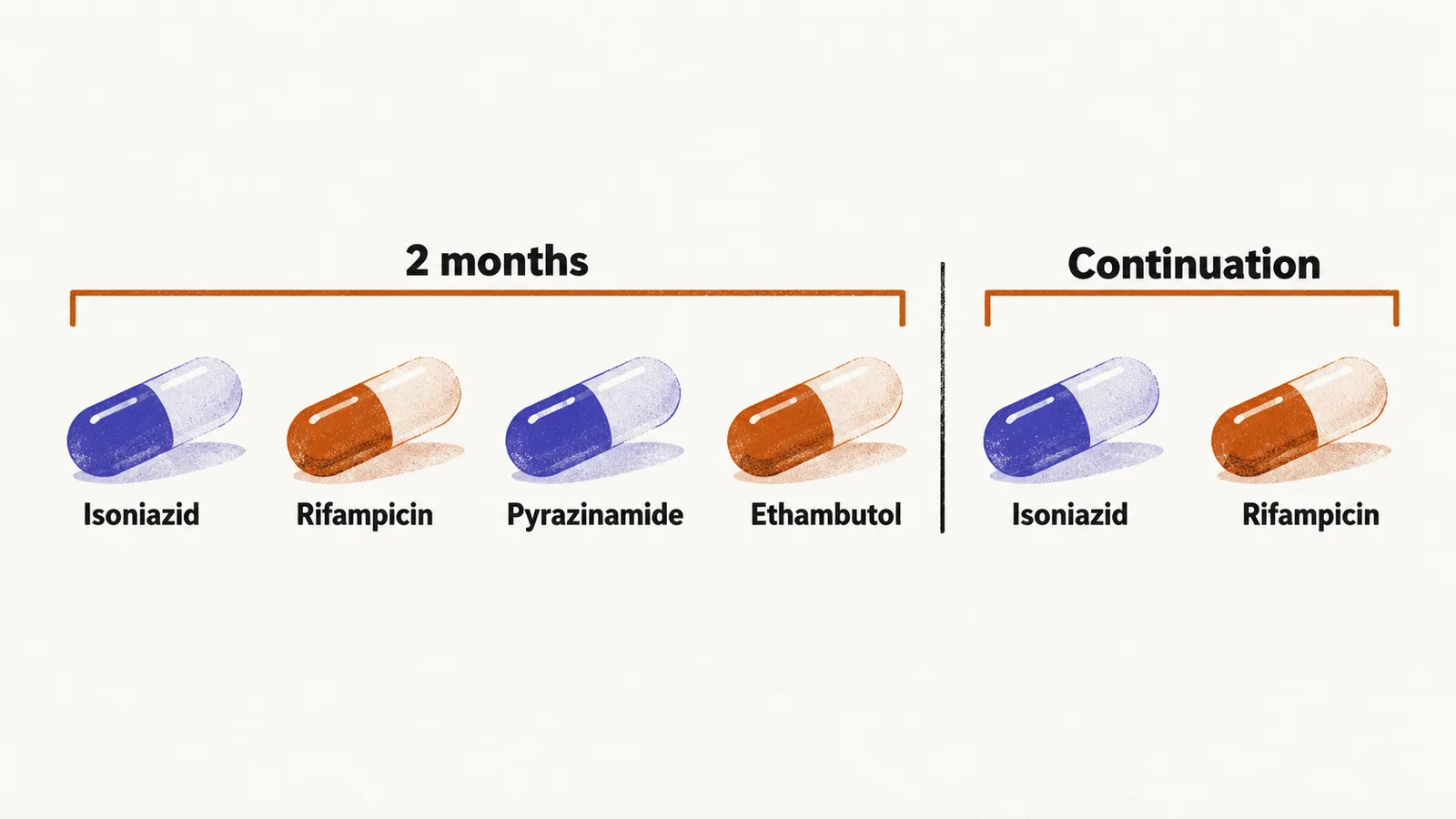
Treatment starts with isoniazid, rifampicin, pyrazinamide, and ethambutol daily for the first 2 months. Continuation follows with isoniazid plus rifampicin for many further months. The established standard is 2 months of four drugs followed by about 10 further months of two drugs, and there is insufficient evidence to recommend less than 12 months in adults. In practice the tail is sometimes described shorter or extended, so the working frame is roughly 9 to 12 months with the exact tail uncertain.
Adjunctive corticosteroids are recommended for everyone with tuberculous meningitis regardless of severity. They reduced case fatality, especially in children and in adults without HIV. The concrete anchor is dexamethasone for 6 weeks. In children, weight-banded prednisone with a gradual taper is the parallel anchor. In people living with HIV the steroid benefit is uncertain, so use there is case-by-case rather than routine.