
Thyroid carcinoma is the most common malignancy of the endocrine system, and thyroid cancers are mostly derived from the follicular cells of the thyroid, the cells that make thyroid hormone. A malignant nodule is recognised by its histology, but several mutations recur in thyroid cancer: BRAF, RET, RAS, P53 and PPAR.
Classification and prognosis
Based on the histological findings, thyroid cancers are classified into three main groups: papillary thyroid cancer (PTC), follicular thyroid cancer (FTC) and anaplastic thyroid cancer (ATC). PTC and FTC are well differentiated and keep the features of follicular cells; ATC has lost them, and this difference is what makes its behaviour so different. PTC and FTC have a very good prognosis if they are diagnosed in the first stages, while ATC is very aggressive and its prognosis is much poorer than the other two forms.
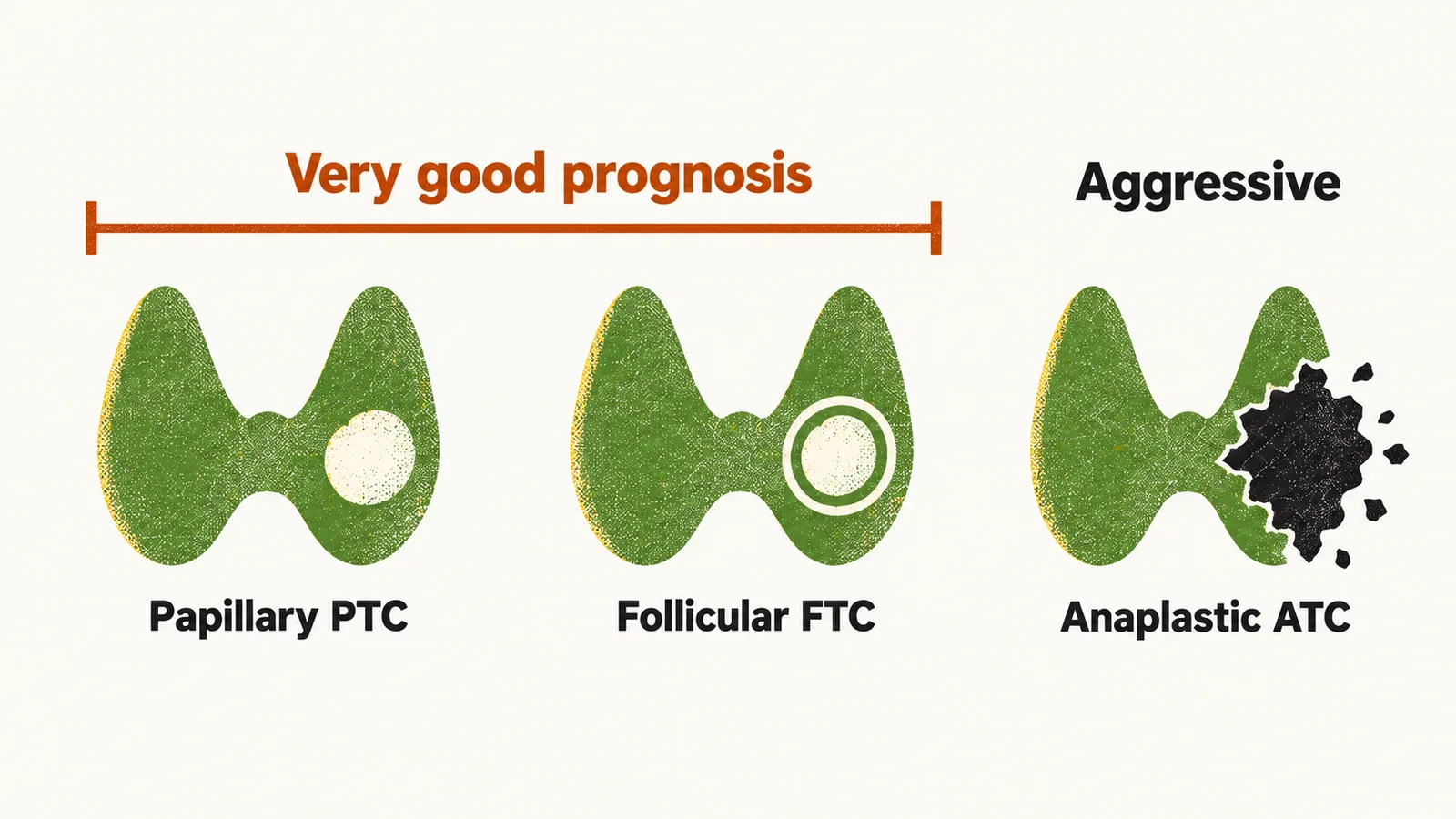
The better prognosis of the well-differentiated cancers does not come from a drug specific to them; it comes from their biology. They grow slowly, they remain able to take up iodine and to respond to TSH (the pituitary hormone that drives thyroid cells), so surgery can remove them and radioiodine can destroy what remains, and thyroglobulin (Tg), a protein made by follicular cells, stays a usable marker for follow-up.
Clinical presentation
Most thyroid cancers present as a nodule. The nodule is usually solitary and is often noticed incidentally. Three features raise the suspicion of malignancy: a hard nodule fixed to surrounding tissue, hoarseness from laryngeal nerve involvement, and palpable cervical lymph nodes. Rapid enlargement, pain and stridor are rare.
Risk factors
Several factors raise the risk of thyroid cancer. Previous irradiation of the head and neck is one, with a latency (the interval between the exposure and the cancer) of 5-40 years and mostly about 20 years. Others are family history, pre-existing thyroid disorders, and ethnicity, with Chinese men and people in Iceland among the higher-risk groups. A single nodule at an age less than 16 or more than 60 years also raises the risk.
Overdiagnosis
During the last 30 years the incidence of thyroid cancer in the USA increased from 5 to 15 in each 100,000, while the mortality rate has barely changed. That contradiction between a rising incidence and a nearly flat death rate led to one important idea, the overdiagnosis of thyroid cancer: many of the newly found cancers would never have caused symptoms. The increase in total incidence is mainly devoted to the increase of the incidence of PTC, and specifically to small T1 papillary thyroid cancer, in which the nodule is less than 2 cm. Thyroid cancer is twice more prevalent in women than men, but the severity of the disorder in men is worse. The modern approach to small T1 cancers is therefore to raise the threshold at which such nodules are investigated and treated rather than to treat every one of them.