
Confirming hyperglycemia is only the first half of the diagnosis. The second half is classification — deciding which category of diabetes the patient has — because the category decides the treatment. The categories overlap, and in some patients the type is not clear when they first present, becoming obvious only as the disease evolves.
The main categories
The American Diabetes Association (ADA) divides diabetes into four clinical categories, which differ in the underlying cause of the hyperglycemia:
- Type 1 diabetes — immune-mediated destruction of the pancreatic β-cells (the insulin-producing cells of the pancreas), usually leading to absolute insulin deficiency. It accounts for 5-10% of all diabetes, and people with it need insulin from outside the body to survive.
- Type 2 diabetes — a non-autoimmune, progressive loss of adequate β-cell insulin secretion, frequently against a background of insulin resistance (a reduced response of the body’s tissues to insulin). It accounts for 90-95% of all diabetes.
- Gestational diabetes mellitus (GDM) — diabetes first recognized in the second or third trimester of pregnancy, in someone who did not clearly have diabetes before pregnancy.
- Specific types from other causes — monogenic diabetes syndromes, diseases of the exocrine pancreas, and drug- or chemical-induced diabetes.
Telling type 1 from type 2
Type 1 and type 2 are both heterogeneous, and both occur at every age, so the old rule that type 1 is a disease of children and type 2 of adults is not reliable. The features that most support type 1 are a younger age at diagnosis (under 35 years), a lower BMI (body mass index, under 25 kg/m²), unintentional weight loss, ketoacidosis (an acute acidosis from a build-up of ketones), and a plasma glucose above 360 mg/dl (20 mmol/L) at presentation. Features classically linked to type 1 but weak on their own include ketosis without acidosis, osmotic symptoms, a family history of diabetes, and a personal history of autoimmune disease.
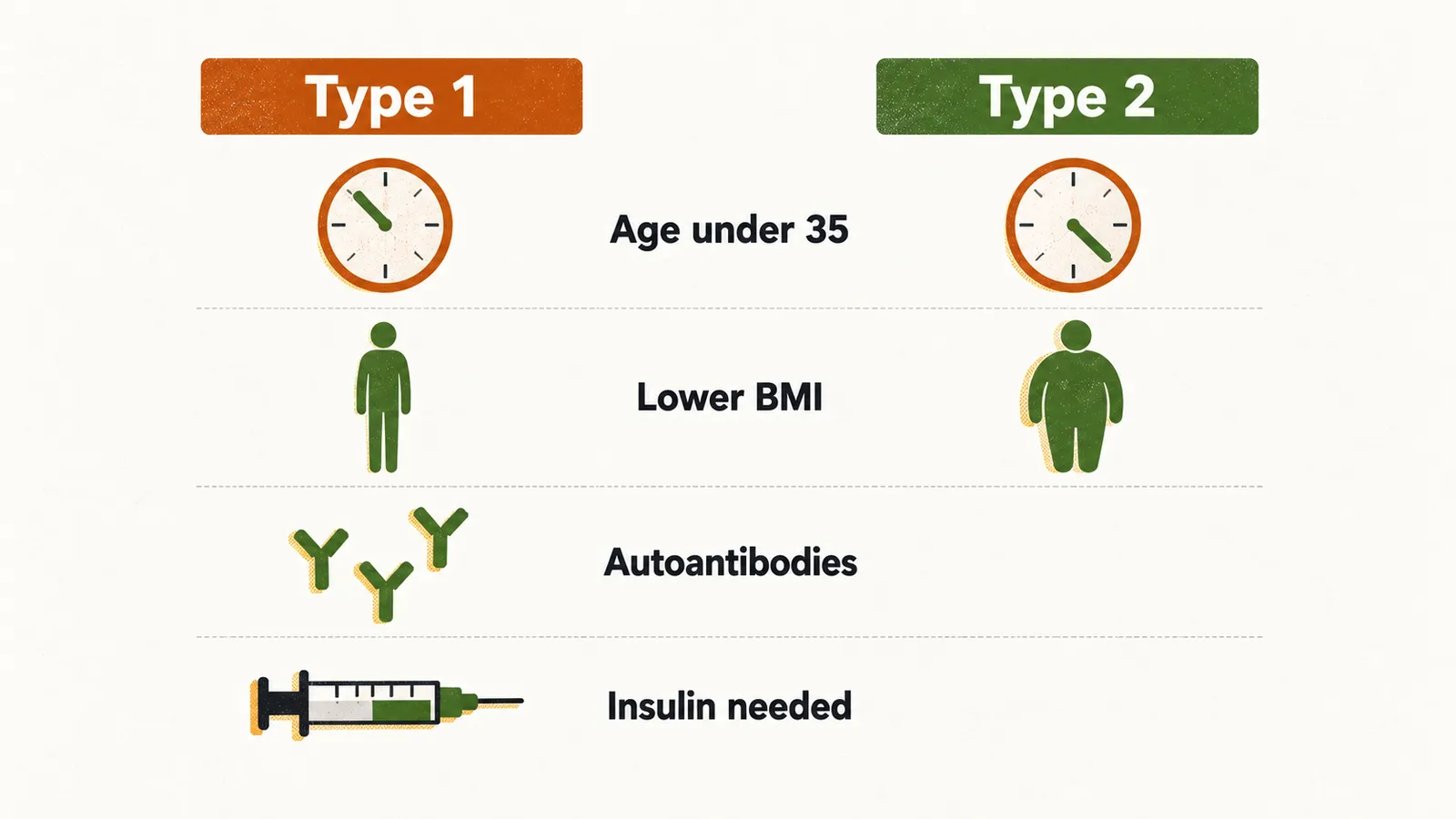
The AABBCC approach gathers the features worth checking: Age, Autoimmunity (personal or family history of autoimmune disease or polyglandular autoimmune syndromes), Body habitus (BMI under 25 kg/m²), Background (family history of type 1 diabetes), Control (failure to reach glycemic goals on non-insulin therapy), and Co-morbidities, such as treatment with immune checkpoint inhibitors for cancer, which can cause an acute autoimmune type 1 diabetes.
Islet autoantibodies support the diagnosis of type 1 diabetes. Glutamic acid decarboxylase (GAD) is the first to measure, followed by islet antigen 2 (IA-2) and zinc transporter 8 (ZnT8) if GAD is negative; in someone not yet treated with insulin, antibodies against insulin can also help. Their absence does not exclude type 1, because 5-10% of people with type 1 diabetes have no islet antibodies. C-peptide, which reflects how much insulin the pancreas still makes, is useful when the question is whether insulin therapy can be reduced or stopped.
Misclassification is common: about 40% of adults with new type 1 diabetes are first diagnosed as having type 2. The distinction matters because it changes whether insulin is needed from the start, so a patient who does not fit the expected picture deserves a second look.
Monogenic diabetes
Monogenic diabetes is caused by a mutation in a single gene. It is rare, present in under 5% of people with diabetes, but recognizing it changes treatment. Diabetes diagnosed within the first 6 months of life should prompt genetic testing for neonatal diabetes, and 30-50% of cases caused by mutations in the β-cell KATP channel, which controls insulin release, respond to high-dose oral sulfonylureas instead of insulin.
MODY (maturity-onset diabetes of the young) is a group of monogenic, non-syndromic forms inherited in an autosomal dominant pattern. It is suggested by diabetes without the typical features of type 1 or type 2, a family history of diabetes across successive generations, and stable, mild fasting hyperglycemia. The most common forms differ in treatment: HNF1A and HNF4A MODY are sensitive to sulfonylureas, while GCK MODY causes stable, non-progressive fasting hyperglycemia that usually needs no treatment.
The last category, gestational diabetes, is diagnosed with thresholds of its own, because pregnancy changes what counts as an abnormal glucose result.