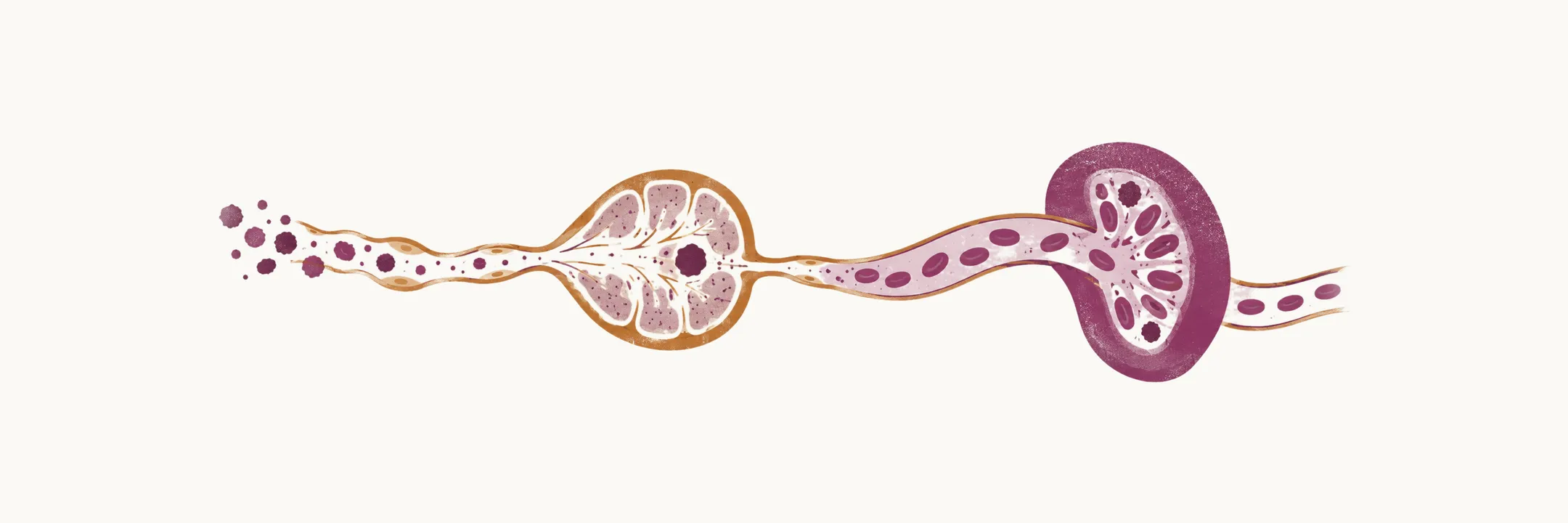
Lymph nodes are secondary lymphoid organs: they sit on the course of lymphatic vessels, which carry lymph, the fluid that drains from the tissues, and immune cells are activated in them, antigens are presented there, and B cells complete their terminal differentiation into antibody-secreting plasma cells and memory cells. The spleen is the other great secondary lymphoid tissue, and it does the same immune work for the blood that a lymph node does for the lymph. Lymphadenopathy (an enlarged lymph node) and splenomegaly (an enlarged spleen) are the two problems that bring these organs to clinical attention, and both are approached in the same way: the cause is found by reading the pattern of the enlargement against the structure and function of the organ involved.
- Lymph node structure and the approach to lymphadenopathy explains how a lymph node is built and how an enlarged node is assessed.
- B-cell maturation and lymphoid neoplasms follows B-cell maturation through the bone marrow, the follicle, the marginal zone and the germinal center, and shows how the region in which an error occurs determines which leukemia or lymphoma develops.
- The spleen and splenomegaly covers what the spleen does, the causes of its enlargement, and how it is examined, diagnosed and managed.
Start with the lymph node note, since the structure it describes is what the B-cell maturation note builds on.