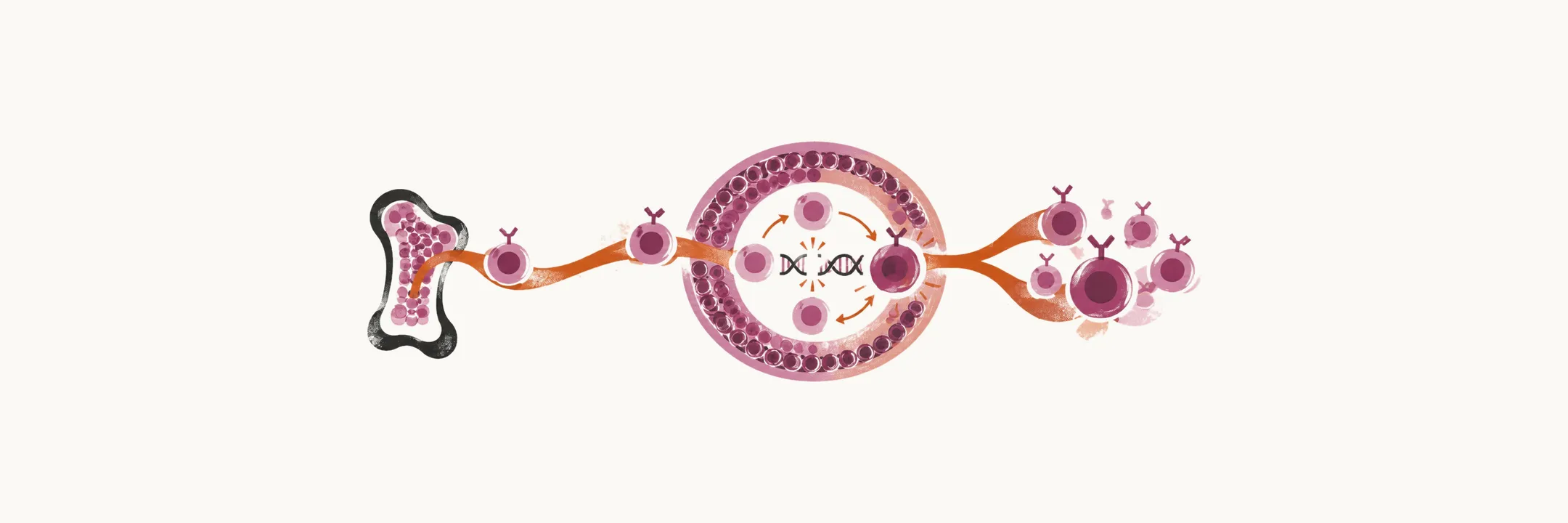
B cells are the lymphocytes that make antibodies, and they mature in a fixed sequence of steps, each of which takes place in a particular region. The machinery that reshapes the B-cell receptor, the immunoglobulin through which a B cell recognizes antigen, is active in those regions, so the errors that cause lymphoid neoplasms happen where the cells are, and the region in which the error occurs predicts which leukemia or lymphoma develops. The characteristic lesions named below are gene mutations or translocations, in which a piece of one chromosome is joined to another.
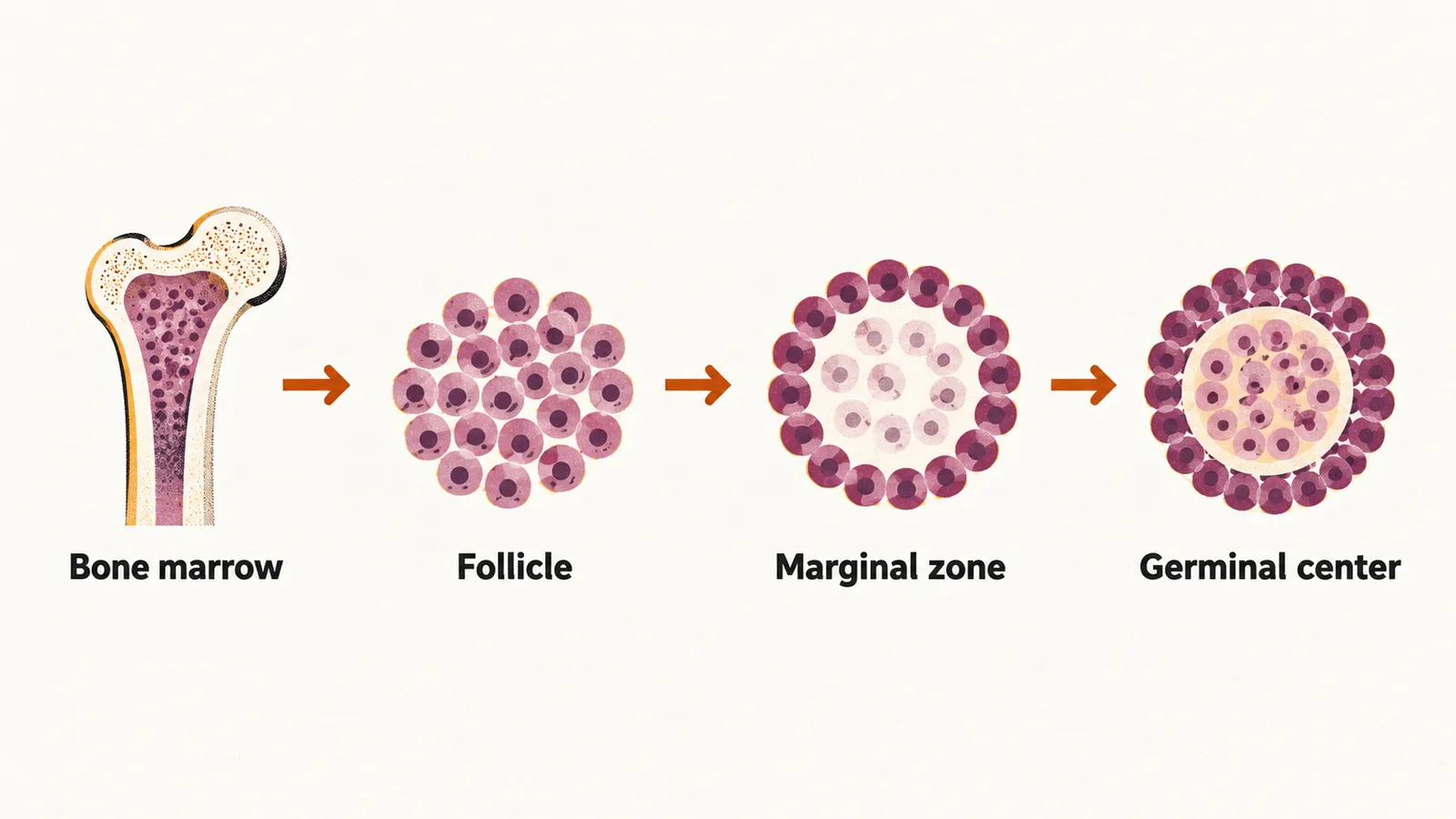
Bone marrow
B cells are produced in the bone marrow, where they pass through stages of large and small B cells and leave as immature B cells. Neoplastic transformation at this earliest stage, mainly in the large pre-B cell, causes B-cell acute lymphocytic leukemia, or B-ALL. The mutations found in B-ALL are mainly a BCR-ABL translocation and mutations of RUNX1, PBX1, MLL, PTPN11 and ROS1.
Follicle
Once in the lymph node, B cells occupy the cortical follicle. The neoplasms that arise in this compartment are B-cell chronic lymphocytic leukemia, or B-CLL, and mantle cell lymphoma, or MCL. The lesion that defines MCL is not a point mutation but a translocation: t(11;14) places the CCND1 gene, which encodes the cell-cycle protein cyclin D1, next to the immunoglobulin heavy-chain locus, so cyclin D1 is overexpressed and the cell cycle is deregulated.
Marginal zone
The next region is the marginal zone. If its B cells undergo neoplastic transformation, the neoplasms are marginal zone lymphoma, or MZL, in which the common lesion is NOTCH2, and MALT (mucosa-associated lymphoid tissue) lymphoma, in which the common lesions are MALT1 and BCL10.
Germinal center
The germinal center holds the germinal-center B cells and the cells they become as they mature, the memory B cells and the plasma cells. A neoplastic event in a germinal-center B cell produces one of three lymphomas, each with its own characteristic lesion:
| Neoplasm | Characteristic lesion |
|---|---|
| Follicular lymphoma | BCL2 |
| Diffuse large B-cell lymphoma (DLBCL) | BCL6 |
| Burkitt lymphoma | MYC |
When maturation proceeds instead of transformation, the memory B cell is the cell of origin of B-CLL, and the plasma cell is the cell of origin of multiple myeloma.
Why B cells are prone to new mutations
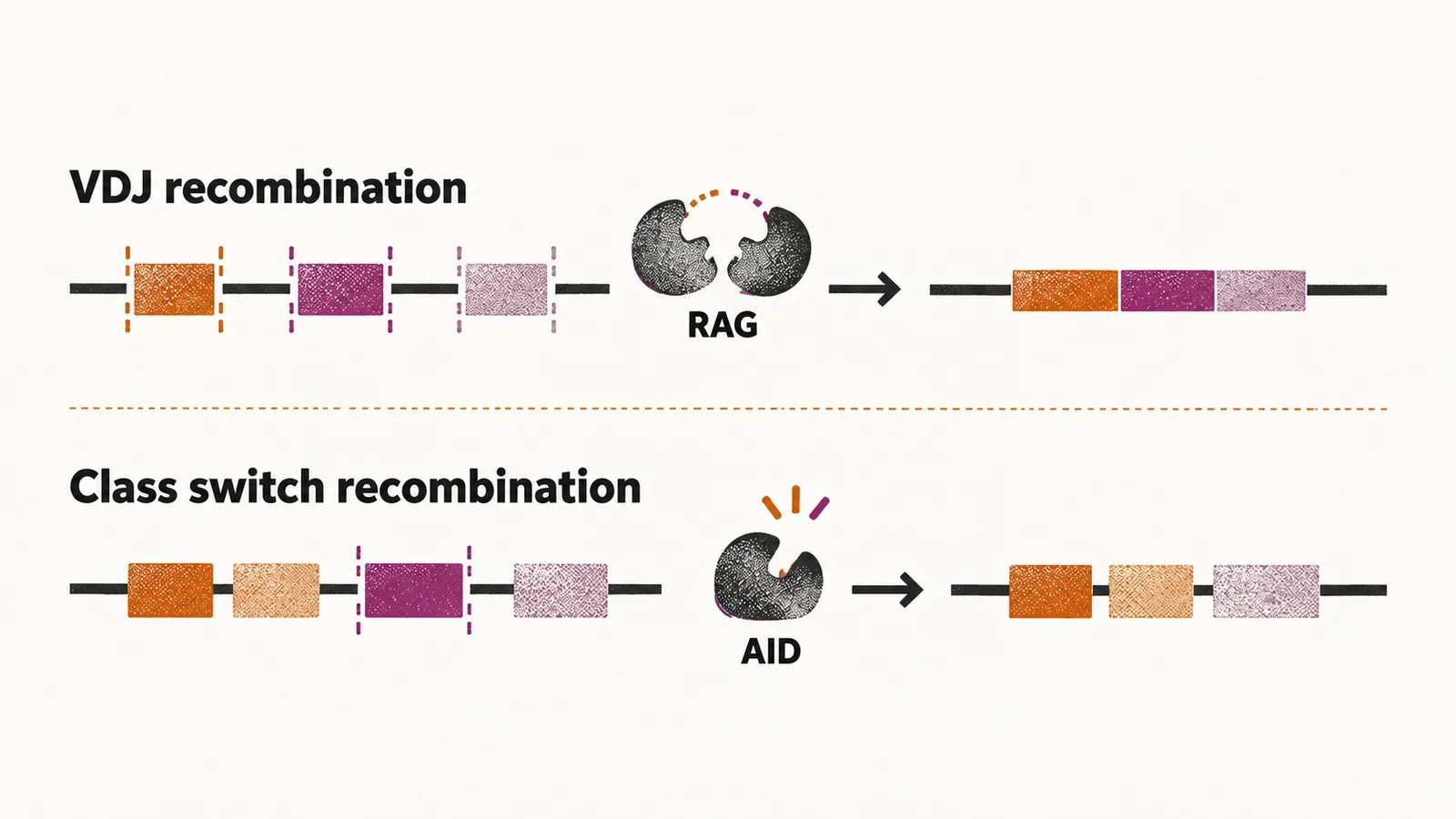
The transformations above all begin with an error in DNA. During proliferation and maturation, B cells deliberately cut and rejoin their own DNA, and this is why they are so prone to new mutations. Two processes matter most.
VDJ recombination assembles the variable region of the B-cell receptor from separate V, D and J segments. The RAG complex cuts the segments and joins them, removing the DNA in between; because the enzyme works by breaking and rejoining DNA, RAG acting at the wrong site can create the translocations that drive B-ALL.
Class switch recombination changes the constant region of the immunoglobulin heavy chain, so that the cell can switch the class of antibody it makes. It is carried out by the enzyme AID (activation-induced cytidine deaminase); when AID acts off target it creates chromosomal breaks that can lead to lymphoma.
These neoplasms arise in lymphoid tissue, and the spleen, the other secondary lymphoid organ, can be infiltrated by leukemia and lymphoma and enlarge as a result.