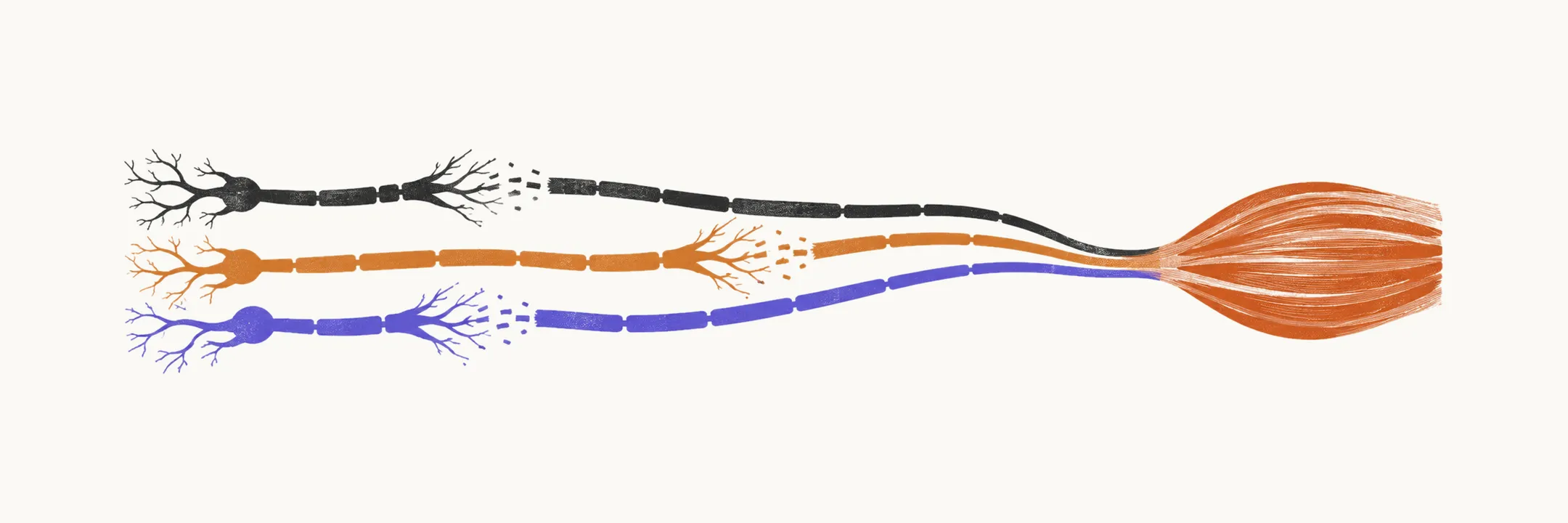
ALS looks different depending on which motor neurons fail first. Upper motor neurons (UMN) run from the motor cortex to the brainstem and spinal cord, and lower motor neurons (LMN) run from there to muscle. Damage to UMN causes spasticity and hyperreflexia, while damage to LMN causes wasting and weakness. Six phenotypes describe the spectrum. Phenotype predicts pace, so recognising the pattern guides prognosis and planning.
The six phenotypes
The table gives the key feature and typical prognosis of each phenotype. Bulbar refers to the muscles of speech and swallowing, dysarthria means slurred or difficult speech, and dysphagia means difficulty swallowing. Figures are cohort approximations. Individual courses vary widely.
| Phenotype | Key feature | Typical prognosis |
|---|---|---|
| Classical ALS | Combined UMN and LMN signs across multiple segments | Around 3–4 years from first symptoms; about 1 in 10 live 10 years or more |
| Progressive bulbar palsy | Speech and swallowing fail first, with dysarthria usually preceding dysphagia | Variable; often spreads to generalised ALS with shorter survival |
| LMN-predominant disease, including progressive muscular atrophy | LMN signs only at onset | Slower on average than classical ALS |
| Primary lateral sclerosis | UMN signs only: spasticity and hyperreflexia | Markedly slow; often a decade or more, with near-normal lifespan in many series |
| Flail-arm syndrome | LMN weakness largely confined to the arms | Median around 5–6 years, roughly double classical ALS |
| Flail-leg syndrome | LMN weakness largely confined to the legs | Median around 5–6 years, with a majority alive at 5 years |
Primary lateral sclerosis is rare, confidently demarcated in under 3% of motor neuron disease. Flail phenotypes progress roughly twice as slowly as classical ALS but do not carry the near-normal course sometimes claimed for them.
How the disease starts
Onset is less uniform than the phenotype names suggest. First symptoms fall roughly into thirds. Some patients notice foot drop or gait disturbance. Others lose hand dexterity. A third group starts with dysarthria or dysphagia.
Respiratory onset and isolated neck flexor weakness are uncommon. Bulbar onset is relatively more common in older women.
One bedside heuristic separates bulbar ALS from myasthenia gravis, a disorder of neuromuscular transmission, when speech and swallowing are affected. In bulbar ALS, dysarthria usually precedes dysphagia. In myasthenia, dysphagia often comes first, reflecting fatigable transmission rather than neuron loss. This contrast is a heuristic, not a rule.
Staging the course
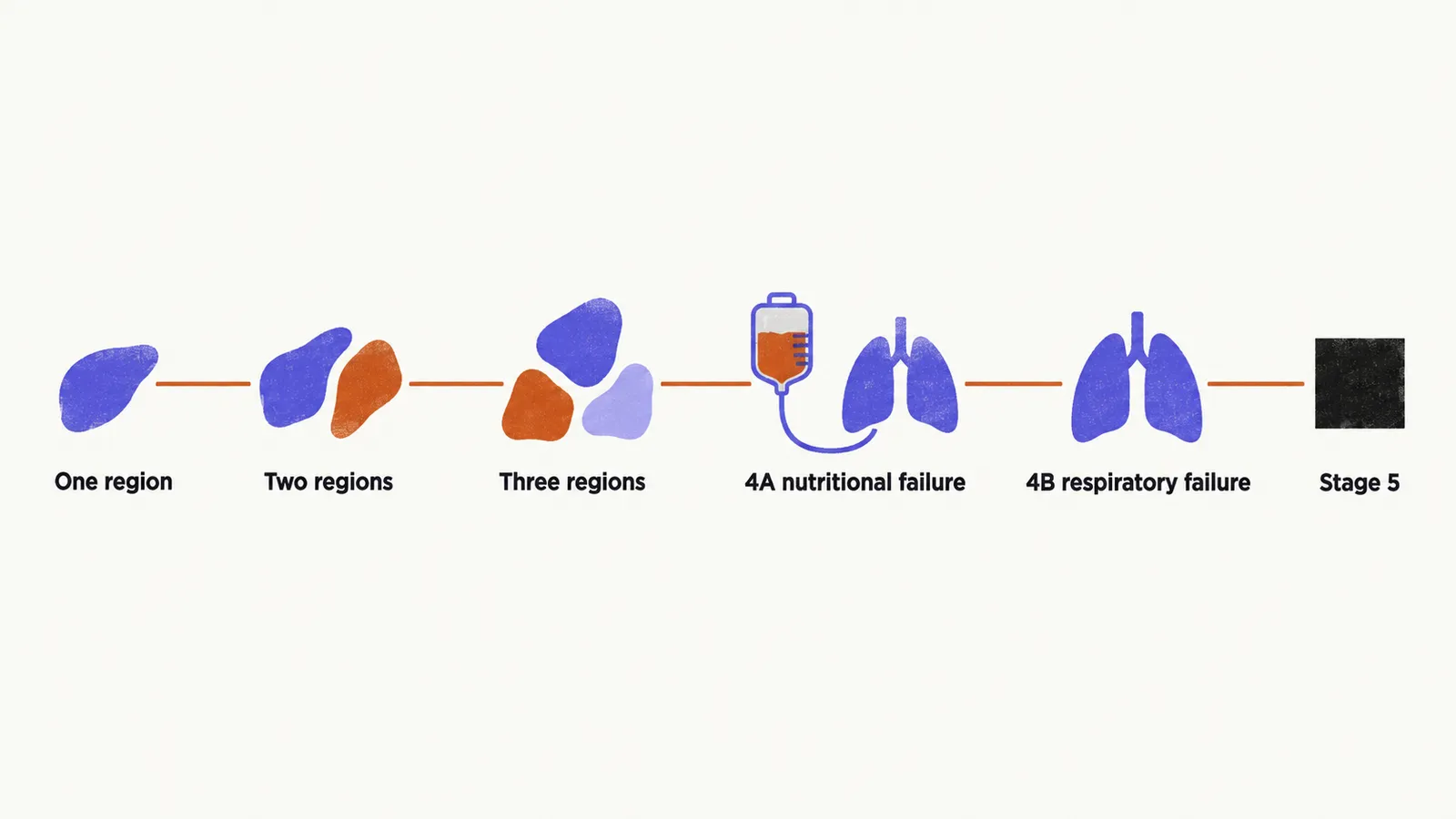
Phenotype describes where the disease starts. Staging describes how far it has advanced, and two systems stage progression. King’s staging counts anatomical spread: one region, then two, then three. Stage 4 marks nutritional (4A) or respiratory (4B) failure. Stage 5 is death.
MITOS tracks loss of independence across four functions: movement, swallowing, communication, and breathing. It draws on ALS Functional Rating Scale scores.
What modifies prognosis
Prognosis within any phenotype is not fixed. Non-invasive ventilation and timely nutritional support extend survival. Executive dysfunction predicts shorter survival, plausibly because it complicates decisions about gastrostomy and ventilation.
Since so many of these presentations overlap with other conditions of muscle, nerve, and spinal cord, the pattern alone does not settle the diagnosis, and the question becomes how ALS is recognised and separated from its mimics.