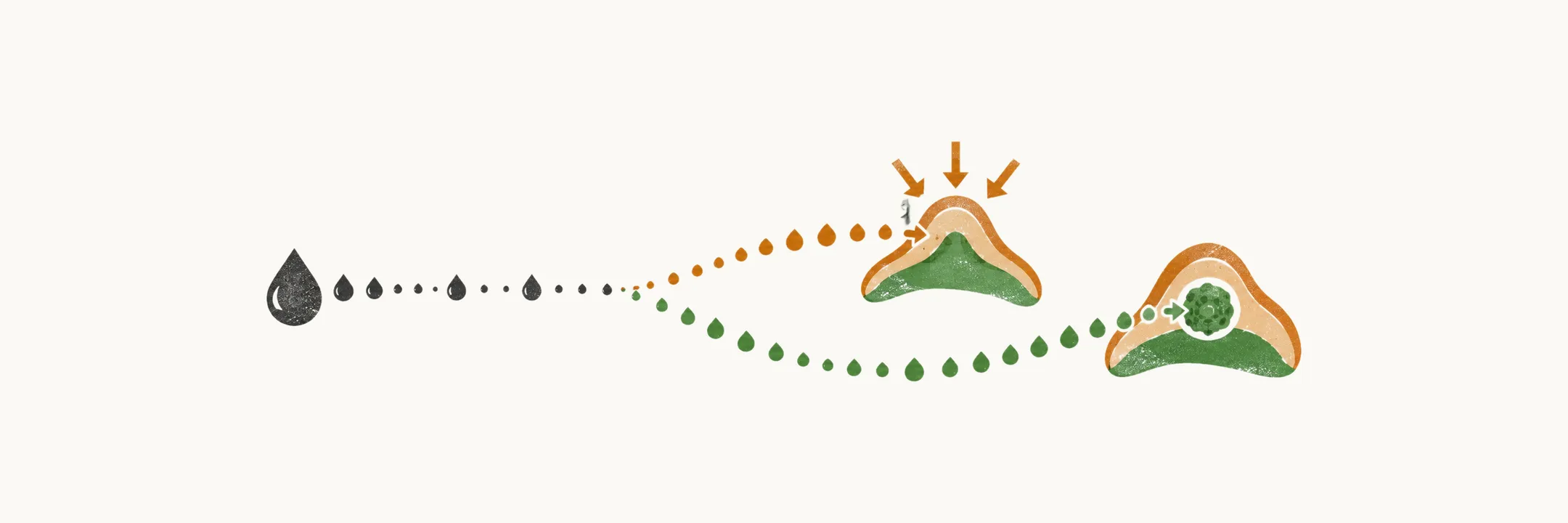
Cushing’s syndrome is defined by a chronic excess of glucocorticoids. The most common cause of that excess is iatrogenic — it follows glucocorticoid treatment given for another reason, such as immunosuppression. The endogenous forms, in which the patient’s own cortisol production is excessive, are much rarer: the incidence is about 1-2 new cases per million people each year.
The two forms: ACTH-dependent and ACTH-independent
The classification follows one question. Are the adrenal glands being driven from outside, or are they the source themselves?
In ACTH-dependent disease a tumour secretes adrenocorticotropic hormone (ACTH), the pituitary hormone that instructs the adrenal cortex to produce cortisol. Because that signal travels through the blood, it reaches both glands, so both adrenals become hyperplastic and overproduce cortisol. In ACTH-independent disease an adrenal gland makes cortisol on its own, and the resulting excess shuts down ACTH through the normal negative feedback of the hypothalamic-pituitary-adrenal axis.
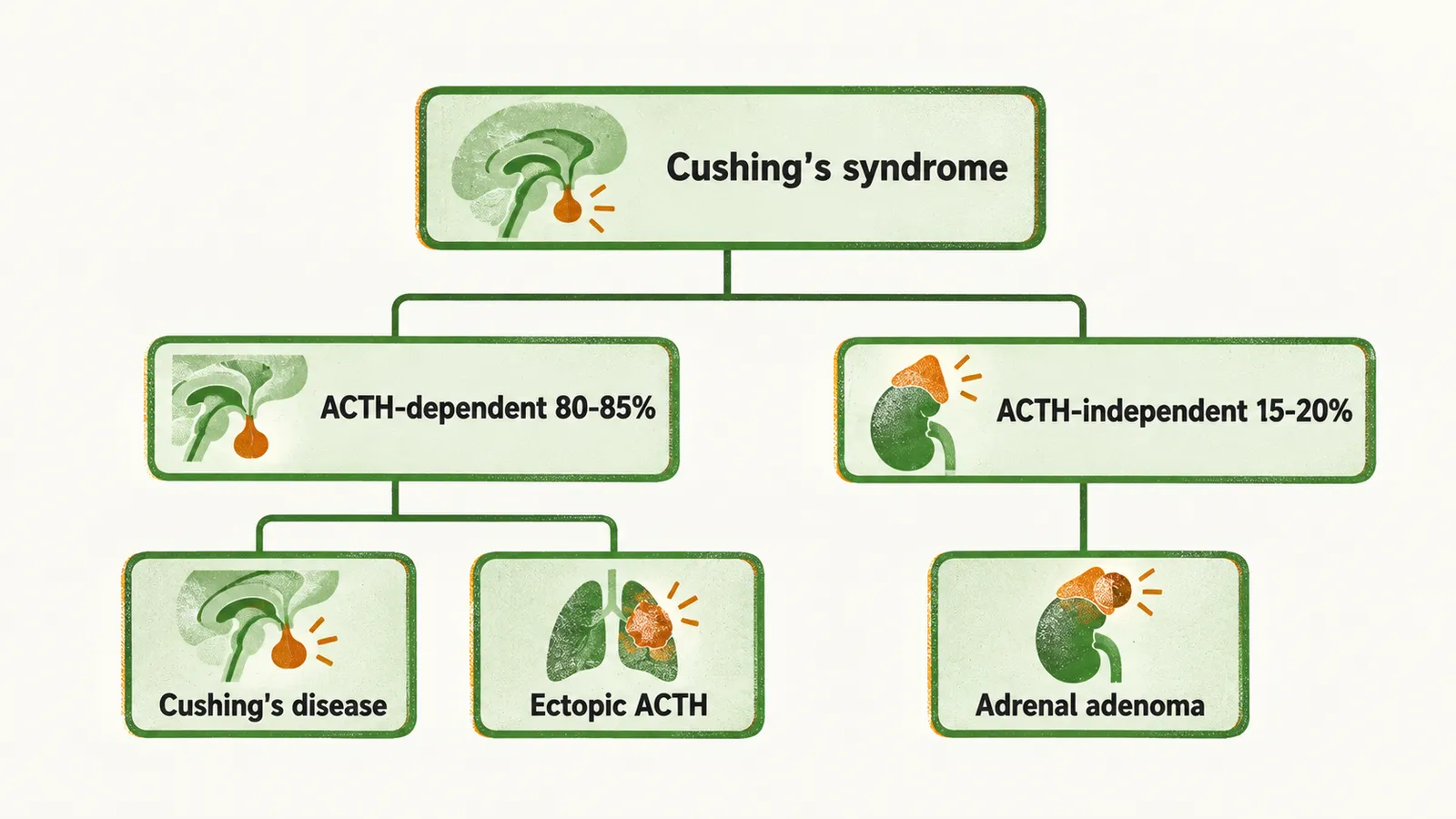
This distinction is not only descriptive. Because it determines which hormone is measured next, a plasma ACTH level is the first step in separating the two groups. About 80-85% of endogenous cases are ACTH-dependent, and 15-20% have their primary cause in the adrenal gland.
ACTH-dependent causes
ACTH-dependent disease has two sources: a pituitary adenoma, which accounts for most cases, and a tumour outside the pituitary that makes ACTH ectopically.
Cushing’s disease
Most ACTH-dependent cases are Cushing’s disease, the term reserved for a pituitary corticotrope adenoma — a benign tumour of the pituitary cells that normally produce ACTH. It is the most common endogenous cause overall. Cushing’s disease is more common in women, with a female-to-male ratio of about 4:1, except in the pre-pubertal years, when it is more prevalent in boys.
Two features of the adenoma matter in practice. The first is size: microadenomatous disease means an adenoma less than 1 cm across, the finding in more than 90% of cases of Cushing’s disease, while macroadenomatous disease means an adenoma more than 1 cm across, in a minority of patients, about 10% of cases. Because a microadenoma can be too small to see, negative imaging does not exclude Cushing’s disease. The second is origin: the adenoma usually occurs sporadically, but in rare cases it appears in the context of MEN1 (multiple endocrine neoplasia type 1) as familial Cushing’s disease.
The molecular basis of the adenoma is partly known. A somatic mutation of the USP8 gene (a mutation acquired in the tumour cells, not inherited) is present in 35-62% of corticotroph adenomas. USP8 is a deubiquitinase: it removes ubiquitin, the tag that marks a protein for destruction, from the epidermal growth factor (EGF) receptor, and so shelters the receptor from degradation. The recurrent mutations are gain-of-function, making the enzyme constitutively active, so it deubiquitinates the receptor more than usual, the EGF receptor escapes degradation, its signalling persists, and it drives transcription of POMC (pro-opiomelanocortin), the precursor from which ACTH is cleaved. The tumour therefore secretes ACTH without the usual hypothalamic drive.
Ectopic ACTH production
The other ACTH-dependent source is ectopic ACTH production, meaning ACTH made by a tumour outside the pituitary; it is more common in males. It comes most often from bronchopulmonary neuroendocrine tumours, including carcinoids, and from small cell lung cancer, as well as carcinoids of the thymus and pancreas. In very rare cases, ectopic production of CRH (corticotropin-releasing hormone) and/or ACTH is also seen with thyroid medullary carcinoma and pheochromocytoma.
ACTH-independent causes: the adrenal gland
In the majority of patients with endogenous ACTH-independent Cushing’s syndrome the cause is a cortisol-producing adrenal adenoma, and these primary forms are more common in females than in males. About 40% of these adenomas carry a mutation in PRKACA, the gene for the catalytic subunit of protein kinase A (PKA). The mutation weakens the binding of the regulatory subunit that keeps the enzyme switched off, so PKA is constitutively active and drives cortisol synthesis. Adrenocortical carcinoma is a rarer adrenal cause.
Rare genetic and nodular forms of adrenal disease
The adenoma is not the only adrenal source. Three uncommon adrenal causes each pair a distinctive mechanism with a characteristic association, and the first two act, like the PRKACA mutation above, through the PKA pathway.
Primary bilateral macronodular adrenal hyperplasia (PBMAH) is characterised by a low circulating ACTH together with evidence of autocrine stimulation of cortisol-producing cells through intra-adrenal ACTH production. The nodules also often carry G protein-coupled receptors (GPCRs) that the adrenal gland does not express physiologically, such as receptors for vasopressin, GIP (glucose-dependent insulinotropic peptide), LH (luteinizing hormone) and serotonin. These receptors activate the PKA pathway, so ordinary circulating signals can drive further cortisol release. Germline mutations (present in every cell of the body) of the tumour suppressor gene ARMC5 are found in about 20-25% of apparently sporadic cases and in most familial cases.
Primary pigmented nodular adrenal disease (PPNAD) carries a germline mutation in PRKAR1A, one of the regulatory subunits of PKA, which again releases the enzyme from inhibition. PPNAD is part of Carney’s complex, an autosomal dominant multiple neoplasia condition combining PPNAD with cardiac myxomas — benign tumours of connective tissue inside the heart chambers, and the main cause of morbidity and mortality in these patients — Sertoli cell tumours and lentiginosis.
McCune-Albright syndrome is caused by a mutation in the G protein alpha subunit 1, or GNAS1. The mutation arises after fertilisation, so it is present in only a proportion of the body’s cells; this mosaicism is why the syndrome is not inherited and why its features vary in extent from patient to patient. It is associated with polyostotic fibrous dysplasia, precocious puberty and unilateral café-au-lait spots.
Whatever the source, the result is the same excess of cortisol, and what that excess does to the patient is the next question.