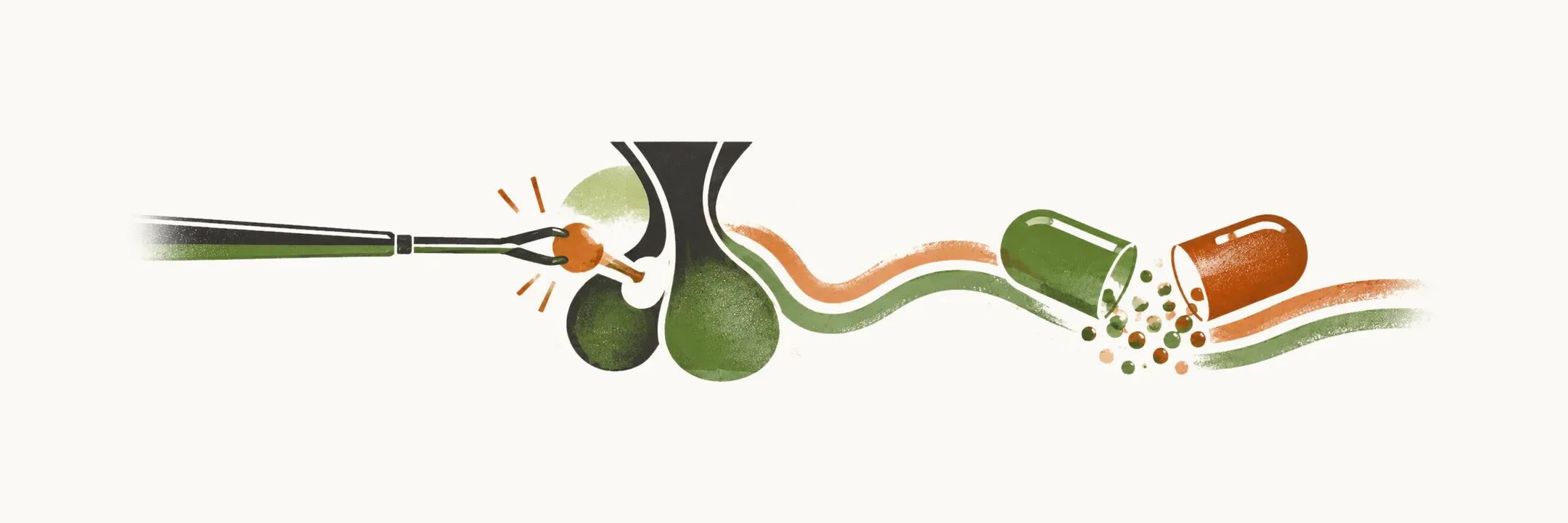
Treatment of Cushing’s syndrome removes or blocks the source of the cortisol excess. Because the source differs between causes, the choice of treatment follows the classification: in ACTH-dependent disease, where an ACTH-secreting tumour drives both adrenal glands, the tumour lies in the pituitary or elsewhere, and in ACTH-independent disease, where the adrenal gland makes cortisol on its own, it lies in the adrenal gland. The first-line principle is the same in all forms: remove the causal tumour when that is possible, because removal leaves the hypothalamic-pituitary-adrenal axis (the hypothalamus, pituitary and adrenal chain that regulates cortisol) intact and does not commit the patient to lifelong replacement therapy.
Surgery on the causal tumour
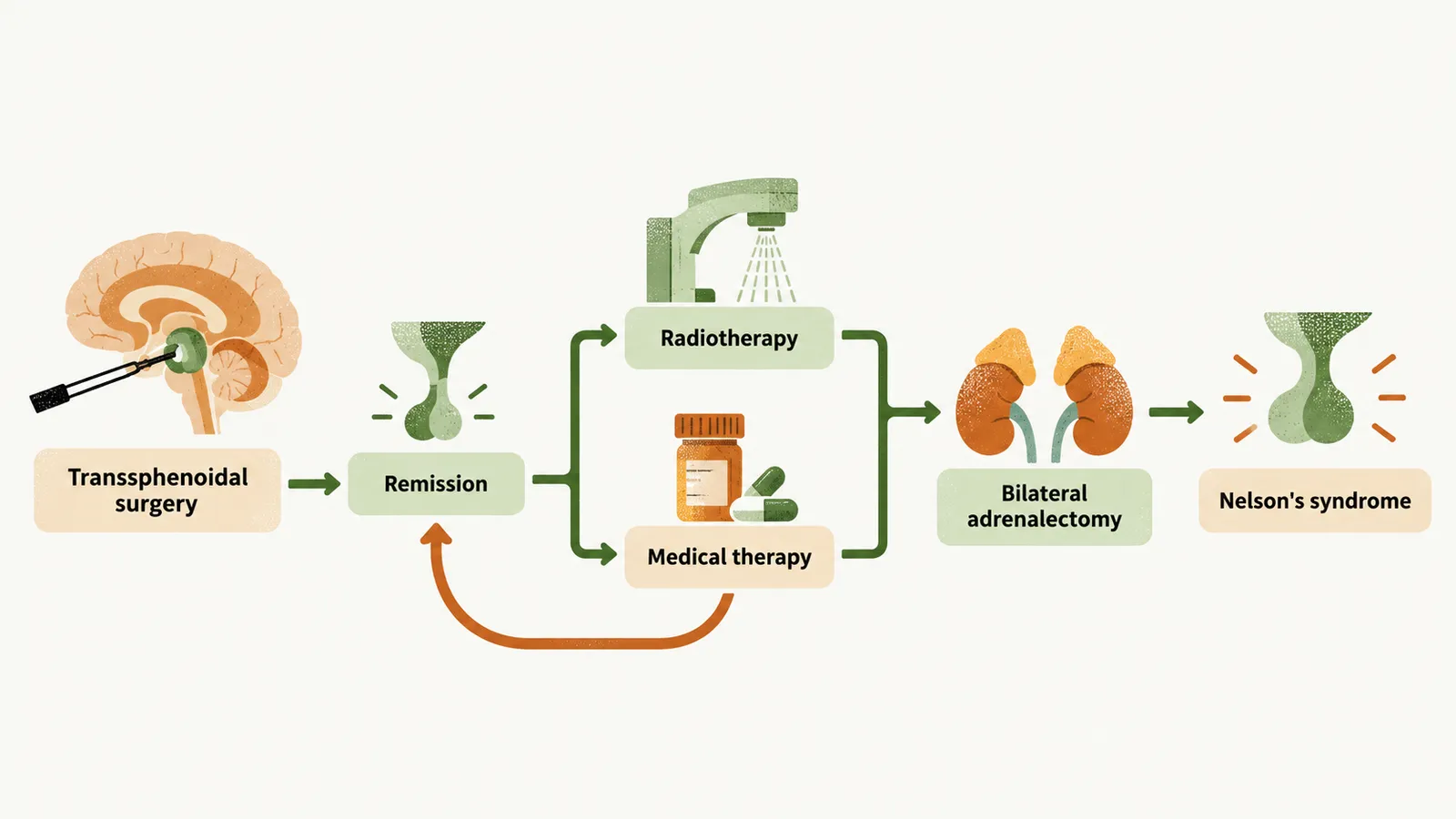
Which operation is performed depends on where the tumour lies. For Cushing’s disease, the tumour is a pituitary corticotrope adenoma, and the first-line treatment is transsphenoidal surgery (removal of the adenoma through the sphenoid sinus) performed by an experienced pituitary surgeon. Remission follows in most patients when the adenoma is a microadenoma, and in fewer when it is a macroadenoma, but recurrence years later is common enough that the patient needs long-term surveillance.
Ectopic ACTH is treated by resecting the responsible tumour when it can be found; when the tumour cannot be located, has metastasised, or cannot be resected, the cortisol excess is controlled medically instead.
In ACTH-independent disease the adrenal gland is the target. A cortisol-producing adrenal adenoma is treated by removing the affected adrenal gland, and adrenocortical carcinoma by resection, often combined with mitotane, which is both a steroidogenesis inhibitor and adrenolytic (toxic to adrenal tissue).
Medical therapy
Medical therapy lowers cortisol without operating on the tumour, and it has four main roles: persistent hypercortisolism after surgery, a patient who is not a surgical candidate, ectopic disease whose tumour cannot be found or removed, and control of cortisol while waiting for radiotherapy to take effect.
The main group is the steroidogenesis inhibitors, which block the adrenal enzymes that build cortisol: ketoconazole and its isomer levoketoconazole, metyrapone, osilodrostat — which inhibits both 11β-hydroxylase and aldosterone synthase — and mitotane. Etomidate is the only parenteral agent in the group and the fastest, lowering cortisol within hours, so it is used in an intensive care setting for severe, life-threatening hypercortisolemia. A second group acts on the pituitary instead: pasireotide, a somatostatin analogue, and cabergoline, a dopamine agonist. Treatment is monitored by measuring urinary free cortisol and adjusting the dose until the level is controlled.
Radiotherapy
Pituitary radiotherapy is a second-line option for Cushing’s disease that persists or recurs after surgery. It does not act at once — its effect develops over months to years — so medical therapy is used to control cortisol during the interval.
Bilateral adrenalectomy and Nelson’s syndrome
When the excess cannot be controlled by other means, bilateral adrenalectomy removes the source definitively, at the cost of permanent glucocorticoid and mineralocorticoid replacement. Its specific complication is Nelson’s syndrome: removing the adrenals also removes the cortisol feedback that restrained the pituitary adenoma, so the adenoma can grow into a large ACTH-secreting macroadenoma, producing hyperpigmentation and, through compression of the optic chiasm, visual field defects. Prophylactic pituitary radiotherapy at the time of adrenalectomy has been used in an attempt to lower that risk, but a benefit has not been established, and it is not standard practice.
Adrenal insufficiency after remission
Successful removal of the source leaves the patient temporarily adrenal insufficient (unable to make enough cortisol), because the normal cortisol-producing tissue has been suppressed for as long as the disease lasted. Patients need hydrocortisone (the medicinal form of cortisol) replacement after surgery, with additional doses during illness, until the axis recovers; recovery can take from a few months to a year or more, so replacement is reassessed periodically rather than stopped abruptly.
Follow-up after remission
Follow-up serves three purposes. Because recurrence is common, cortisol is reassessed at regular intervals. Because the complications of the excess do not all reverse with the cortisol, hypertension, diabetes, osteoporosis and the raised cardiovascular risk need continued management, and the hypercoagulable state that persists around surgery and into early remission is the reason thromboprophylaxis is considered after pituitary surgery, particularly in patients at higher risk of venous thromboembolism.
The third purpose concerns the thyroid: patients successfully treated for Cushing’s syndrome have a significant increase in the prevalence of autoimmune thyroid diseases. Hypercortisolemia appears to mask an underlying autoimmunity, which can surface early after cortisol is normalised, so thyroid function should be followed after remission.