
Diabetes insipidus (DI) is hypotonic polyuria, the passing of large volumes of dilute urine, caused by too little action of antidiuretic hormone (ADH, also called arginine vasopressin or AVP). Its three forms are hypothalamic DI (HDI, too little ADH secreted), nephrogenic DI (NDI, a kidney resistant to ADH) and dipsogenic DI (DDI, fluid intake so large that it suppresses ADH). Diagnosis has to establish that polyuria is present, show that it is DI, and then tell the forms apart, because treatment differs between them.
Diagnosis
The first steps in the investigation of patients suspected of polyuria caused by diabetes insipidus are the physical examination, the history, and the laboratory findings that rule diabetes insipidus out.
Physical examination and history are often the most important step in diagnosis and differential diagnosis. The factors that matter most are:
- Form of polyuria. Daytime polyuria occurs in patients with DDI, while in patients with HDI and NDI there is nocturia (waking at night to pass urine) as well.
- Drugs. A history of drug use, especially lithium, is important.
- History of sellar masses. A history of a sellar mass (a mass in the region of the pituitary fossa), or current signs and symptoms of a sellar tumour, has important value in the differential diagnosis, especially for craniopharyngioma and germinoma, two tumours of that region. It also indicates that the mass is most probably not a pituitary adenoma.
- Family history of autoimmune conditions. A strong family history of autoimmune thyroid disease can suggest autoimmune HDI.
Next, the diagnosis requires confirmation of polyuria. In some cases there is only a frequency of urination, caused by a urinary tract infection. Several laboratory findings point away from diabetes insipidus:
- A 24-hour urinary volume of less than 3 litres means that osmotic studies are unnecessary.
- The presence of glycosuria (glucose in the urine) indicates diabetes mellitus, not diabetes insipidus.
- A urine osmolality (the concentration of dissolved particles in the urine) of greater than 700 mosmol/kg indicates proper function of AVP; when polyuria is present with a normal urine osmolality, the diagnosis is mostly polydipsia.
Urine osmolality in patients with diabetes insipidus is very low, mostly close to the maximally diluted urine, which is less than 100 mosmol/kg; almost all patients have a urine osmolality of less than 300 mosmol/kg.
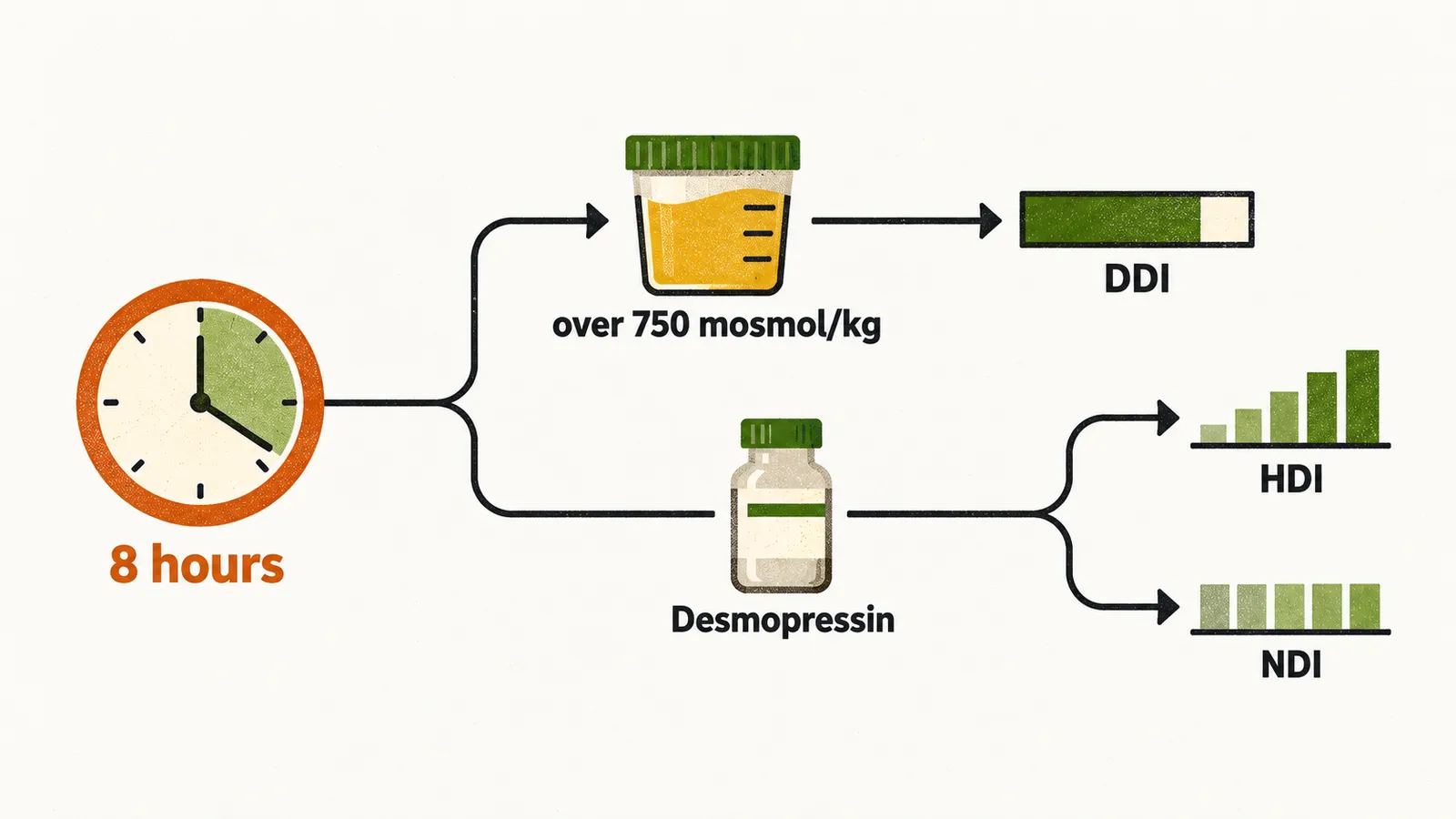
For confirmation of polyuria caused by diabetes insipidus, a two-step water deprivation test is performed. In the first step the patient is dehydrated for 8 hours. The normal physiological response to 8 hours of dehydration is secretion of AVP and an increase of urine osmolality over 750 mosmol/kg. In patients with DDI the response to the first step is similar to the normal physiological situation, so urine osmolality is greater than 750 mosmol/kg; in patients with HDI the urine osmolality does not increase to the normal values, and in patients with NDI it does not increase either.
The second step is the response to intramuscular desmopressin, which distinguishes NDI from HDI. In patients with HDI the response is an increase of urine osmolality; in patients with NDI, because of the resistance to AVP, the urine osmolality does not increase.
The most accurate way to diagnose diabetes insipidus is to stimulate AVP release with an infusion of hypertonic saline and measure the hormone in the plasma. AVP itself is difficult to measure, because most of it is bound to platelets and the sample must be handled quickly, so the stable fragment copeptin, which is released from the same precursor in equimolar amounts, is now measured instead. The response of the AVP system, which copeptin reflects, separates the forms:
- HDI. After infusion of hypertonic saline there is no increase of AVP correlated with the increase of plasma osmolality.
- NDI. There is an increase of AVP secretion in plasma correlated with the osmolality of the blood, but the patient still has hypotonic polyuria.
- DDI. There is an increase of AVP secretion in plasma correlated with the osmolality of the blood, and the kidney responds normally to it, producing less urine and concentrating it.
A further, less common form is pregnancy-related diabetes insipidus, caused by placental vasopressinase, an enzyme that degrades ADH in the mother’s circulation and rises with placental size. It mostly occurs in the third trimester of pregnancy.
Treatment
Because each form fails at a different step, treatment differs by form. In hypothalamic diabetes insipidus, desmopressin, the analogue of vasopressin, is administered. It is not degraded by the vasopressinase of pregnancy and so also treats the pregnancy-related form. The dose is kept to the smallest that controls the symptoms, because desmopressin retains water and can produce hyponatremia (a low plasma sodium) if the patient drinks more than the urine output.
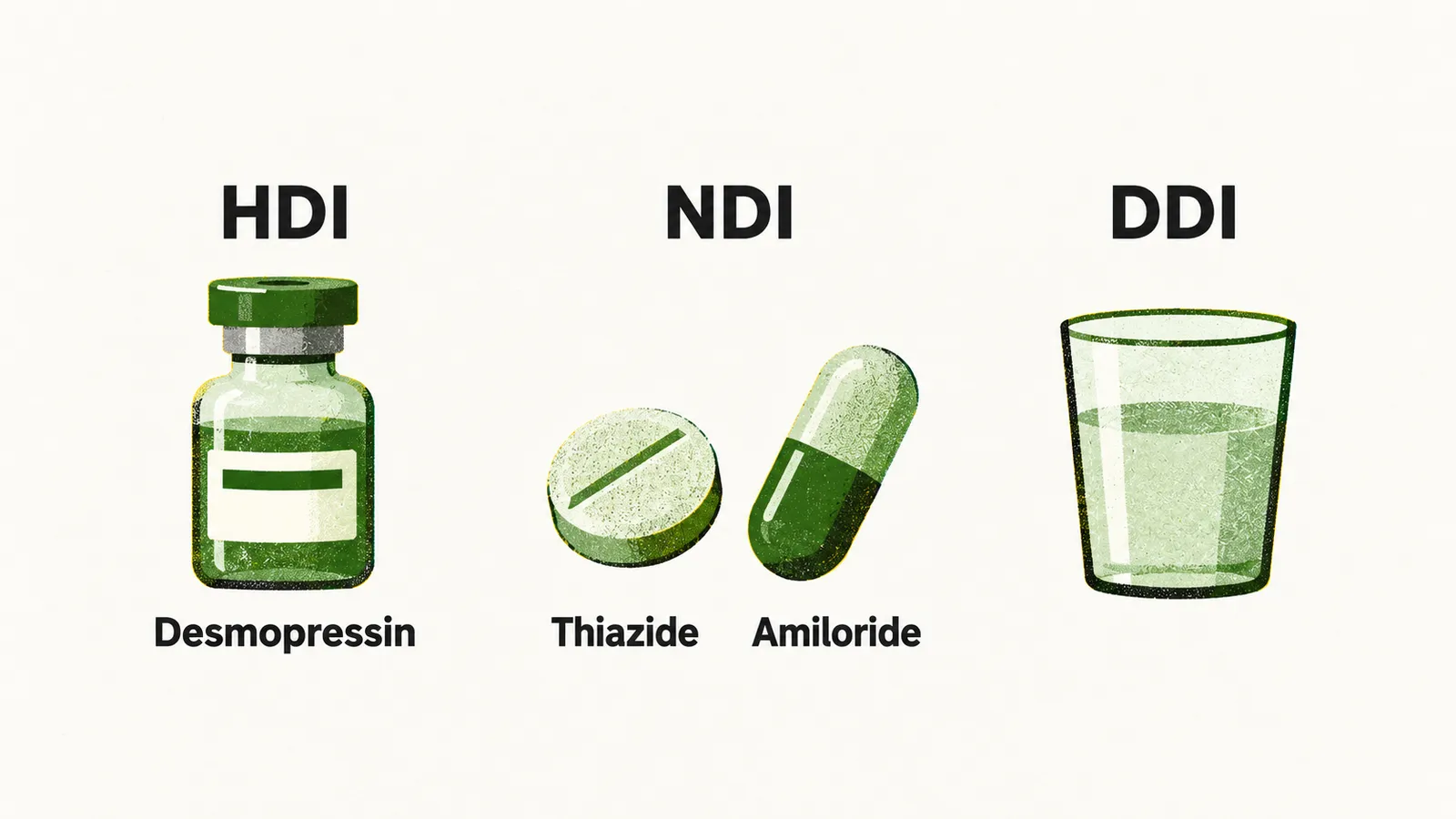
In nephrogenic diabetes insipidus the hormone itself will not help, because the kidney is resistant to it, so treatment acts on the kidney indirectly. Sodium intake is restricted, and a thiazide is used: although it is a diuretic, it reduces urine volume in nephrogenic diabetes insipidus by causing mild sodium and volume depletion, which increases water reabsorption in the proximal tubule so that less water reaches the collecting duct. Amiloride, which blocks the channel through which lithium enters the principal cells, is added in lithium-induced disease, and an NSAID such as indomethacin can be used as well.
In dipsogenic diabetes insipidus, where the kidney responds normally, treatment is directed at the excessive drinking rather than at the kidney, and the underlying psychiatric condition is treated.