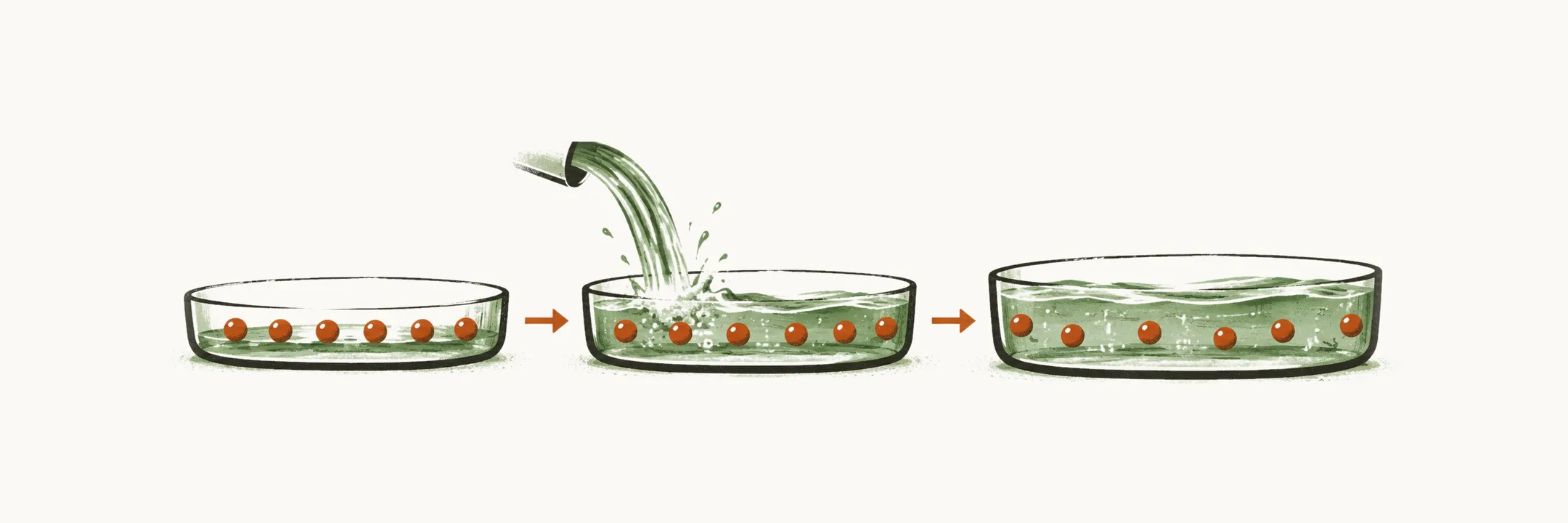
Plasma sodium concentration reflects two quantities held in balance: the extracellular water content and the extracellular sodium content, where extracellular means outside cells. Although the amount of sodium in the blood is one of them, most cases of both hyponatremia and hypernatremia (a plasma sodium above the normal range) are caused not by a change in salt but by a change in water; an excess of water dilutes the sodium already present, and a deficit concentrates it.
Hyponatremia is a plasma sodium concentration below the normal range. Because the concentration is a ratio of sodium to water, the same low value can arise from too much water, too little sodium, or a shift of water between compartments, and it can range from an incidental laboratory finding to a medical emergency depending on how low it is and how quickly it developed. Hyponatremia is therefore read as a question about water: how the body measures and holds its concentration, what can upset that balance, and what the upset does to the patient.
- Osmolality, Osmolarity and Tonicity defines the concentration terms used for body fluids, explains why osmolality rather than osmolarity is used clinically, and shows why total osmolality is not the same as tonicity. Start here, because the later notes use these terms throughout.
- Total Body Water and Its Compartments describes how total body water is divided between the intracellular and extracellular compartments and within the extracellular fluid, and how the main ions are distributed between them.
- ADH and the Regulation of Plasma Tonicity explains how extracellular fluid tonicity is held within its narrow range by thirst and by water retention or excretion driven by ADH (antidiuretic hormone, also called vasopressin), and how osmosensors and baroreceptors control its release.
- Causes of Hyponatremia groups the causes into intravascular volume depletion, hypotonic fluid intake that exceeds the kidney’s water excretion, and the syndrome of inappropriate antidiuresis (SIAD, in which ADH action fails to switch off when it should), and covers SIAD causes, central salt wasting and nephrogenic SIAD, the form in which the abnormality lies in the kidney.
- Clinical Presentation and Complications of Hyponatremia explains how hyponatremia presents, why the rate of the fall matters as much as its depth, and the neurological complications of the disorder and of its treatment.
- Diagnosis and Initial Management of Hyponatremia covers the history, examination and laboratory tests used to narrow down the cause, then the first steps of correction.