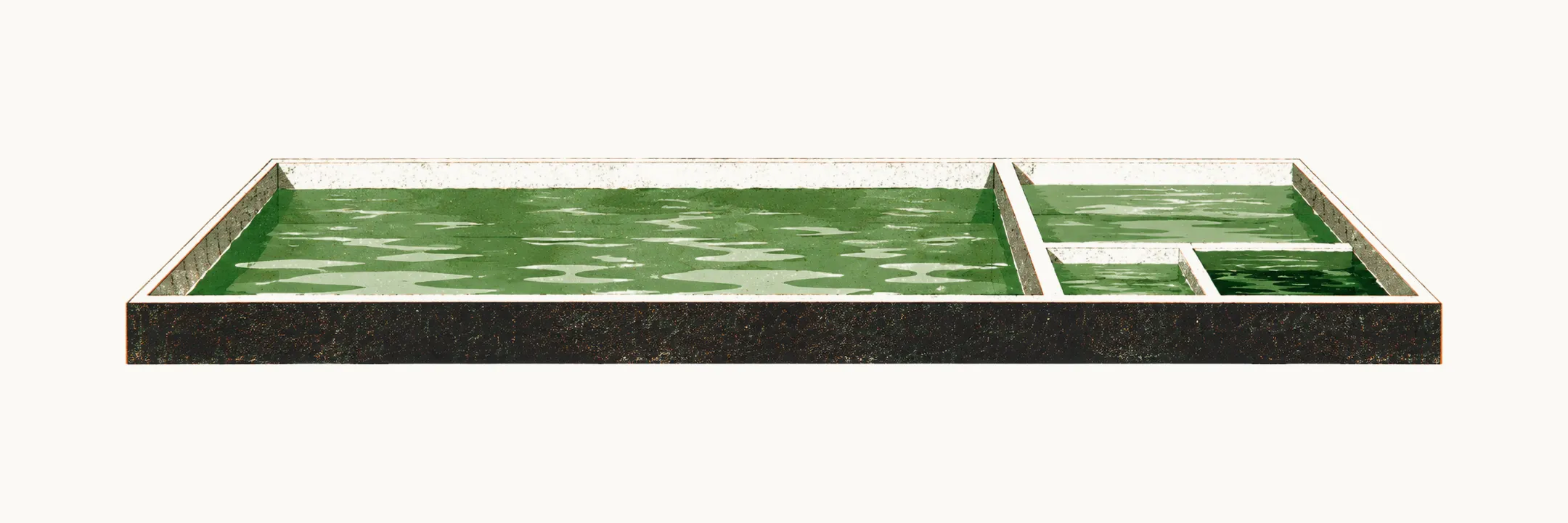
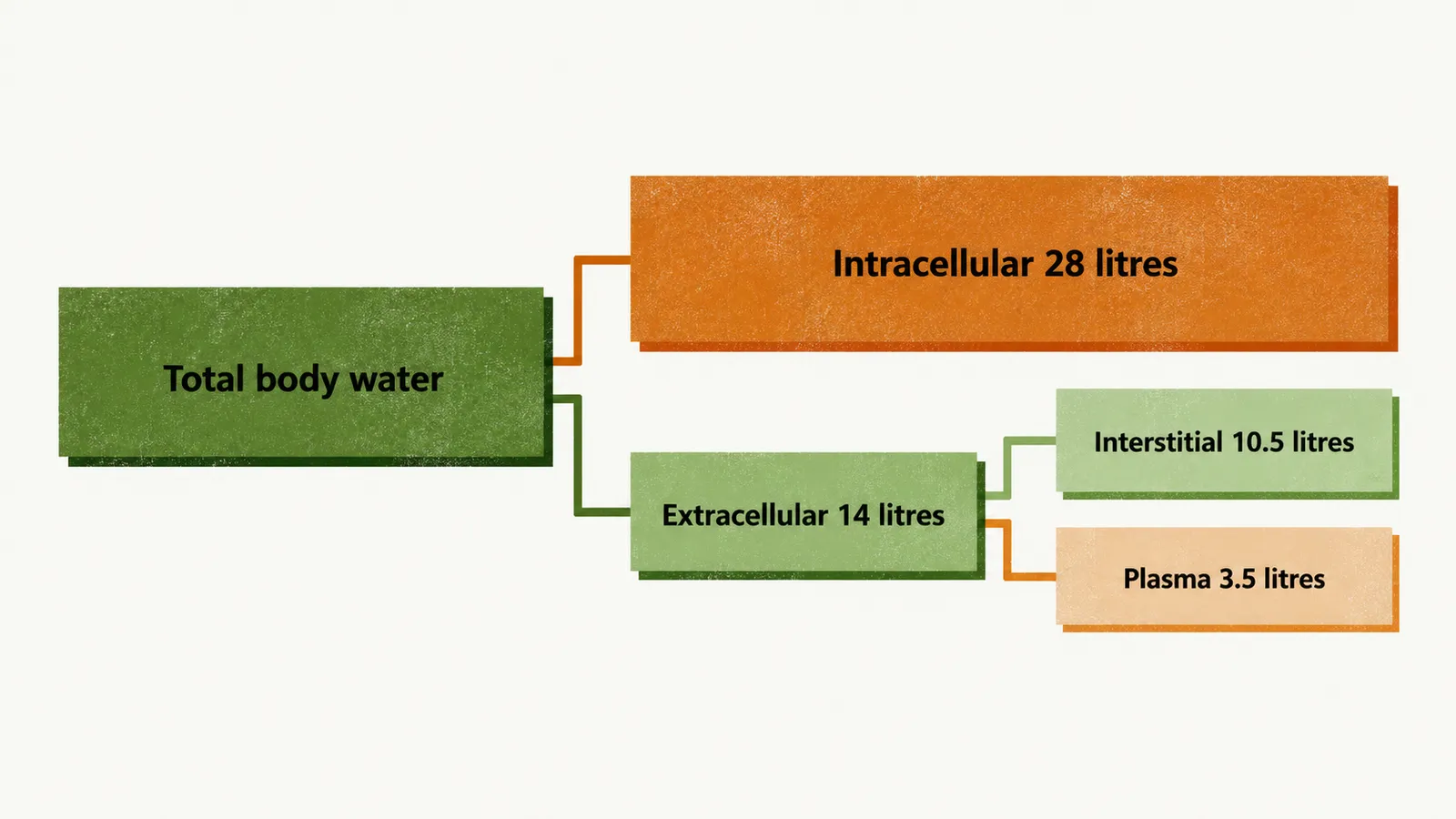
In a healthy adult man weighing 70 kg, water accounts for about 60% of body weight, roughly 42 litres. That water is not in one compartment but in two, and the split matters because the compartments hold different solutes and respond differently to fluid loss.
About two thirds of total body water, 28 litres, lies inside cells as the intracellular compartment, and about one third, 14 litres, lies outside cells as the extracellular compartment. The extracellular fluid itself is further divided: roughly three quarters of it, about 10.5 litres, is interstitial fluid, the fluid that bathes the cells, and the remaining quarter, about 3.5 litres, is the plasma inside blood vessels.
The 60% figure is an average, not a constant. The total body water percentage falls with age and differs between the sexes, and body composition shifts it further, because muscle stores more water than fat does. As fat tissue increases, the water percentage falls, so obese individuals sit below the average.
The two compartments also differ in the ions they hold. Sodium is the main cation (positively charged ion) of the extracellular fluid and potassium the main cation inside cells; the main extracellular anions (negatively charged ions) are chloride and bicarbonate, while the main intracellular anions are phosphate and protein. That sodium is confined almost entirely to the extracellular fluid is what ties this distribution to plasma sodium: extracellular fluid volume follows sodium, and water follows sodium, so the extracellular compartment is the one whose concentration the plasma sodium measurement reports.