
Hyponatremia, a plasma sodium concentration below the normal range, is the most common electrolyte disorder in clinical practice, reported in roughly 15–20% of patients in some emergency department populations. It can be entirely asymptomatic, or it can present as a seizure or coma, and the gap between those two extremes is explained less by the sodium value alone than by how quickly that value developed.
What governs the symptoms
Four factors determine how a given plasma sodium is tolerated: the degree of the hyponatremia, its rate of progression, the neurophysiological adaptive capacity of the individual, and their comorbidities. Of these, the rate of progression is often the most decisive.
When the extracellular fluid becomes hypotonic, meaning its effective solute concentration falls below that inside cells, water moves along the osmotic gradient into cells, and the brain — which sits inside a rigid skull — is where that matters most. Cerebral cells swell, raising intracranial pressure, and this is what produces the neurological symptoms. The brain defends itself against the swelling. Over roughly 24–48 hours it first sheds intracellular electrolytes and then organic osmolytes (small organic molecules that act as osmotic solutes), lowering its own osmolality so that water no longer enters and cell volume returns toward normal.
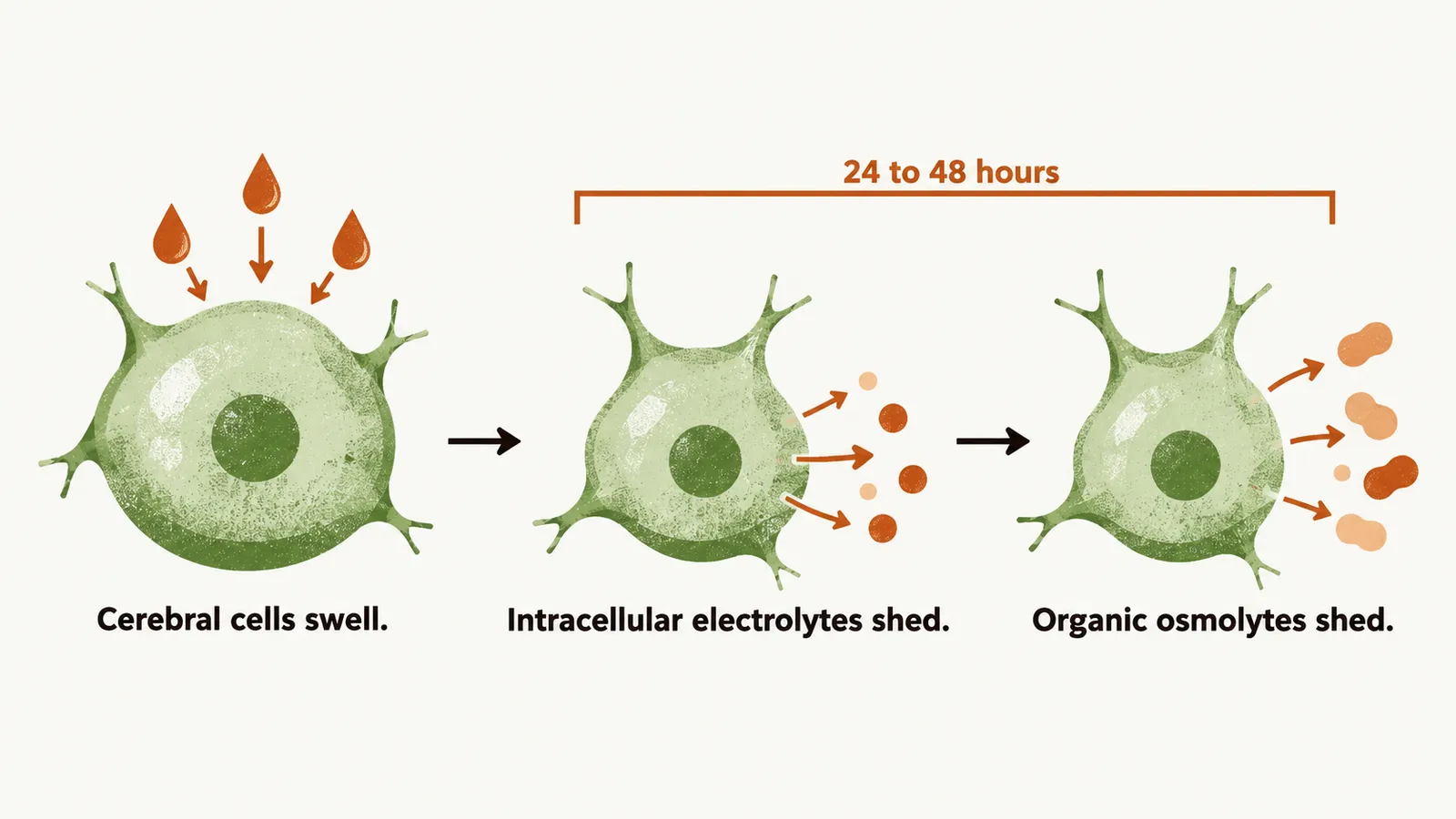
This adaptation explains the clinical pattern. A patient whose sodium has fallen slowly over days may have adapted and feel well even at a low value, whereas the same value reached in hours leaves no time to adapt and produces severe symptoms. The adaptation also sets a limit on treatment: a brain that has spent days losing osmolytes cannot tolerate a sudden rise in plasma sodium, which is why correction must be gradual.
The symptom spectrum
Symptoms are uncommon while the sodium is only mildly reduced, and become more likely as it falls further. Headache, nausea, malaise and poor concentration appear first; confusion, disorientation and unsteadiness follow; and vomiting, seizures, coma and cardiorespiratory distress mark the severe end of the spectrum. Symptoms become common below about 125 mmol/L, and severe symptoms are most likely below about 120 mmol/L, although a rapid fall can cause them at higher values and a fully adapted patient may have none at lower ones.
Complications
The complications of hyponatremia come from the disorder itself and from its treatment.
The cardinal complication of the disorder is cerebral oedema, the brain swelling described above, which is the mechanism behind the seizures, coma and, in the worst cases, herniation. It is most dangerous when the sodium falls acutely.
The cardinal complication of treatment is osmotic demyelination syndrome, a delayed non-inflammatory demyelination of the pons and other regions that follows correction of hyponatremia that is too rapid. It does not appear at the time of correction but days later, and it produces difficulty speaking (dysarthria), difficulty swallowing (dysphagia), weakness progressing to quadriparesis (weakness of all four limbs), and in severe cases a locked-in state, in which the patient is conscious but can move only the eyes. The risk is greatest when hyponatremia has been long-standing — because the brain has adapted — and in patients with a very low starting sodium, alcohol use disorder, malnutrition, hypokalemia or advanced liver disease.
Both complications therefore turn on the same question — whether the fall in sodium was slow and adapted or fast and unadapted — which is also what decides how the sodium should be corrected.