
Hyponatremia is a plasma sodium concentration below the normal range, and its causes fall into three groups: intravascular volume depletion, hypotonic fluid intake that exceeds the kidney’s water excretion, and the syndrome of inappropriate antidiuresis (SIAD), in which the antidiuretic hormone vasopressin (AVP, also called ADH) keeps acting when it should be suppressed. Diagnosis works out which group a patient belongs to, and management follows from the severity of the presentation and from that cause.
History and examination
The most important step in the diagnosis and differential diagnosis of hyponatremia is the history and physical examination of the patient, because they decide which of the three causal groups the patient belongs to before any laboratory result returns.
| Focus area | Key elements to check |
|---|---|
| History | Fluid loss (e.g. vomiting, diarrhea); causes of SIAD; symptoms of endocrine dysfunction suggestive of hypoadrenalism or hypopituitarism; medication/drug use; psychological condition such as psychogenic polydipsia |
| Examination | Signs of extracellular volume depletion; orthostatic or persistent hypotension; signs of peripheral oedema or ascites; signs of heart failure, cirrhosis or renal failure |
The history looks for the routes by which water is gained or lost and for the drugs and diseases that drive each group: fluid loss and diuretics point toward hypovolemia, drugs and CNS, pulmonary or malignant disease toward the syndrome of inappropriate antidiuresis (SIAD), and excessive thirst toward water intake that exceeds excretion. The examination then fixes the volume state, because the same urine results carry a different meaning in a hypovolemic patient than in a euvolemic one.
Laboratory tests
Three laboratory questions narrow the differential: the osmolarity of the serum, which shows whether the low sodium reflects a truly hypotonic state; the kidney’s dilution capacity as reflected in urine osmolarity, which shows whether vasopressin is acting; and the sodium content of the urine, which shows whether the kidney is retaining sodium.
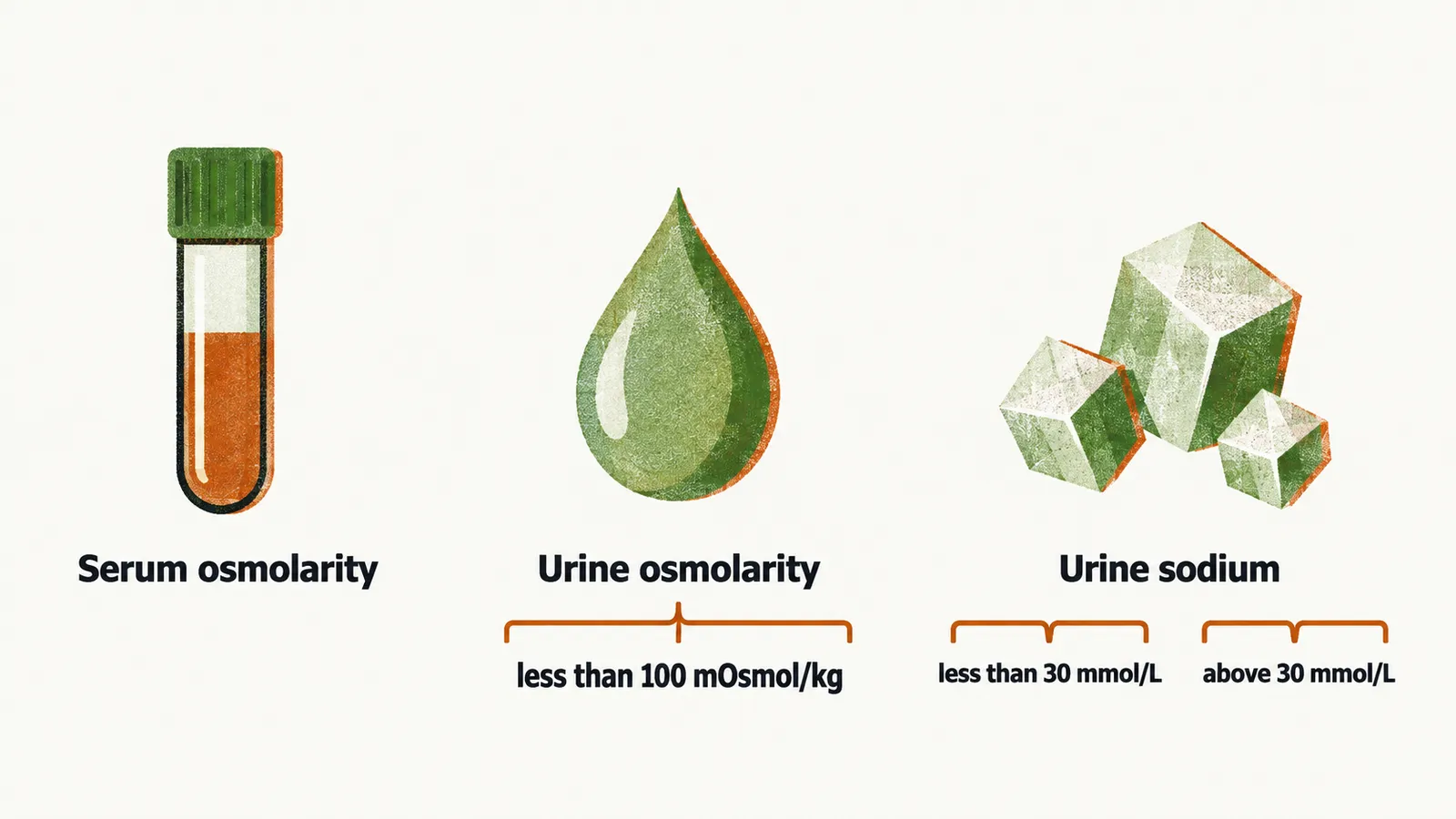
Serum osmolarity is mainly determined by sodium and its associated anions, so it falls in most patients with hyponatremia, and the normal value is between 275 and 290 mOsmol/kg. This divides hyponatremia into hypotonic and non-hypotonic forms.
Most hyponatremic patients are hypoosmolar, but the sodium can also be low with a normal osmolarity, as in severe hyperproteinemia or hyperlipidemia, where the sodium is measured in a smaller plasma water fraction and the true concentration is normal; a raised osmolarity instead points to another solute, such as glucose in hyperglycemia, pulling water out of the cells.
Urine osmolarity tests the normal response to hyponatremia, which is a reduction in vasopressin (AVP) release that dilutes the urine as much as possible. An appropriate response gives a urine osmolarity of less than 100 mOsmol/kg, while a value over 100 indicates excessive action or production of AVP.
Urine sodium concentration separates the causes that reduce effective arterial volume from those that do not. A urine sodium of less than 30 mmol/L suggests that the kidneys are retaining sodium because effective arterial volume is low, as in hypovolemia, heart failure or cirrhosis. A value above 30 mmol/L in a patient who is not fluid-overloaded fits SIAD, though on its own it is not specific, since diuretics, adrenal insufficiency and other causes can raise it.
Treatment
The approach to a patient with hyponatremia depends on the severity of the manifestation at the time of presentation, and severity here means the symptoms rather than the number alone.
Severe symptoms — vomiting, seizures, coma or cardiorespiratory distress — are a medical emergency and are treated with hypertonic saline: 3% saline, 150 mL over 20 minutes, repeated until the symptoms improve or the sodium has risen by about 5 mmol/L.
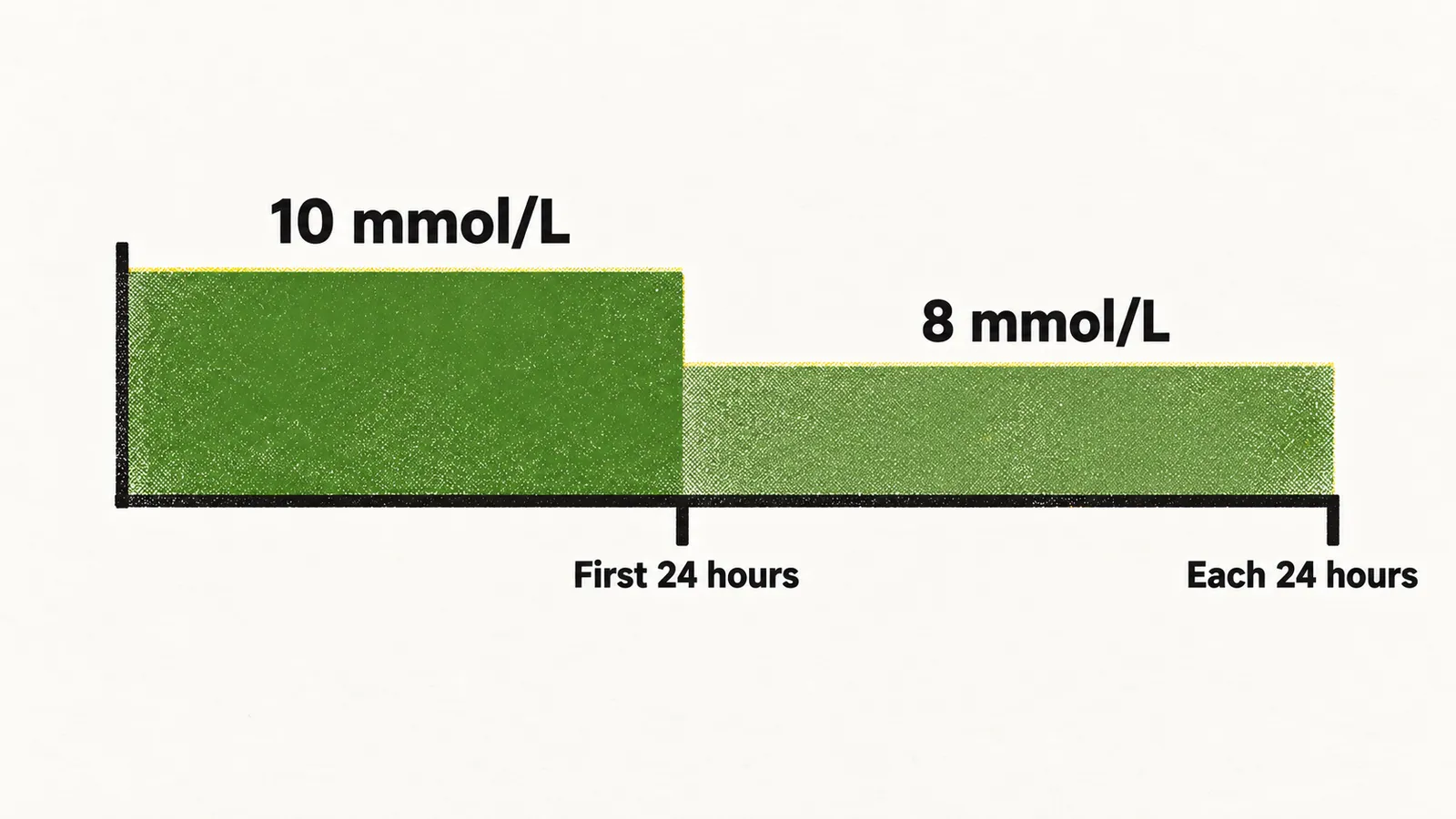
Correction is then capped to avoid injury. In chronic hyponatremia the sodium should not rise by more than 10 mmol/L in the first 24 hours, or by more than 8 mmol/L in each subsequent 24-hour period, because a faster rise risks osmotic demyelination. The cause is treated in parallel: the offending drug is stopped, fluid is restricted in SIAD, and volume and salt are replaced in hypovolemia.
Chronic hyponatremia, even if it is very profound, is tolerated well by the body, so in patients who are asymptomatic and chronically hyponatremic, correction of the hyponatremia may be skipped at the time of diagnosis, before the cause of the hyponatremia is determined.