Body fat can be measured directly or estimated indirectly, while everyday risk classification relies on BMI and waist circumference.
Methods of measurement
Fat mass and adiposity in an individual can be measured in several ways. Some methods are easy to use and cost-effective, while others are neither but are the most accurate. They fall into direct and indirect methods.
The direct methods — MRI, CT and DEXA (dual-energy X-ray absorptiometry) — measure fat mass by imaging or modelling the body itself. MRI and CT quantify fat and can separate visceral from subcutaneous fat, but CT carries a substantial dose of ionising radiation and is costly. DEXA involves much less radiation and is a standard method for measuring body fat in clinical research.
The indirect methods estimate fat from some other measurable property: underwater weighing and air displacement (BODPOD) work from body density, bioimpedance works from electrical resistance, and indirect calorimetry works from energy use.
BIA, or bioimpedance analysis, sends a low-amplitude electrical current between two electrodes and measures the resistance of the body. Fat tissue is highly resistant to the signal, while muscle and water are highly conductive, so the measured resistance can be converted into an estimate of fat percentage. Because it depends on the body’s water content, recent exercise and recent hydration interfere with the measurement, and its estimates are less accurate than those from DEXA, MRI or CT.
Indirect calorimetry estimates the calories an individual uses by measuring oxygen consumption (VO2) and carbon dioxide production (VCO2), rather than measuring fat directly. The Weir formula converts these gas measurements into energy expenditure:
EE = [3.941 × VO2 + 1.106 × VCO2] × 1.44
Studies based on indirect calorimetry show that the higher the BMI, the higher the basal metabolic rate (BMR), the energy the body uses at rest. When a person loses weight, they therefore need less energy at rest, so a diet prescribed for weight loss has to be modified — the amount of food reduced — after some weight is lost, to keep the loss going as the BMR falls. In a sedentary person the resting metabolic rate accounts for most of the daily energy expenditure, with physical activity making up the remainder.
Two further values come from the same measurement. The respiratory quotient, or respiratory exchange ratio, is the VCO2/VO2 ratio and reflects the main fuel being used: it is close to 0.7 when fat dominates and close to 1 when carbohydrate dominates. Protein use is estimated from the urinary nitrogen content, because the amount of urinary nitrogen is proportional to the amount of protein used for energy expenditure.
BMI and its interpretation
These methods are not commonly used in practice because of their cost; the most commonly used index is BMI, or body mass index, which relates body weight to height. BMI correlates well with the fat percentage of the body, except in individuals such as bodybuilders, and its relation to fat percentage depends on age, gender and race.
Because the interpretation of BMI as a fat percentage depends on race, sex and age, thresholds differ between countries and ethnicities. For instance, in the USA:
- men between 20 and 29 years of age with a BMI of 27.8 or more are considered overweight
- women between 20 and 29 years of age with a BMI of 27.3 or more are considered overweight
The classification and risk assessment for hypertension and cardiovascular disease made by the WHO is mainly applicable to individuals of European ancestry. For Southern Asian countries the thresholds are lower, because central obesity and fat percentage are more prevalent there:
- normal risk: 18.5 to 23 kg/m2
- slightly increased risk: 23 to 27.5 kg/m2
- highly increased risk: more than 27.5 kg/m2
Waist circumference
The other important value for risk stratification is waist circumference, because fat in the abdomen and trunk carries a higher risk of comorbidities than fat elsewhere. The values above which the risk rises are:
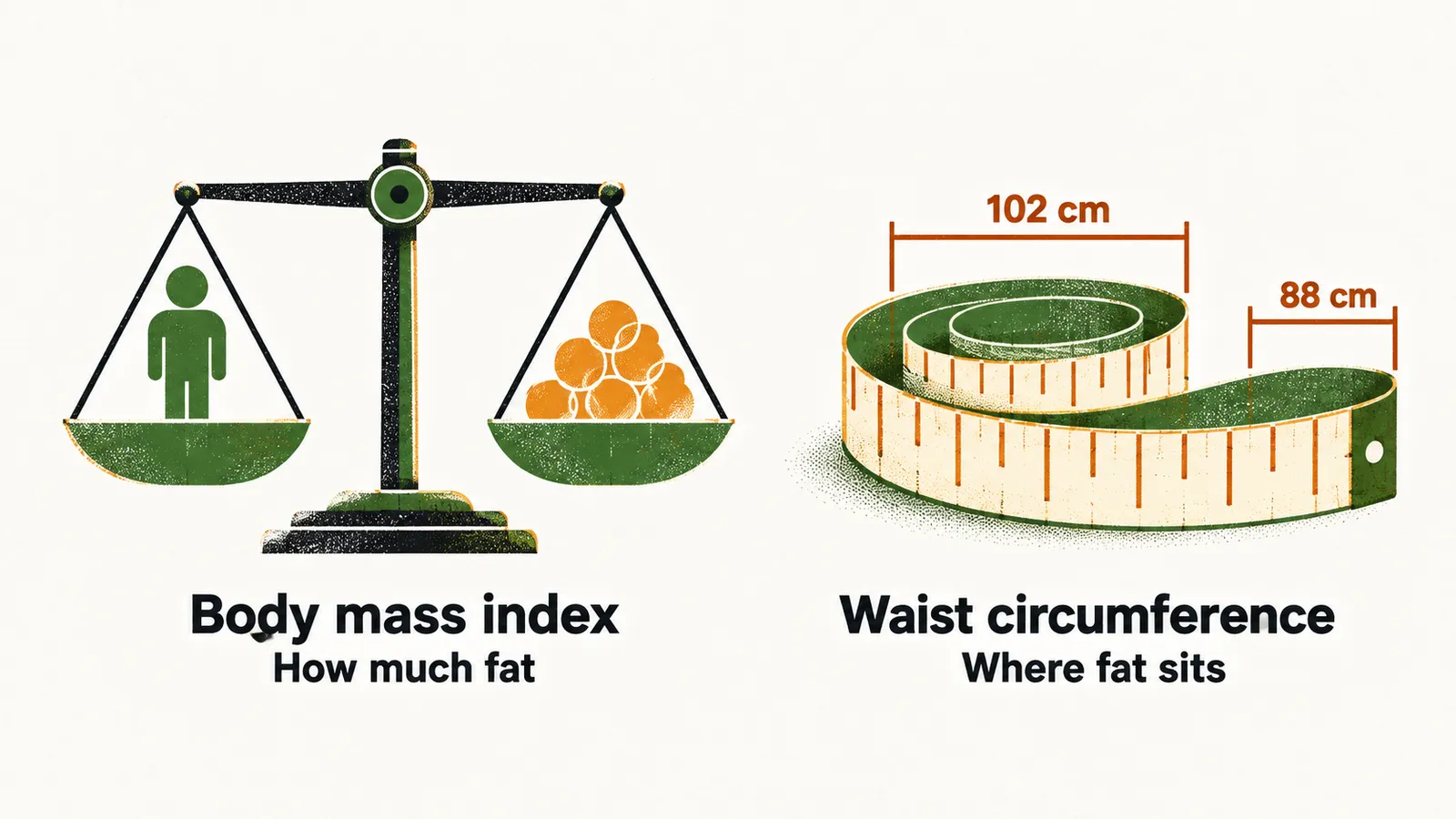
- Americans: more than 102 cm in men, more than 88 cm in women
- Europeans: more than 94 cm in men, more than 80 cm in women
- South Asians: more than 90 cm in men, more than 80 cm in women
A patient with a normal BMI but a waist circumference outside the normal range is still considered obese.
These measures describe how much fat a person carries and where it sits, but not why some people accumulate it and keep it; that depends in part on how the brain regulates hunger and satiety.