
A pituitary adenoma usually begins with one anterior pituitary cell that acquires changes letting it divide when its neighbours do not. The tumour that follows is monoclonal: it descends from that single cell, not from the whole gland. Two kinds of change cooperate. Primary changes start the clone: activation of an oncogene (a gene whose activity pushes the cell to divide), or inactivation of a tumour-suppressor gene that would normally restrain division. Promoting changes then let the clone grow: an excess of a growth factor, loss of the normal feedback that restrains the cell, or loss of an inhibiting factor. Because the same few signalling steps are reused across cell types, mutations in different genes can converge on the same result.
Signalling through cyclic AMP
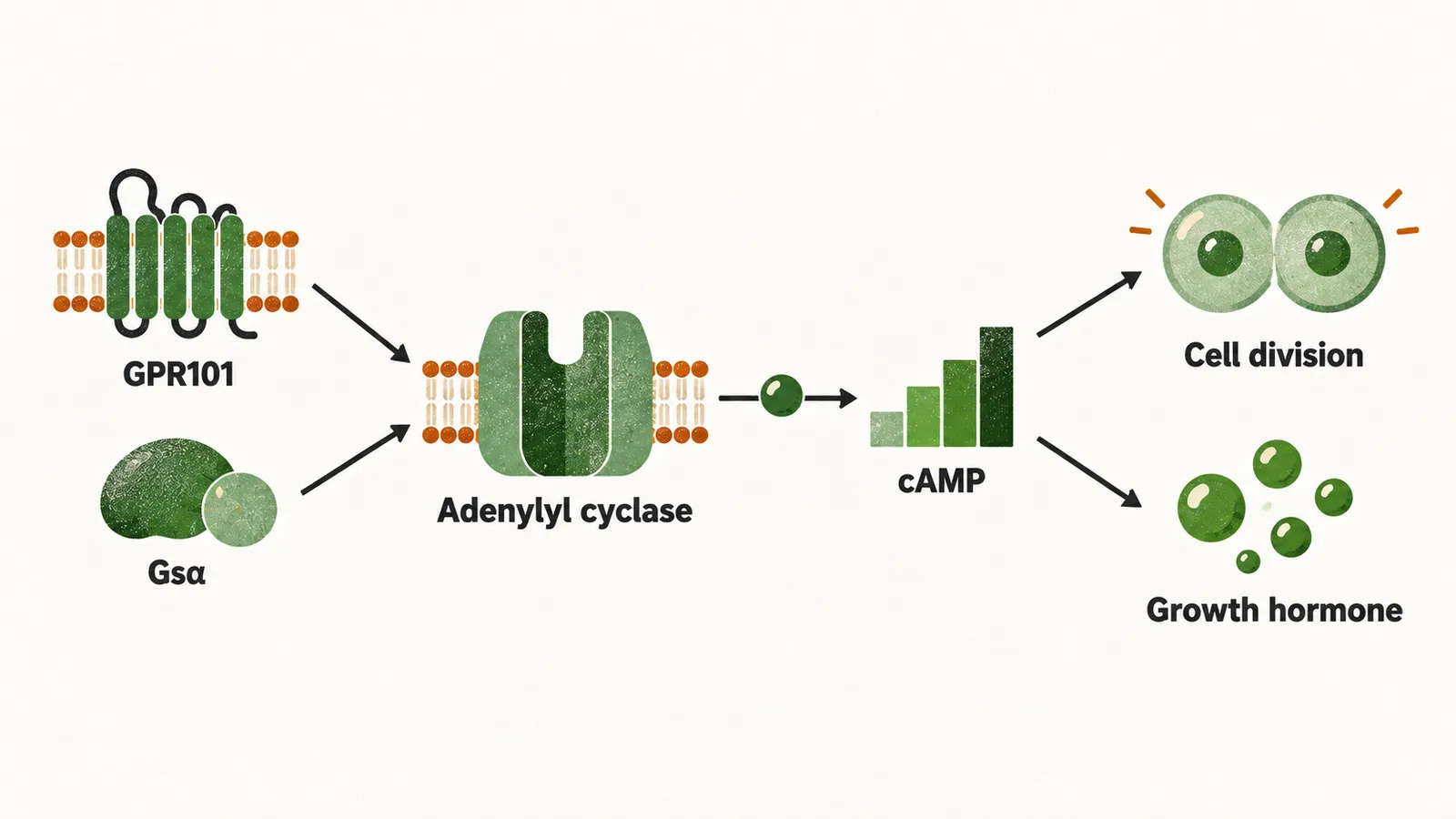
Several of the mutations found in somatotrope adenomas act on one node: the Gsα protein, which switches on adenylyl cyclase (AC), the enzyme that makes cyclic AMP (cAMP). When Gsα is locked in its active form, cAMP stays high, and high cAMP drives the somatotrope cell to divide and to release growth hormone. The GNAS gene encodes the Gsα subunit of the G-protein-coupled receptor complex, and it is the only recurrent genetic alteration found in somatotrope adenomas: it is mutated in 15-58% of them, producing exactly this constitutive activation of adenylyl cyclase, meaning activation that no longer depends on a signal.
A second route to the same node is GPR101, an orphan G-protein-coupled receptor (one whose natural activating molecule is not known) that also couples to Gsα and raises adenylyl cyclase activity. Children with early-onset gigantism and growth hormone excess can carry a heritable microduplication of chromosome Xq26.3, a small extra copy of that chromosome segment; in these tumours GPR101 messenger RNA is increased about 1000-fold. This familial form is called X-linked acrogigantism (X-LAG).
AIP and hereditary somatotrope adenomas
The AIP gene is mostly associated with somatotrope adenomas and behaves as a tumour suppressor: the mutations found in it are nonsense mutations that destroy the protein, and the protein is believed to restrain the cell, although what AIP does is still only partly understood. A germline AIP mutation (one present in every cell and passed down in a family) is relatively common among young adults with acromegaly (5-14%), and it also explains a share of familial acromegaly, the rare families in which members develop acromegaly or gigantism. Tumours in these patients tend to be larger and more invasive, more likely to recur, and less responsive to somatostatin analogues. In patients without an AIP mutation, treatment with a somatostatin analogue raises AIP expression. Several of the genes above are germline and cause inherited syndromes (see Genetic syndromes associated with pituitary tumours).
Ghrelin and somatostatin receptors
Somatostatin analogues act through somatostatin receptors, so the receptor pattern on a tumour is relevant to treatment. Ghrelin is a growth factor that acts on the pituitary, and GHSR is the gene that encodes its receptor. The pattern of somatostatin receptor expression differs between the subtypes of somatotrope adenoma and is changed by treatment with somatostatin analogues: densely granulated adenomas express mainly somatostatin receptor type 2 (SSTR2), while sparsely granulated adenomas express mainly type 5 (SSTR5). The more of SSTR2 a tumour expresses, the more likely it is to respond to somatostatin analogue treatment.
Whatever the genetic route, a tumour that has formed causes harm in two ways: through the hormones it secretes and through the structures it compresses.