
Non-functioning sellar tumors are defined as tumors that have very little or no hormone production and do not make any clinical alterations in the patient. Because no hormone syndrome draws attention to them, they tend to be recognised through the pressure they exert.
Non-functioning pituitary adenomas
The non-functioning pituitary adenomas (NFPAs) are the most common form of sellar mass after prolactin-producing tumors of the sellar region. They are mostly macroadenomas at the time of diagnosis, because they cause clinical effects only when they are big enough to produce a compression effect.
NFPAs affect males and females equally, and they are mostly diagnosed at the age of 40-50.
Based on histochemical studies, most non-functioning pituitary adenomas originate from the gonadotropin cells or from the null cells of the pituitary gland, cells that produce no hormone. These non-functioning tumors usually make small amounts of intact gonadotropins such as FSH, and of uncombined gonadotropin subunits such as LH-β, FSH-β and the glycoprotein α subunit.
If a patient with a non-functioning gonadotropin-derived neoplasm is stimulated with TRH, there is an atypical increase of tumor-derived gonadotropin hormones and subunits.
Manifestations
The most common manifestations of non-functioning pituitary adenomas are:
- compression effects: visual disturbances and headache
- hypopituitarism: loss of ACTH, TSH, and gonadotropins
- hyperprolactinemia
Usually the non-functioning pituitary adenomas are asymptomatic during the first phases, and they become symptomatic when they get big enough to press on the optic chiasm. They therefore manifest with visual disturbances, hyperprolactinemia, and hypogonadism.
The hypogonadism comes from compression of the pituitary stalk and the resulting hyperprolactinemia, which blocks the pulsatile release of GnRH. Very rarely they cause menstrual disturbances and ovarian hyperstimulation, and in those cases of ovarian hyperstimulation the patients mimic polycystic ovary syndrome (PCOS) with a high level of estrogen production.
Macroprolactinoma or stalk compression
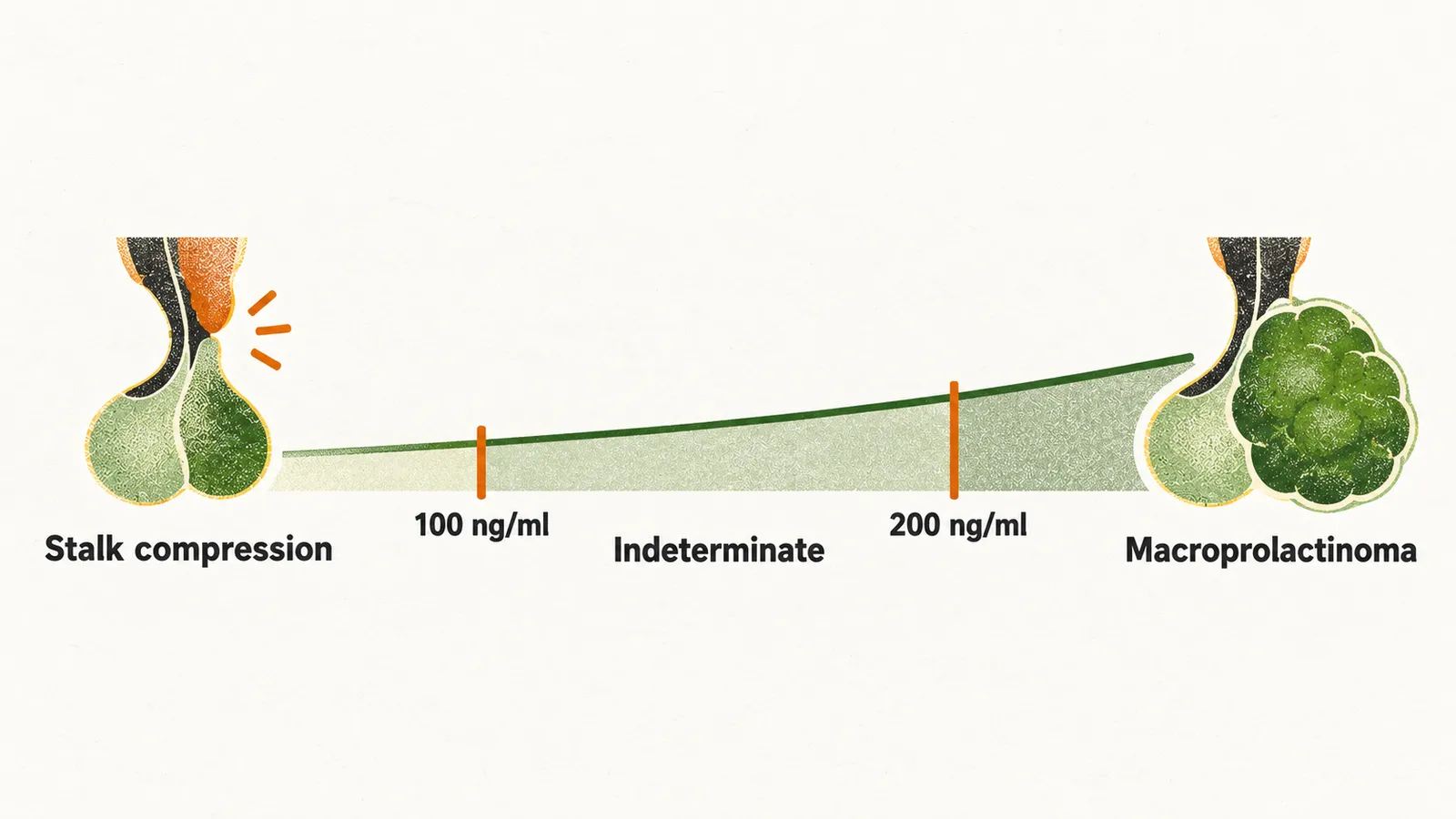
In a patient with radiological evidence of a macroprolactinoma, the prolactin level normally rises with the size of the tumor, because the tumor itself secretes it. When the level does not fit the size, a second explanation must be considered: the tumor is not a functioning one that releases prolactin into the blood, and the cause of the hyperprolactinemia is only compression of the pituitary stalk. A macroprolactinoma with a prolactin of 100-200 ng/ml that does not correlate with the size of the tumor is the typical example. A true macroprolactinoma usually raises prolactin above 200 ng/ml, whereas hyperprolactinemia from stalk compression is usually below about 100 ng/ml; a value in between is indeterminate. The two scenarios must always be differentiated from one another because of the difference in treatment: in the first case pharmacological treatment is used, while in the second the patient is operated on.
Gonadotropinomas
Gonadotropinoma is more prevalent in males, but it is believed that there is extreme under-estimation in females, because during and after menopause the lack of estrogen production leads to hypersecretion of FSH and LH, which is the same characteristic as gonadotropinoma; therefore, under-diagnosis, especially in women of menopausal age, is very common.
The clinical manifestation of gonadotropinoma differs based on age and sex. In males, a gonadotropinoma before puberty causes precocious puberty, and after puberty it causes erectile dysfunction and hypoactive desire. In females, before puberty it causes precocious puberty, and before menopause it causes amenorrhea and menstrual irregularities; after menopause its hormonal effect is masked by the signs and symptoms of menopause itself. In both sexes, visual disturbance is a common way it comes to attention.