
Acute promyelocytic leukemia (APML) is the M3 subtype of acute myeloid leukemia, the subtype that behaves like an emergency. It kills through a bleeding tendency that is present before any treatment is given, and a patient who is not treated urgently can die within days. Its behavior follows from the cell it is named after, the promyelocyte.
The 15;17 translocation and the PML-RARA block
In acute promyelocytic leukemia there is usually a balanced translocation between chromosomes 15 and 17. The translocation joins the PML gene to the RARA gene and produces the fusion protein PML-RARA. RARA is a transcription factor, a protein that switches genes on; the fusion protein keeps RARA’s target genes switched off in the blast cells, so they never receive the signal to differentiate. The leukemic cells therefore arrest at the promyelocyte stage and accumulate.
Promyelocyte granules and the coagulopathy
Promyelocytes are packed with acidophilic granules, and when promyelocytes are abundant in the peripheral blood their granules can be released. Those granules carry thrombotic and inflammatory activity, and they set off two complications at once. The first is DIC (disseminated intravascular coagulation): the released granules cause microangiopathic thrombosis, meaning clotting in the small vessels, which produces multi-organ failure and damage. Patients with APML are in a hypercoagulable state, which means a tendency to clot, and at the same time in a hyperfibrinolytic state, in which clots are broken down excessively. The second complication is hemorrhage: because platelets and coagulation factors are consumed and cleared at a high rate during those microangiopathic thrombotic events, the chance of bleeding is also increased in these patients.
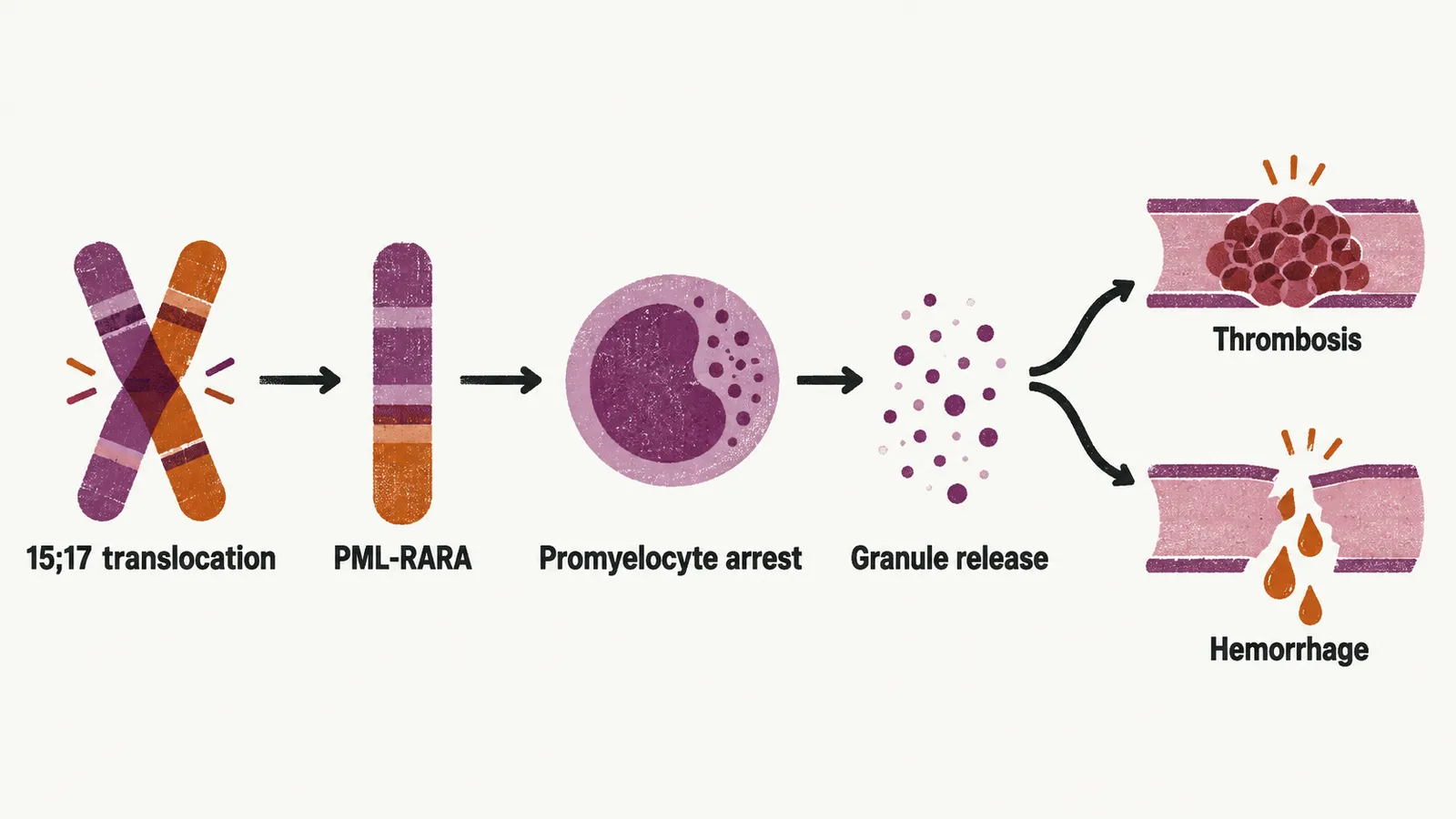
These complications are what kill patients with APML when it is left untreated. They develop very quickly, and if treatment is not started urgently they can lead to death within days. Bleeding is the leading cause of early death in APML, most often hemorrhage into the brain or the lungs.
APML is the most brutal hematological cancer, but it is also the most curable one.
Treatment with ATRA
The high curability of APML comes from all-trans retinoic acid (ATRA). ATRA binds the PML-RARA fusion protein and releases the block on RARA, so the transcription factor can switch its target genes on again and the promyelocytes differentiate into mature cells. Once the cells mature, the granule-driven coagulopathy resolves, and the patient is treated.
Because the coagulopathy is what kills in the first days, ATRA is started as soon as APML is suspected — before the genetic result that confirms the PML-RARA fusion is available. At the same time, supportive care replaces what the coagulopathy consumes: platelets are transfused to keep the count above 30–50 ×10⁹/L and fibrinogen is replaced to keep it above 1.5 g/L, until the clinical and laboratory signs of the coagulopathy disappear. Invasive procedures are avoided while the coagulopathy is active. The diagnosis is suggested by the abnormal promyelocytes in the blood and bone marrow and is then confirmed by demonstrating the t(15;17) or the PML-RARA fusion, using cytogenetics, FISH (fluorescence in situ hybridization) or PCR, because the response to ATRA depends on that fusion being present.
Differentiation syndrome
The differentiation that ATRA restores has a complication of its own. As the promyelocytes mature, they release cytokines that make capillaries leak, and this produces differentiation syndrome — a second emergency, with its own features, mimics and treatment, explained in Differentiation Syndrome in Acute Promyelocytic Leukemia.