
Once the diagnosis is made and treatment has started, three questions follow: how the epilepsy is likely to behave over time, what to do when drugs fail, and how to keep the patient safe in daily life.
Prognostic courses
Prognosis in epilepsy falls into four courses, taught here as a teaching schema, not as a cited classification. Spontaneously benign epilepsy, such as benign rolandic epilepsy of childhood, resolves on its own. Pharmacologically responsive epilepsy remits after adequate therapy. Pharmacologically dependent epilepsy, including juvenile myoclonic epilepsy, stays controlled only while treated. Pharmacoresistant epilepsy resists drugs and includes syndromes such as Lennox-Gastaut.
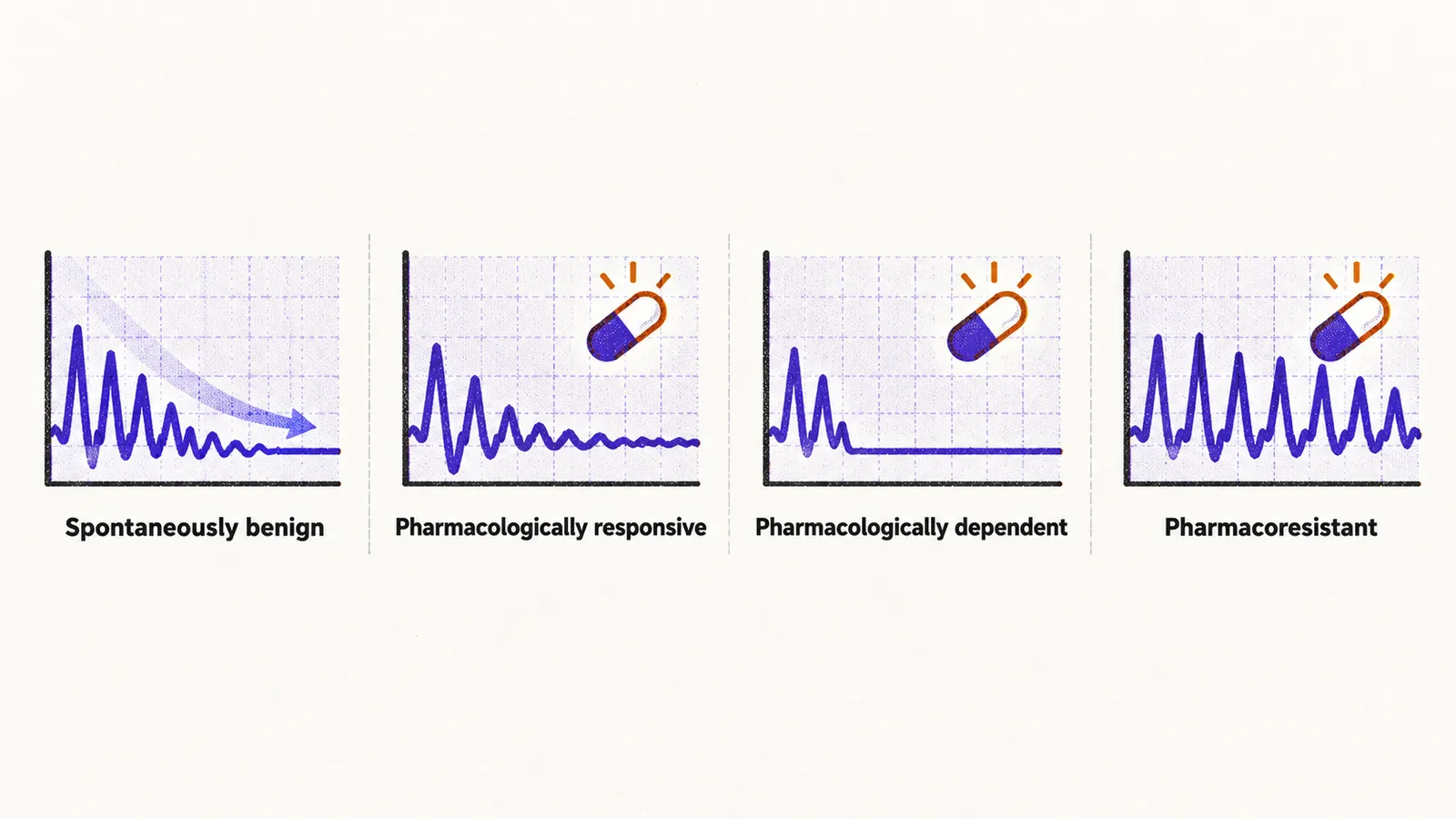
The last course has a formal definition. Drug-resistant epilepsy means failure of two adequate, tolerated, appropriately chosen and used schedules to reach sustained seizure freedom. About 20 to 30% of patients are drug-resistant, while 70 to 80% achieve acceptable control. For these patients the next question is whether surgery can help.
Surgery
Referral follows failure, not age. NICE refers people with drug-resistant seizures, diagnostically uncertain epilepsy, or intolerable side effects to a tertiary epilepsy service within 4 weeks, explicitly including surgery workup. No age gate applies. Presurgical workup centers on neuropsychology, high-resolution structural MRI, and video scalp EEG, with invasive recording when data disagree. Depth electrodes are one invasive option among others, not the default mapping method.
Yield figures, meaning how often surgery achieves seizure freedom, come from selected adult temporal lobe populations. In drug-resistant temporal lobe epilepsy, surgery beat continued medical therapy 58% to 8% for freedom from awareness-impairing seizures, with better quality of life. Temporal resection yields seizure freedom in up to 70%, with meaningful reduction in another fifth.
Driving
Driving intervals are set by the licensing jurisdiction, not by a universal seizure-free year, so the patient should be advised to check the local rules. The safety logic is consistent: uncontrolled seizures bar driving, and driving against medical advice risks insurance cover after a crash. Sleep-only or awareness-sparing seizures may qualify after an observation period under local rules, and provoked seizures from an avoidable cause are treated more leniently.
Mortality and safety counselling
Safety counselling starts at diagnosis. Mortality in epilepsy runs 1.6 to 3.0 times the general population. Death comes from sudden unexpected death in epilepsy (SUDEP) plus injury plus status epilepticus. SUDEP affects about 0.22 per 1,000 child-years and 1.2 per 1,000 adult-years, with a lifetime estimate of 7 to 12%. The major risk factor is the occurrence and frequency of generalized tonic-clonic seizures. Freedom from these seizures is strongly tied to lower SUDEP risk, so ongoing tonic-clonic seizures demand active therapy review. Modifiable risks include non-adherence, alcohol and drug misuse, uncontrolled seizures, and living or sleeping alone. Risk discussion runs from diagnosis onward.
Of these causes of death, status epilepticus is the one that develops during a single prolonged seizure and is managed as an emergency.