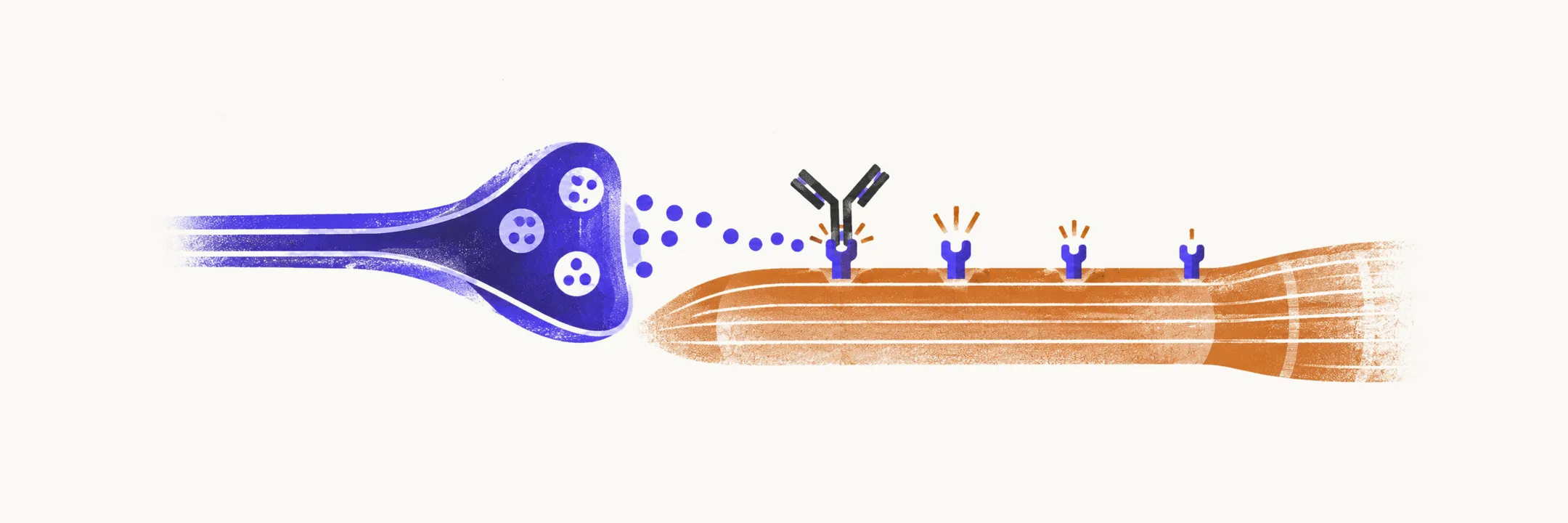
Myasthenia gravis means fatigable muscle weakness caused by autoantibodies (antibodies directed against the body’s own tissue) against the muscle endplate, the postsynaptic side of the neuromuscular junction, where a motor nerve hands its signal to the muscle. Strength fades with repetition and returns with rest, often fluctuating through the day. Ocular muscles (eyelids and eye movements) and bulbar muscles (speech and swallowing) are usually affected first, and reflexes and sensation stay normal throughout.
The behaviour follows from the antibody attack itself: fewer working receptors remain at the endplate, so each repeated impulse finds less reserve.
Choose a route through the topic
The topic is understood by asking why the weakness fatigues, how it presents, how it is proven, how it is treated, and how it differs from the presynaptic disorder that can look similar. The useful sequence is the mechanism and clinical picture first, then diagnosis, then treatment, with the comparison alongside whenever proximal weakness could sit on either side of the junction.
- Myasthenia Gravis — Pathophysiology: how the endplate attack produces fatigable weakness, the antibody subtypes, and why the thymus matters.
- Myasthenia Gravis — Clinical Features: who is affected, the descending pattern of weakness, the findings that stay normal, and how severity is graded.
- Myasthenia Gravis — Diagnosis: how fatigable weakness is provoked at the bedside, confirmed with electrodiagnosis and antibody testing, and separated from mimics, with chest imaging for thymic disease.
- Myasthenia Gravis — Treatment: symptom control, immunosuppression, thymectomy, targeted biologics, crisis management, and the medicines that can worsen weakness.
- MG versus LEMS: the postsynaptic-versus-presynaptic distinction across reflexes, exercise effect, autonomic features, cancer associations, electrodiagnosis, and first-line treatment.