
Myasthenia gravis (MG) and Lambert-Eaton myasthenic syndrome (LEMS) share the symptom of weakness but differ in almost every other respect. One anatomical fact organises the whole comparison: at the neuromuscular junction, where a motor nerve releases acetylcholine onto the muscle, MG attacks the postsynaptic muscle endplate, while LEMS attacks the presynaptic nerve terminal. Every clinical difference below flows from that single distinction (Titulaer et al., 2011).
Why exercise helps one and harms the other
In LEMS, antibodies destroy presynaptic calcium channels, so a single impulse admits too little calcium and releases too little transmitter. With repeated impulses, calcium accumulates in the terminal faster than it clears, partially compensating for the missing channels and transiently improving strength. That residual-calcium logic is the shared basis of clinical facilitation and the electrical incremental response. In MG no such compensation exists: with fewer receptors available, repeated signalling only depletes the remaining reserve further, so weakness deepens with use.
Head-to-head comparison
With that mechanism in hand, the two diseases can be compared feature by feature.
| Feature | Myasthenia gravis | Lambert-Eaton myasthenic syndrome |
|---|---|---|
| Antibody target | Postsynaptic acetylcholine receptor (or MuSK/LRP4) | Presynaptic voltage-gated calcium channels |
| Mechanism | Fewer working receptors, so each signal answers less | Less calcium entry, so less acetylcholine released per signal |
| Ocular involvement | Common and often the first sign (ptosis, diplopia) | Usually spared |
| Weakness pattern | Ocular, then bulbar, then proximal limbs | Proximal limbs, legs more than arms; bulbar less prominent |
| Reflexes | Normal | Absent or reduced, sometimes normalising briefly after exercise |
| Exercise effect | Worsens with sustained activity (fatigability) | Improves briefly with repeated effort (facilitation) |
| Autonomic symptoms | Rare | Common: dry mouth, constipation, erectile dysfunction, orthostatic hypotension |
| Age and sex pattern | Bimodal: young women and older men | Slight male predominance; median onset around 60 |
| Tumour association | Thymoma in 10–15%; thymic hyperplasia in about 70% of the rest | Small cell lung carcinoma in roughly half; neurology may precede the cancer by months to years |
| Electrodiagnosis | Decremental response on slow repetitive stimulation (over 10% fall) | Incremental response on rapid stimulation or after exercise (over 100% growth) |
| Acetylcholinesterase inhibitor response | Good; pyridostigmine is first-line | Poor; more transmitter cannot fix a release defect |
| First-line treatment | Pyridostigmine, then steroids, azathioprine, thymectomy | 3,4-diaminopyridine plus treatment of the underlying lung tumour |
Approaching proximal weakness at the bedside
When the presentation is proximal limb weakness, six checks separate the two. Reflex behaviour comes first, including whether reflexes recover after brief exercise: normal reflexes fit MG, while absent or reduced ones fit LEMS. Autonomic symptoms are the second check, since they are rare in MG and common in LEMS. Third, early and prominent ocular signs favour MG. Fourth, smoking history and lung-cancer risk favour LEMS. Fifth is the stimulation response, decremental in MG and incremental in LEMS. Sixth, when LEMS is suspected, chest imaging is mandatory, together with calcium-channel antibody testing and ongoing cancer surveillance.
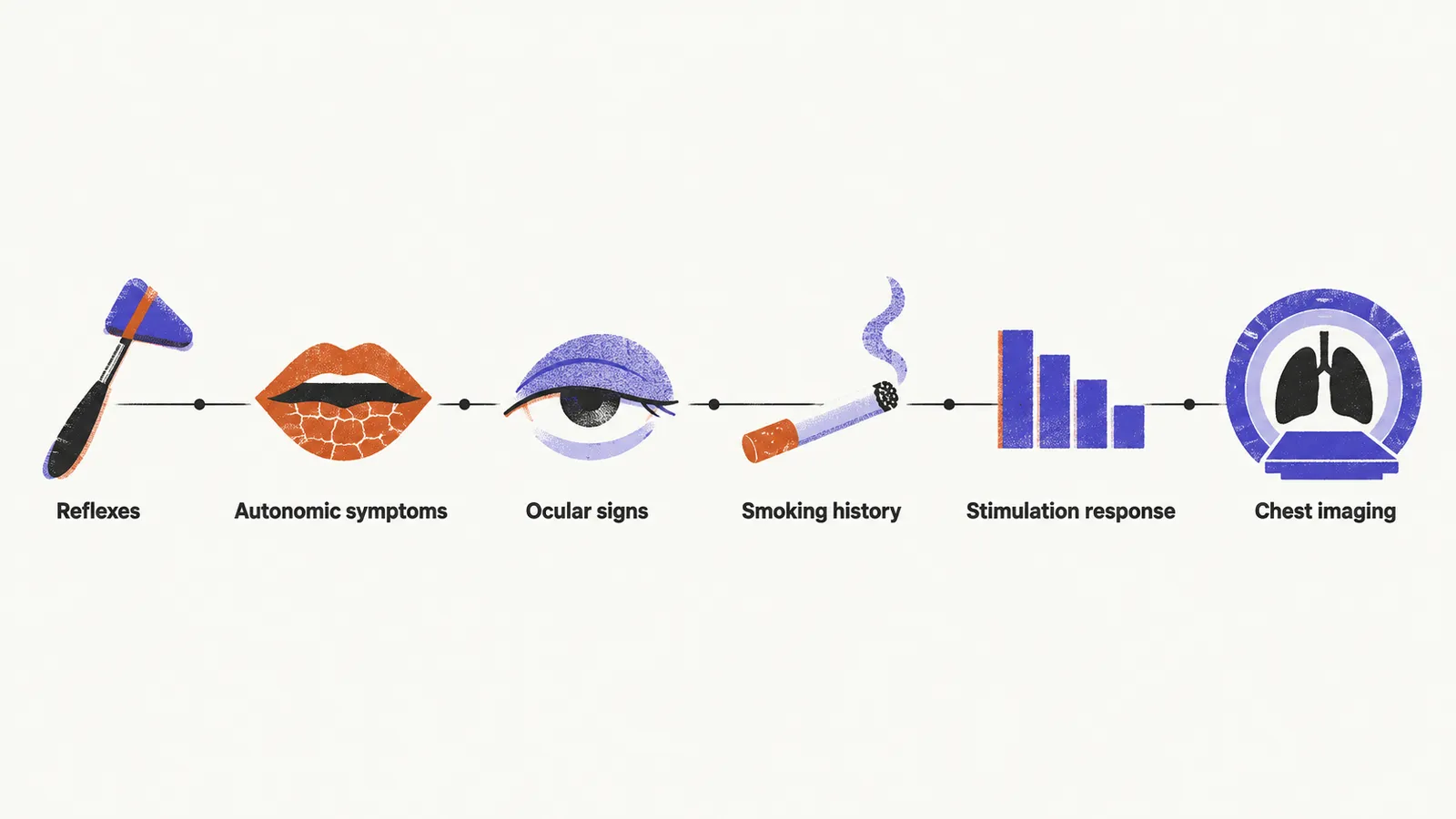
Proximal weakness with absent reflexes should always raise LEMS and trigger the malignancy search, since finding the tumour early can be life-saving.
A third junction-adjacent disorder completes the landscape by contrast: neuromyotonia (Isaacs syndrome), driven by potassium-channel antibodies of the peripheral nerve, produces continuous muscle overactivity with cramps and stiffness rather than weakness at all.