
Dysphagia matters less for the sensation of difficulty than for what it causes. Reduced intake, repeated micro-aspiration — small amounts of food, liquid, or saliva entering the airway — and the effort of eating safely all accumulate over days to weeks, and the resulting complications can be what brings the patient to attention.
Aspiration pneumonia
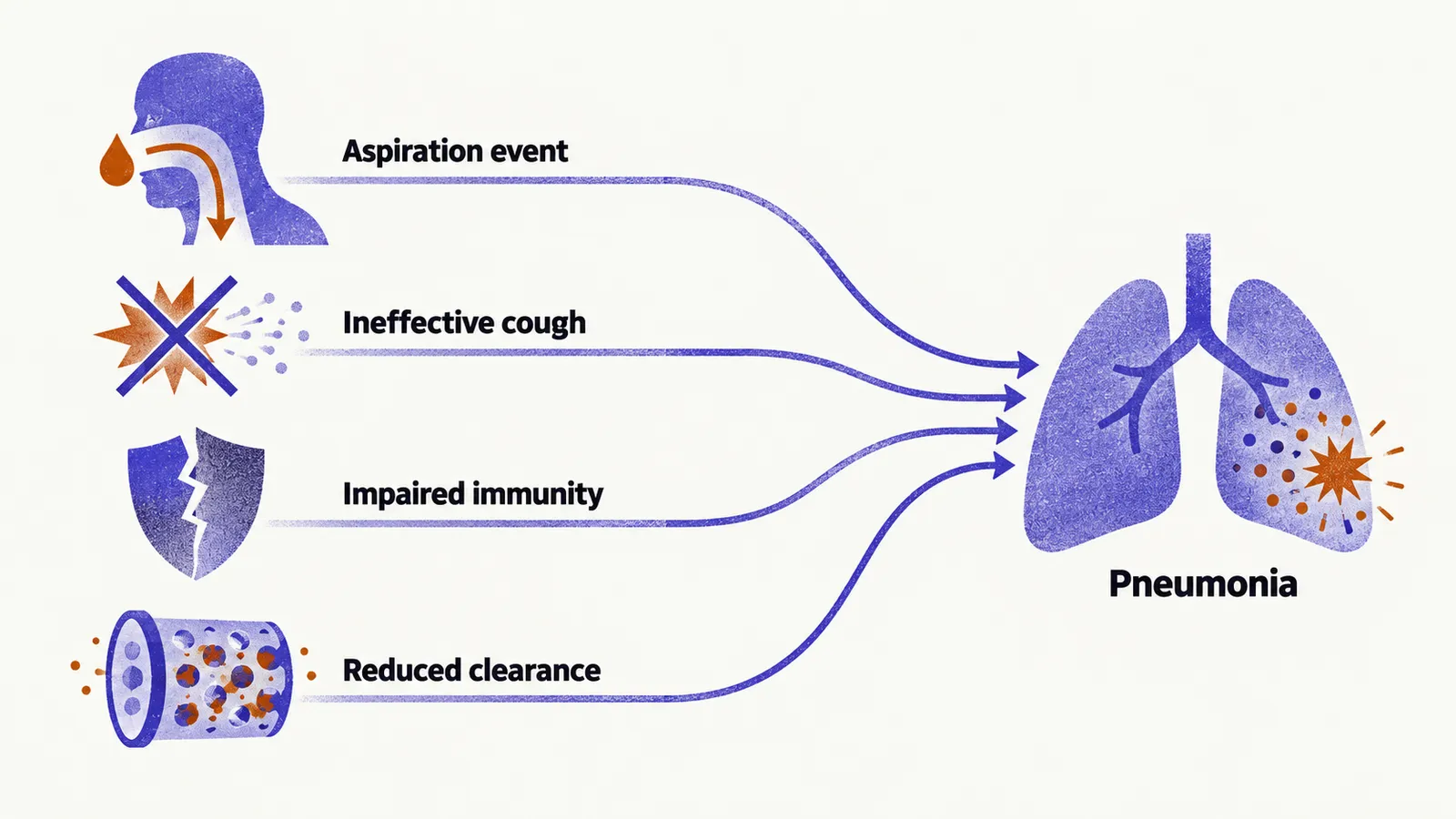
Aspiration pneumonia is the leading cause of death in this population, and it is not simply bacteria arriving in the lung. It results from a convergence of factors: an aspiration event, an ineffective cough that fails to clear it, impaired cellular immunity (alveolar macrophages, lymphocytes, neutrophils), and reduced mucociliary and lymphatic clearance. Malnutrition and dehydration weaken the immune and clearance arms of this model, which is why improving nutrition, hydration, oral hygiene, and reflux management lowers pneumonia risk even when some aspiration continues, and why ventilation support matters alongside swallowing measures.
Reported figures vary because populations and methods differ, so treat any single percentage as approximate rather than exact. In stroke, dysphagia raises the risk of pneumonia roughly 3-fold (relative risk 3.17), and the risk is markedly higher — up to 11-fold — when aspiration is confirmed on videofluoroscopy.
Aspiration does not always produce an acute illness. Small amounts of material reaching the airway repeatedly cause chronic bronchitis rather than a single episode of pneumonia.
Malnutrition and dehydration
The same swallowing difficulty that lets material reach the airway also limits what reaches the stomach. Malnutrition follows both from reduced intake and from the metabolic cost of inefficient swallowing. Dehydration follows from reduced intake and from deliberate avoidance of the fluids that provoke coughing. The ESPEN guideline on clinical nutrition in neurology notes that neurological disease is frequently accompanied by malnutrition, micronutrient deficiency, and dehydration, with oropharyngeal dysphagia among the causes. These deficits feed back into pneumonia risk, as described above.
Choking and psychosocial consequences
Choking on a food bolus is rare, but it is potentially fatal.
Eating also has a social side. When eating becomes difficult or embarrassing, patients withdraw from shared meals, and low mood follows.
Prognosis
After stroke, dysphagia independently predicts disability and mortality, and recovery tends to be better with cortical lesions than with brainstem lesions. In myotonic dystrophy type 1, death is from aspiration pneumonia or cardiac arrhythmia.
The risk of these complications can be lowered even when the underlying disease cannot be treated, which is why the practical questions become how to protect the airway and how to maintain nutrition.