
Nuclear imaging in epilepsy exists for one clinical situation: drug-resistant epilepsy facing possible surgery. About one-third of patients never reach seizure control with medication. Resistance is declared only after careful years-long work: at least two drugs tried as monotherapy (one drug alone), then combinations, each change requiring a taper, an overlap, and time to judge effect.
The localizing gap
For these patients surgery is the realistic chance of cure, but the surgeon must know exactly where the seizures start, the seizure onset zone. Two routine investigations are meant to show it, and neither answers the question alone.
Electroencephalography (EEG) records the brain’s electrical activity. It captures seizure timing exquisitely but localizes crudely, partly because activity from one mesial temporal lobe (the inner surface of the temporal lobe, where the hippocampus lies) reflects almost instantly to the other, defeating lateralization, the decision of which side the seizures come from. Magnetic resonance imaging (MRI) shows structure yet is normal in about one-third of drug-resistant patients, leaving no visible target.
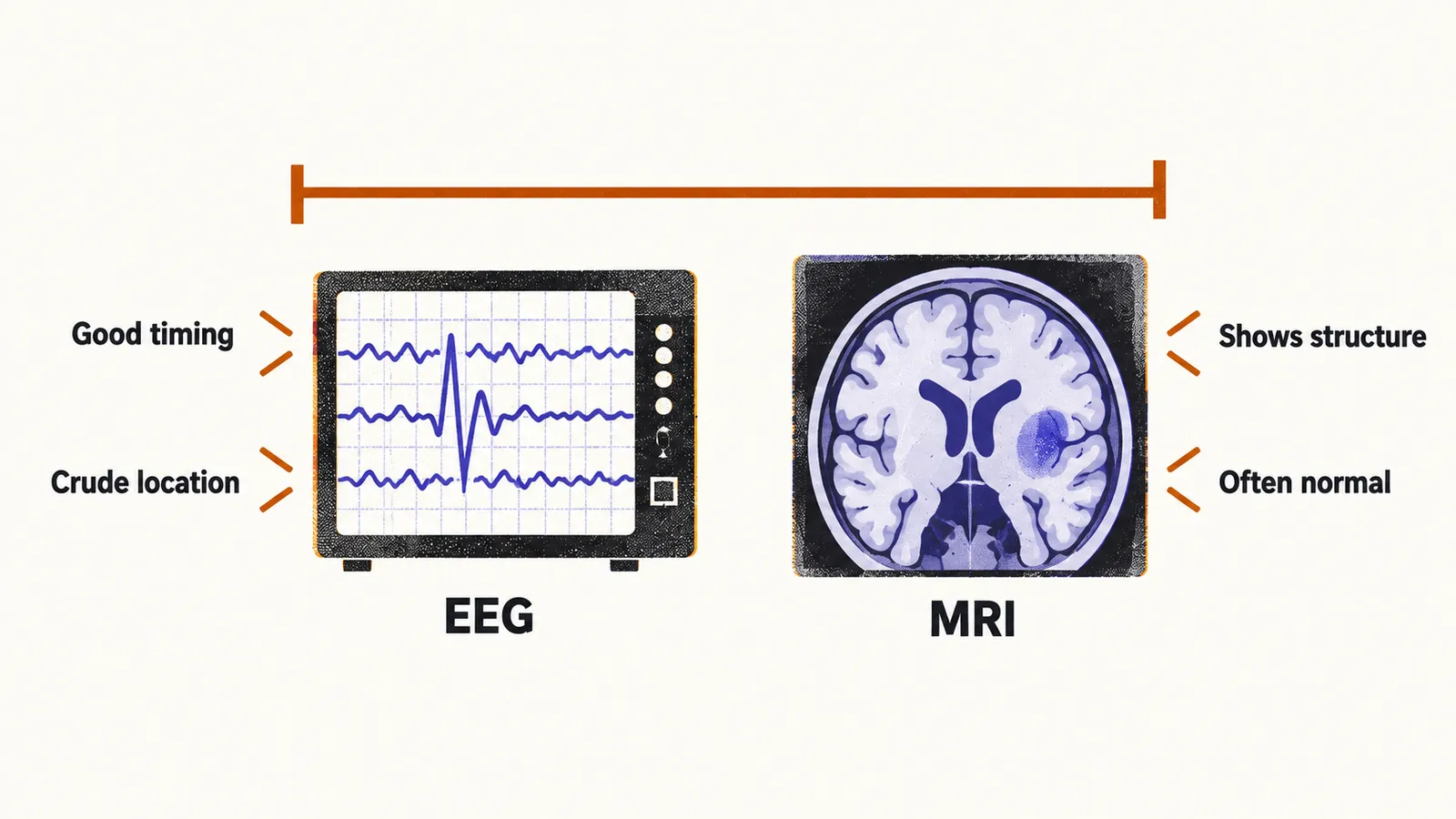
Functional imaging fills that spatial gap by reading brain metabolism and blood flow rather than structure. Interictal FDG-PET, taken between seizures (“interictal”), shows where glucose metabolism has fallen around the focus; ictal SPECT, taken during a seizure (“ictal”), captures increased blood flow, or hyperperfusion, at the seizure onset itself. The first question is how PET reads that metabolic signal, and how it must be acquired to be trusted.