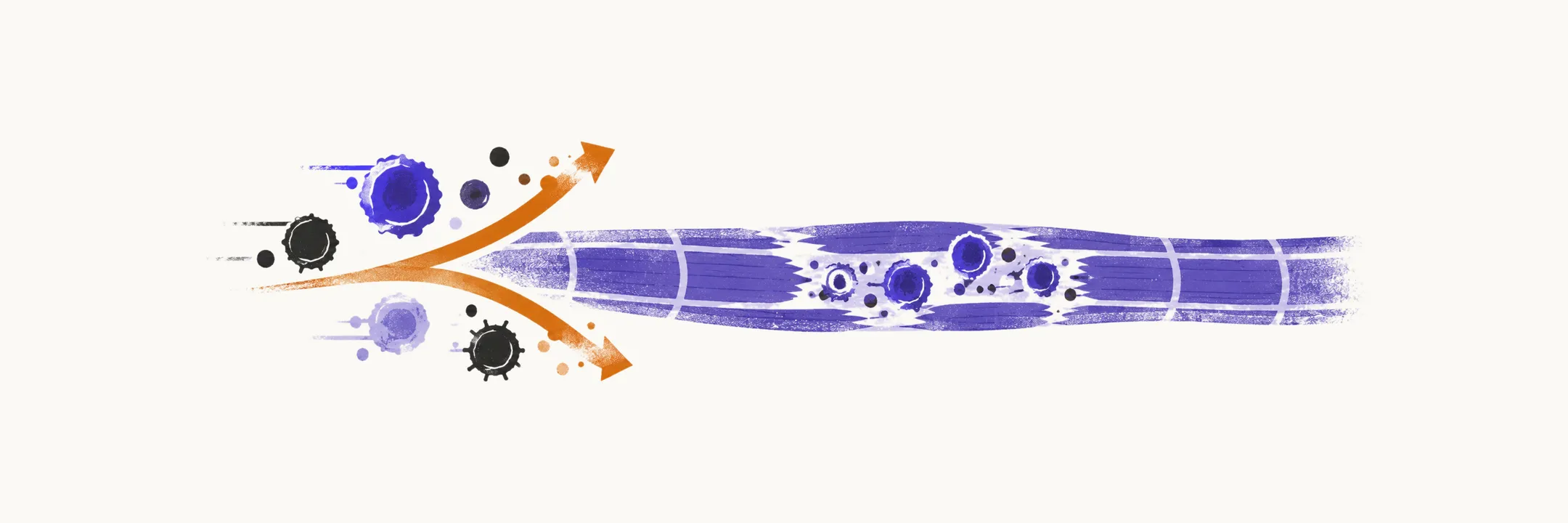
Polymyositis is an inflammatory myopathy of subacute symmetric proximal weakness without the rash that defines dermatomyositis. It is a diagnosis of exclusion: the label applies only after inherited, toxic, metabolic, endocrine, and inclusion body disease have been ruled out. Under strict criteria it is the least common of the three classic inflammatory myopathies, because many historical cases prove to be necrotising myopathy, inclusion body myositis, or dystrophy on modern review.
Presentation
Onset centres on middle adulthood, with a modest female predominance and rarity in childhood. Weakness follows the familiar proximal symmetric distribution of the arms and legs, sometimes with neck-flexor failure and head drop. Myalgia comes and goes rather than dominating. About a third develop dysphagia (difficulty swallowing) from pharyngeal weakness with oesophageal hypomotility, and diaphragmatic and intercostal involvement can compromise ventilation. Joint pain without frank arthritis, Raynaud phenomenon, and occasional fever round out the systemic picture, while visible atrophy arrives late and only after prolonged undertreated disease. Any cutaneous finding should redirect the diagnosis toward dermatomyositis or an overlap syndrome rather than being absorbed into polymyositis.
Laboratory support comes from consistently raised creatine kinase (CK) reflecting ongoing fibre injury and from a myopathic electromyogram with fibrillations and positive sharp waves marking membrane irritability. Anti-Jo-1 may accompany the anti-synthetase pattern of myositis with interstitial lung disease, arthritis, Raynaud phenomenon, and mechanic’s hands.
Defining it by exclusion
The older Bohan and Peter formulation requires acquired subacute disease with no family history, no toxic or metabolic cause, no dystrophic features, and no inclusion body pattern, supported by raised enzymes, myopathic electromyography, endomysial cytotoxic infiltrates with fibre MHC (major histocompatibility complex) class I expression, and myositis antibodies. Modern practice increasingly uses the 2017 EULAR/ACR classification criteria, which formalise serotype-defined subsets and outperform the older scheme, but the exclusion principle survives intact.
Because the label depends on exclusion, the clinician must actively dismiss inclusion body myositis by distribution and vacuoles, necrotising myopathy by antibody and CK profile, metabolic disease by exercise history and biochemistry, and dystrophy by inheritance and genetics before calling polymyositis.
Treatment
Polymyositis follows the dermatomyositis protocol in full: weight-based prednisone induction, taper with azathioprine, methotrexate, or ciclosporin on relapse, low-burden maintenance, and intravenous immunoglobulin rescue for refractory or steroid-intolerant disease. Response to this regimen is itself diagnostically informative: weakness that ignores adequate immunosuppression in an older adult should reopen the question of inclusion body myositis rather than prompting endless escalation.