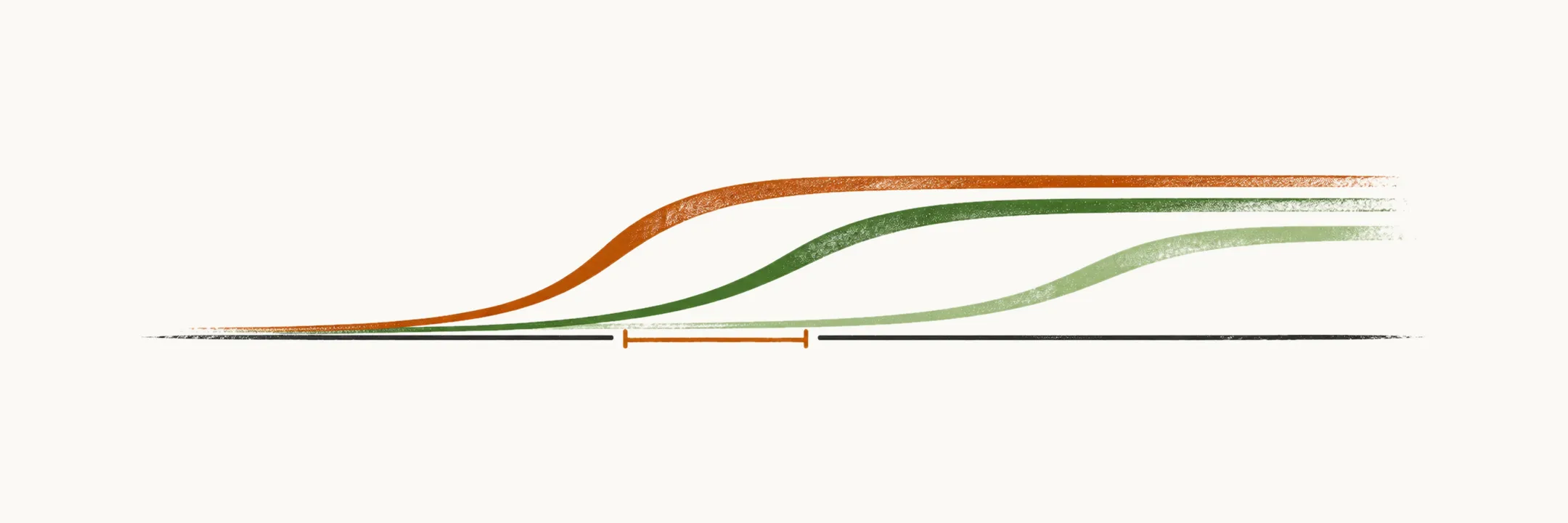
The classical definition of abnormal pubertal timing, whether precocious or delayed, is a deviation of more than 2.5 standard deviations (SD) from the mean of the population. Because the mean itself varies with ethnicity, the definition is not a single fixed age, and the practical cutoffs that follow from it differ between populations.
Definitions and age cutoffs
The 2.5 SD rule becomes a practical age only once a reference population is chosen, so the cutoffs are stated for specific groups.
On the classical definition, and on new epidemiological findings, precocious puberty has been defined as puberty occurring before the age of 6 in African-American girls and before the age of 7 in Caucasian girls. This is based on the PROS (Pediatric Research in Office Settings) guideline, with which some experts do not agree; many endocrinologists will still evaluate a girl who has experienced secondary sexual traits before the age of 8.
Delayed puberty is defined as the absence of thelarche — the start of breast development — after the age of 13 in girls, and delayed menarche as the absence of menarche, the first menstruation, by the age of 15 or 16. Beyond those ages, the guideline suggests that the diagnostic procedure for delayed puberty be initiated if a girl does not experience menarche 3 years after thelarche.
Two directions, two mechanisms
Abnormal timing points in one of two directions. In precocious puberty, the appearance of secondary sexual traits comes from an increase in sex steroids, and that increase can arise from a central disorder of the hypothalamus, a disorder of the gonads, or a disorder of the adrenal glands. In delayed puberty, the events are late or absent because the reproductive axis is not being driven hard enough, because the gonads cannot respond to that drive, or because an anatomical block prevents menstruation even when the axis is working.
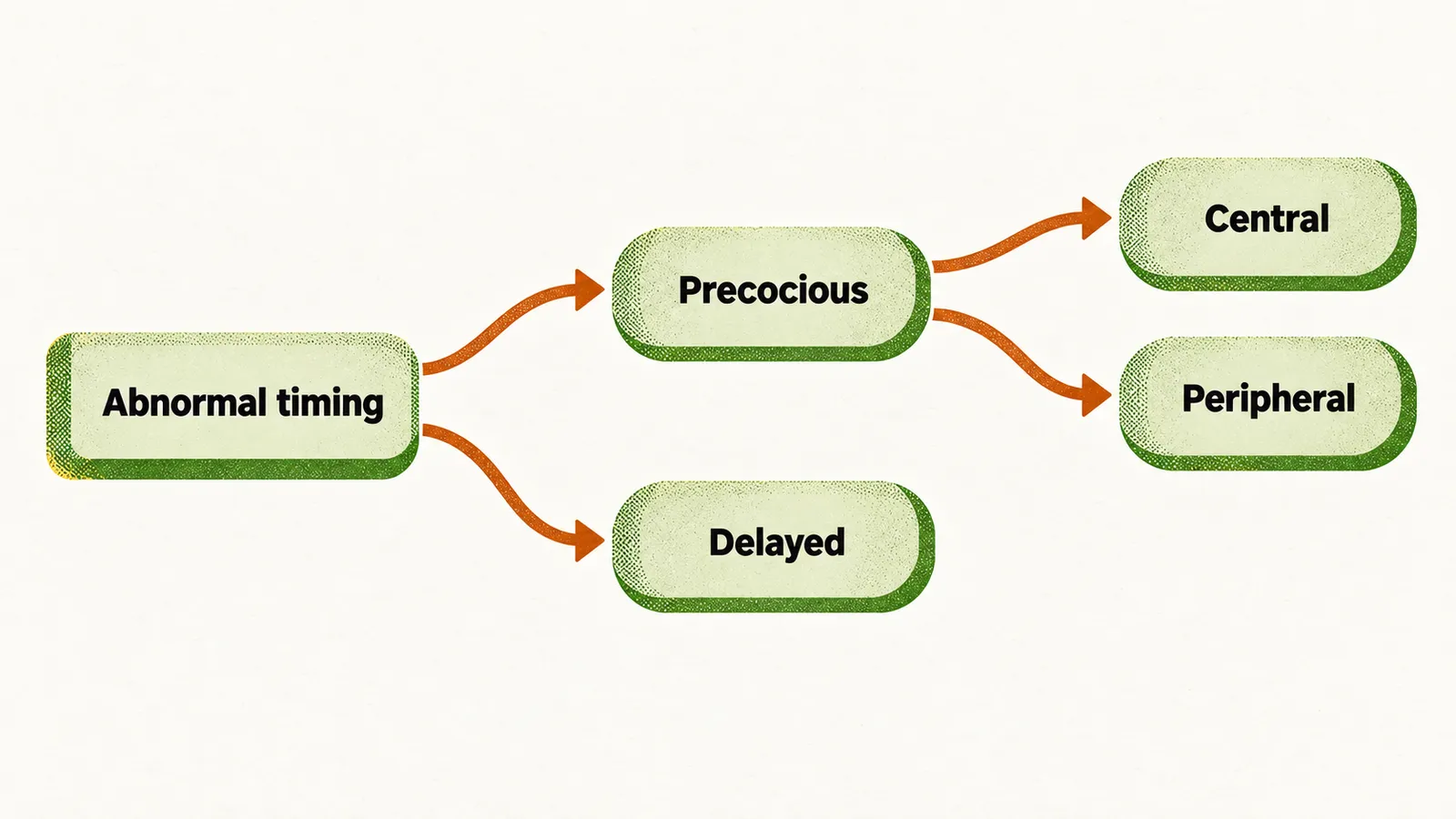
Classifying precocious puberty
The first useful question about precocious puberty is whether the gonadotropins — the pituitary hormones that command the gonads — are driving it. When they are, the precocity is gonadotropin-dependent, or central; when sex steroids are being produced without that drive, it is gonadotropin-independent, or peripheral. A second question is whether the signs match the child’s sex: isosexual precocity develops features of the child’s own sex, such as feminization of a girl, while heterosexual precocity produces features of the opposite sex, such as virilization of a girl.