
Precocious puberty is the appearance of secondary sexual traits before the age cutoffs for normal pubertal timing — before the age of 6 in African-American girls and before the age of 7 in Caucasian girls, with many endocrinologists still evaluating a girl who shows secondary sexual traits before the age of 8. All of these signs come from an increase in sex steroids, and that increase can be derived from central disorders of the hypothalamus, disorders of the gonads, or disorders of the adrenal glands.
The estimated incidence of precocious puberty is about 1 in 5,000 to 1 in 10,000 children, and the prevalence in females is about 10 times that in males.
Classification and causes
The gonadotropins are luteinizing hormone (LH) and follicle-stimulating hormone (FSH), the two pituitary hormones that command the gonads, and their release is driven by GnRH (gonadotropin-releasing hormone), the hypothalamic hormone. Based on the sequence of pubertal events that happens in it, precocious puberty can be classified into two main groups. In complete precocious puberty, the gonadotropin-dependent form, all the stages of normal puberty — thelarche, adrenarche and menarche, which are the start of breast development, of adrenal androgen production and of menstruation — appear before the age cutoff. In incomplete precocious puberty, the gonadotropin-independent form, one stage appears on its own, and the condition is sub-classified by which it is: isolated precocious thelarche, isolated precocious adrenarche, or isolated precocious menarche.
A separate question is whether the signs match the child’s sex. Isosexual precocity develops features of the child’s own sex, such as feminization of a female; heterosexual (contrasexual) precocity produces features of the opposite sex, such as virilization of a female. The full classification, with the causes in each category, is:
| Category | Subcategory |
|---|---|
| I. Complete Isosexual Precocity (Gonadotropin Dependent) | A. Idiopathic |
| B. CNS lesions: Hamartomas, Craniopharyngioma, etc | |
| C. Primary hypothyroidism | |
| D. Post treatment for CAH | |
| E. Genetic | |
| II. Incomplete Isosexual Precocity (GnRH Independent) | A. Isolated precocious thelarche |
| B. Isolated precocious menarche | |
| C. Estrogen-secreting tumors (ovary/adrenals) | |
| D. Ovarian cysts | |
| E. McCune-Albright syndrome | |
| F. Peutz-Jeghers syndrome | |
| G. Iatrogenic | |
| III. Contrasexual Precocity (Isolated virilization) | A. Isolated precocious adrenarche |
| B. Congenital adrenal hyperplasia | |
| C. Androgen-secreting neoplasm | |
| D. Iatrogenic |
Central precocious puberty
Central precocious puberty (CPP) is the gonadotropin-dependent form. It happens because of earlier maturation of the hypothalamic-pituitary-ovarian axis, so the whole axis switches on prematurely rather than being driven from outside it. These patients are therefore characterised by gonadotropin, GnRH and GnRH pulsatility (the rhythmic pattern in which GnRH is released) that are all in the normal range, similar to the post-pubertal level. CPP accounts for 97.7% of the cases, while gonadotropin-independent precocious puberty (GIPP) accounts for about 2.3%.
The most common cause of CPP is idiopathic; no lesion is found, and the axis simply matures early. When a lesion is responsible, it usually sits in the central nervous system. The most common neoplasm found in CPP is a hypothalamic hamartoma, a benign mass of the tuber cinereum (part of the hypothalamus), and the other CNS causes are trauma, hydrocephalus, congenital brain defects and post-infectious damage.
Some rare genetic conditions also cause CPP. A gain-of-function mutation of KISS1 or of its receptor makes the axis switch on early, because kisspeptin is the primary stimulatory signal of puberty; a loss-of-function mutation of MKRN3, an E3 ubiquitin ligase (an enzyme that tags proteins for degradation) that inhibits the production of kisspeptin before puberty, removes a brake and has the same effect.
Finally, severe primary hypothyroidism can lead to precocious puberty, because the very high level of thyroid-stimulating hormone (TSH), the pituitary hormone that drives the thyroid, in that state cross-reacts with, and activates, the FSH receptors on the ovary.
Presentation and evaluation
Presentation
Precocious puberty usually announces itself with breast development, which may begin on one side before the other. Pubic and axillary hair may appear before, at about the same time as, or well after breast tissue, and the child often shows a growth spurt and an advanced bone age. The growth acceleration is deceptive, because the same sex steroids that speed growth also mature the growth plates: without treatment the child may be tall for age but end up short as an adult.
Benign variants
Two benign variants resemble precocious puberty and must be separated from it. Premature thelarche is the isolated appearance of breast development, usually in girls younger than 3 years, and premature adrenarche is the appearance of pubic hair without other signs of puberty, usually before 7 to 8 years. Both progress slowly or not at all.
Evaluation
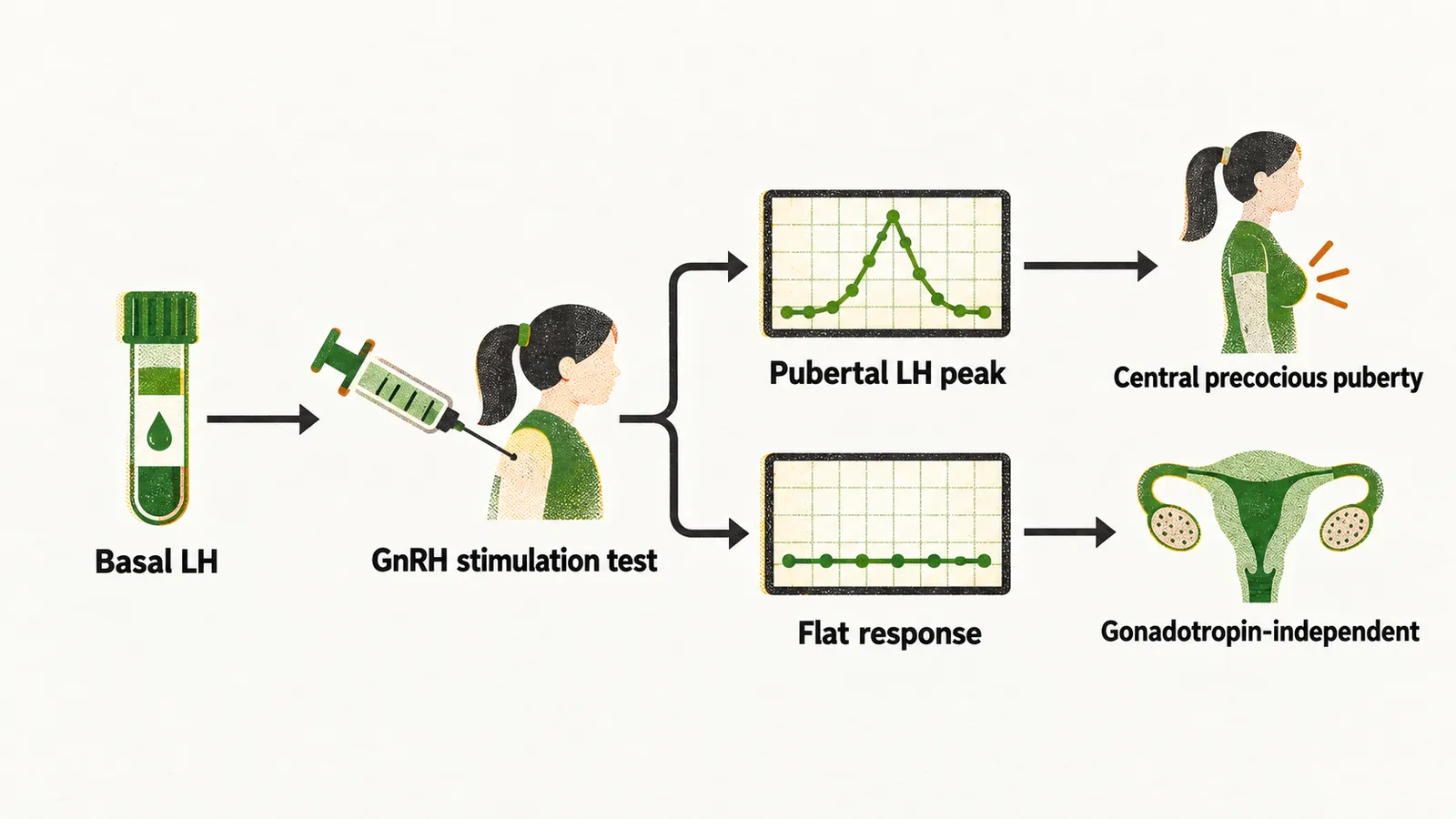
The evaluation starts from the history and the examination, with a growth chart reviewed against population norms. A radiograph of the left hand and wrist gives the bone age, which is advanced by more than a year if the process has been running for a while. An ultrasensitive basal LH is measured, and when it stays low although the clinical suspicion is high, a GnRH stimulation test settles whether the axis has truly switched on: a pubertal peak of LH after the stimulus confirms CPP, whereas a flat response points to a gonadotropin-independent cause. Pelvic ultrasound assesses ovarian and uterine size, and brain MRI is used selectively — in girls younger than 6 years, in boys, and in any child with central symptoms such as headache or visual change — rather than routinely in every girl aged 6 to 8.
Treatment
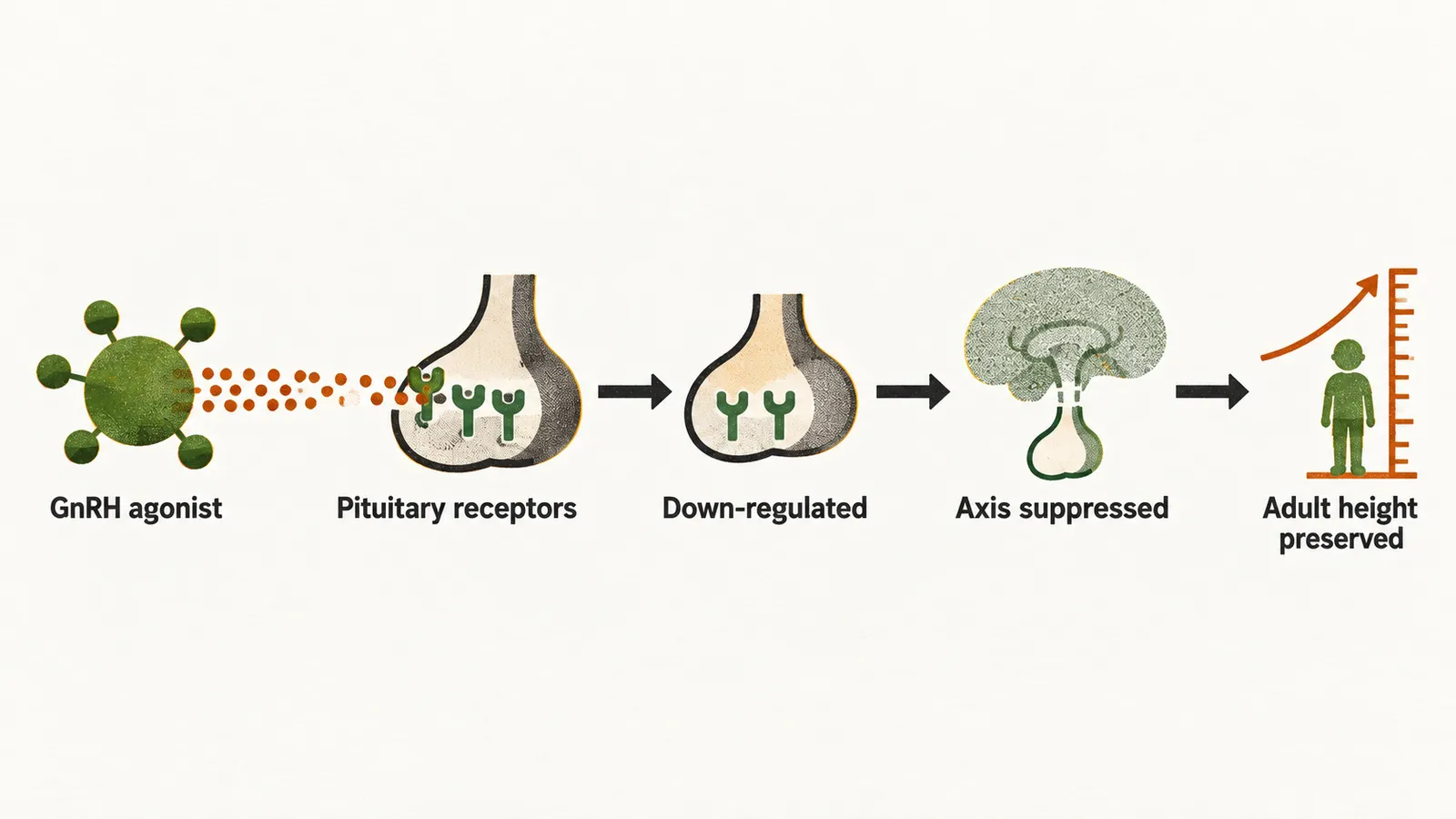
Treatment is directed at the cause. For CPP, the treatment of choice is a GnRH agonist such as leuprolide. Given continuously, the agonist overstimulates and then down-regulates the pituitary GnRH receptors, suppressing the reproductive axis, halting or slowing pubertal progression and delaying the fusion of the growth plates (epiphyseal closure) so that adult height is preserved. Treatment is usually continued to the normal age of puberty, and the axis recovers afterwards.
Two caveats matter. Not every child with CPP needs treatment: a slowly progressive form that does not compromise adult height can be followed without it. And for gonadotropin-independent precocious puberty the axis is not the problem, so GnRH agonists do not work; the underlying source — an estrogen-secreting tumour, an ovarian cyst, the autonomous ovarian estrogen production of McCune-Albright syndrome, or congenital adrenal hyperplasia — has to be treated instead.
Precocious puberty is sex-steroid action arriving too early. The opposite direction of abnormal timing is puberty that is late or absent.