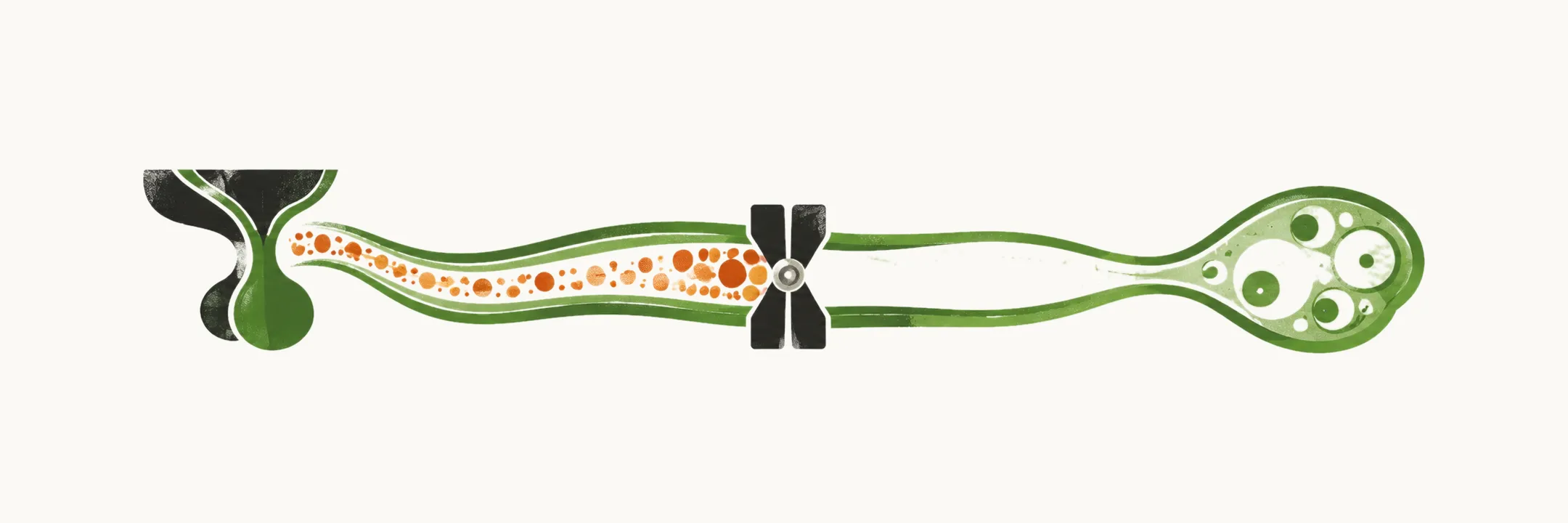
Delayed puberty is the absence of thelarche (the start of breast development) after the age of 13 in girls, and delayed menarche is the absence of menarche (the first menstruation) by the age of 15 or 16. Both describe timing, not a diagnosis: they mark the point at which the clinician should look for a cause.
When to evaluate
Those ages mark the point at which the clinician starts looking for a cause. The guideline recommends evaluation of girls who have:
- absence of thelarche after the age of 13
- absence of menarche after the age of 15 or 16
- absence of menarche by age 14 in the presence of hirsutism (excess male-pattern hair growth), or of a history or examination suggestive of an eating disorder or excessive exercise, or of an outflow abnormality (an anatomical block to menstrual flow)
It also suggests starting the diagnostic procedure if a girl does not experience menarche 3 years after thelarche.
Causes
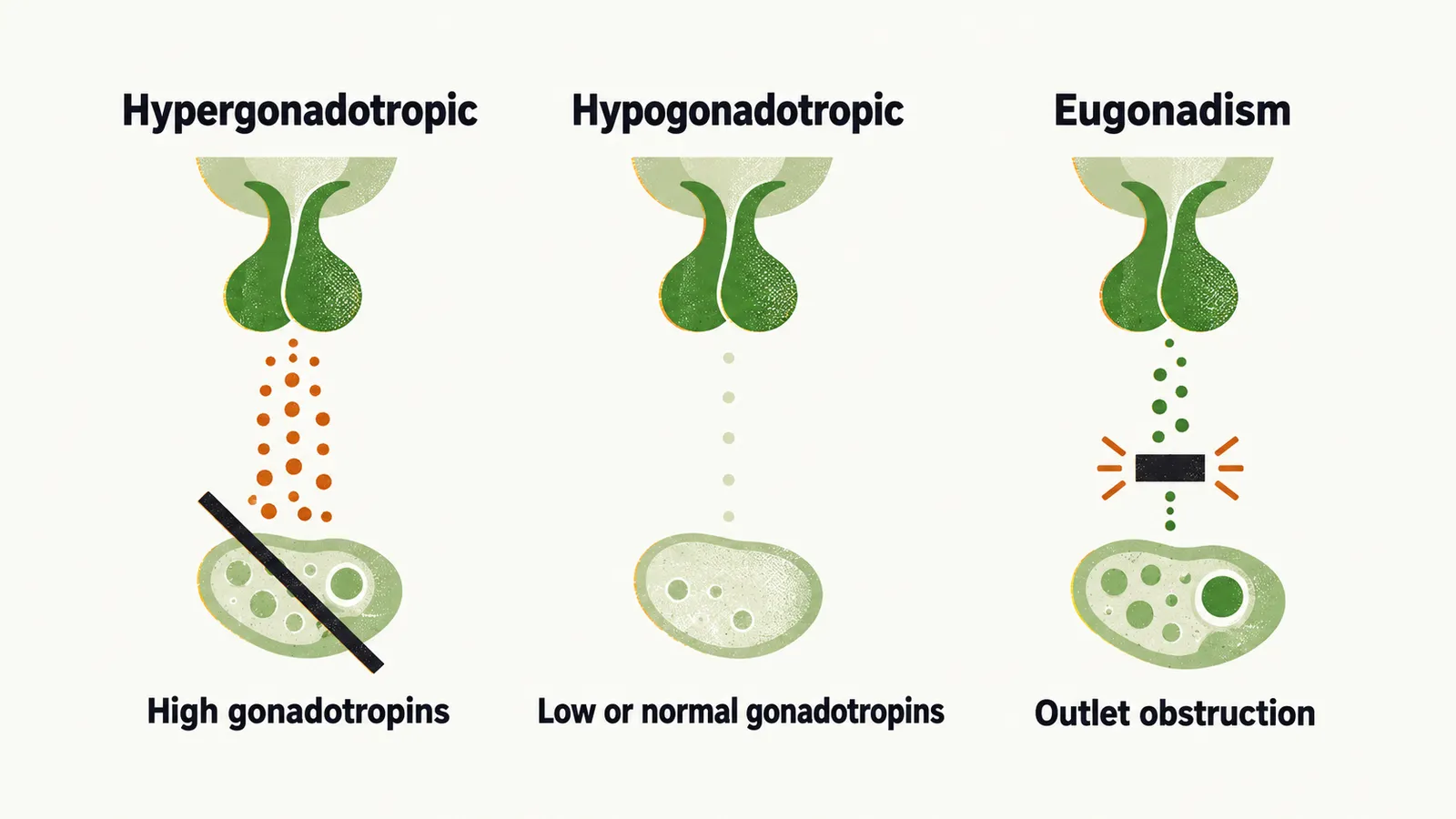
Across girls presenting with delayed puberty or absent menarche, three causes account for more than two thirds of the cases: ovarian insufficiency (42%), congenital absence of the uterus or vagina (14%) and constitutional delay of puberty (10%), in which a healthy child simply matures later than average. The remaining third separates by where the axis has failed. Hypogonadism means underactive gonads (the ovaries in a girl), and the three patterns below differ in what the pituitary is doing and in whether the gonads can respond.
In hypergonadotropic hypogonadism, the gonads fail, so the pituitary compensates and the gonadotropins — LH and FSH, the pituitary hormones that command the gonads — are high. The best-known example is Turner syndrome; the same picture can arise with a normal karyotype, in 46,XX or 46,XY gonadal dysgenesis.
In hypogonadotropic (or eugonadotropic) hypogonadism, the gonadotropins are low or normal because the fault lies in the hypothalamus or the pituitary. The causes divide by whether correcting them restores the axis:
- Reversible, treated by correcting them: constitutional delay, systemic illness, eating disorders, primary hypothyroidism, congenital adrenal hyperplasia, Cushing syndrome, pseudopseudohypoparathyroidism and hyperprolactinemia.
- Irreversible, needing hormone replacement: congenital deficiency syndromes, isolated GnRH deficiency, forms of hypopituitarism, congenital CNS defects, acquired anatomical lesions, and tumours such as an unclassified pituitary adenoma, craniopharyngioma or malignant tumour.
In eugonadism, the axis itself works but menstruation is blocked. The anatomic causes are Müllerian aplasia (the congenital absence of the uterus or vagina) and outlet obstruction, which can come from a transverse vaginal septum, an imperforate hymen or cervical atresia. Inappropriate feedback, intersex disorders, androgen insensitivity and 17-ketoreductase deficiency complete the group.
Evaluation
Assessment begins with the history and the examination, looking for the features of Turner syndrome, for signs of chronic illness or an eating disorder, and for evidence of androgen excess. Bone age, the skeletal maturity read from a radiograph, is obtained, and the gonadotropin levels are the most useful initial test: high LH and FSH identify gonadal failure, while low or normal values point to a hypothalamic-pituitary cause.
Because hypogonadism in a girl raises the possibility of Turner syndrome, a karyotype (the analysis of the chromosomes) is checked early, and any Y-chromosome material found means the gonads have to be removed because of their tumour risk. Prolactin and thyroid function are measured, and brain MRI looks for a hypothalamic-pituitary lesion when the cause appears central.
Treatment
Treatment follows the cause. Constitutional delay of puberty resolves with time, and reassurance may be enough. When low body fat or an eating disorder is responsible, restoring weight can restart the axis on its own.
When the delay causes distress, or when the deficiency is permanent, puberty is induced with estrogen given in a gradual manner, starting at a low dose and increasing slowly to mimic the tempo of natural puberty. Because estrogen alone stimulates the endometrium (the lining of the uterus), a progestin (a synthetic form of progesterone) is added after one to two years, or once breakthrough bleeding appears, so that the endometrium is shed. Girls with primary ovarian insufficiency or a permanent gonadotropin deficiency need long-term estrogen replacement rather than a short course.