
Puberty is the transition from childhood to adulthood. It is characterised by the maturation of several different endocrine axes in the body (chains of glands that signal one another through hormones), and it leads to three important changes:
- the appearance of secondary sexual traits
- the attainment of reproductive capacity
- the secondary phase of skeletomuscular growth, which forms adult stature
The vocabulary of the pubertal events
Before the sequence of events can be followed, their names need to be clear. The events of puberty are named with the suffix -arche, which comes from the ancient Greek for “beginning”:
- thelarche — thela- means nipple, so thelarche is the beginning of nipple budding, the first sign of breast development.
- adrenarche — adren- refers to the adrenal glands, so adrenarche is the beginning of adrenal androgen production, and with it the first secondary male-like features.
- menarche — men- means month, so menarche is the beginning of the monthly period, the first menstruation.
Sequence and timing of the pubertal events
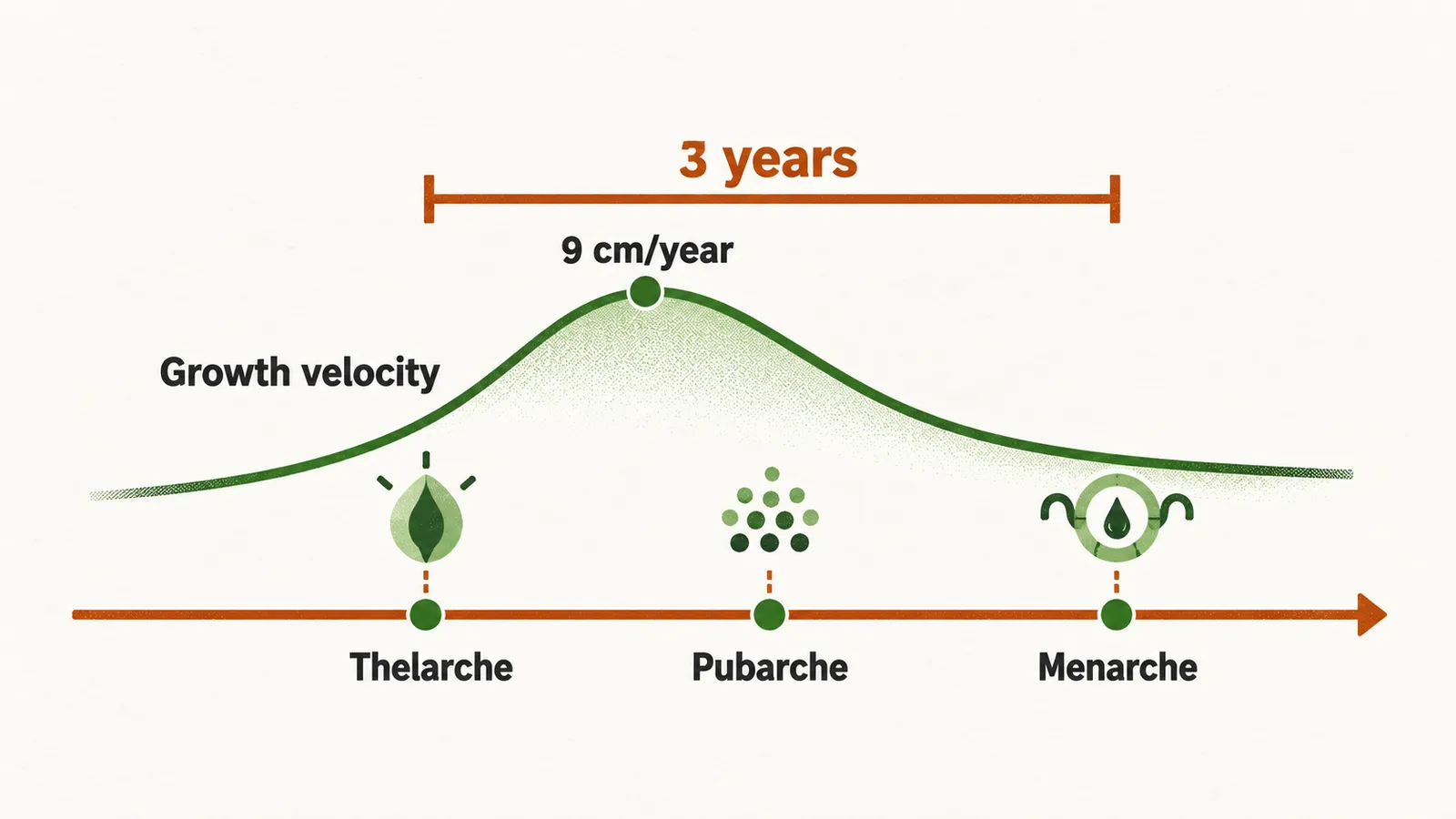
In physiological puberty in girls, the first somatic change is an increment of physical growth velocity. This increment reaches a peak of 9 cm/year, and after that it diminishes as the epiphyses, the growing ends of the long bones, begin to close.
During this time of increasing growth velocity, at about the age of 11 years while growth velocity is still increasing, thelarche appears and then pubarche, the growth of pubic and axillary hair. The underlying rise in adrenal androgen production, or adrenarche, begins in early childhood, years before thelarche, so the hair that follows thelarche is pubarche rather than the start of adrenarche. During the deceleration phase of growth, which is due to the closure of the epiphyses, menarche appears. Menarche mostly happens about 3 years after thelarche.
How the timing varies
The timing and the sequence of the events that happen during the pubertal period are highly dependent on ethnicity. The first normality range was defined for girls by British studies during the 1970s, and it put the mean age of the first sign of puberty, breast budding, at about 11 years. Later studies in the USA found that the age of onset has fallen across all ethnicities, and that the earliest stages of puberty can appear around 8 years of age in some groups, notably African-American girls. Population norms are therefore a moving target, which matters when deciding whether an individual girl’s timing is normal.
Maturity of the hypothalamic-pituitary-ovarian axis
Menarche is not the end of the process. The hypothalamic-pituitary-ovarian (HPO) axis — the hypothalamus, the pituitary gland and the ovaries, linked by their hormones — is not completely mature at the first menarche, and the early cycles are often anovulatory, meaning that no egg is released. It is only about 5 years after menarche, when most of the menstrual cycles are ovulatory, that the HPO axis can be called mature and puberty can be considered complete.