
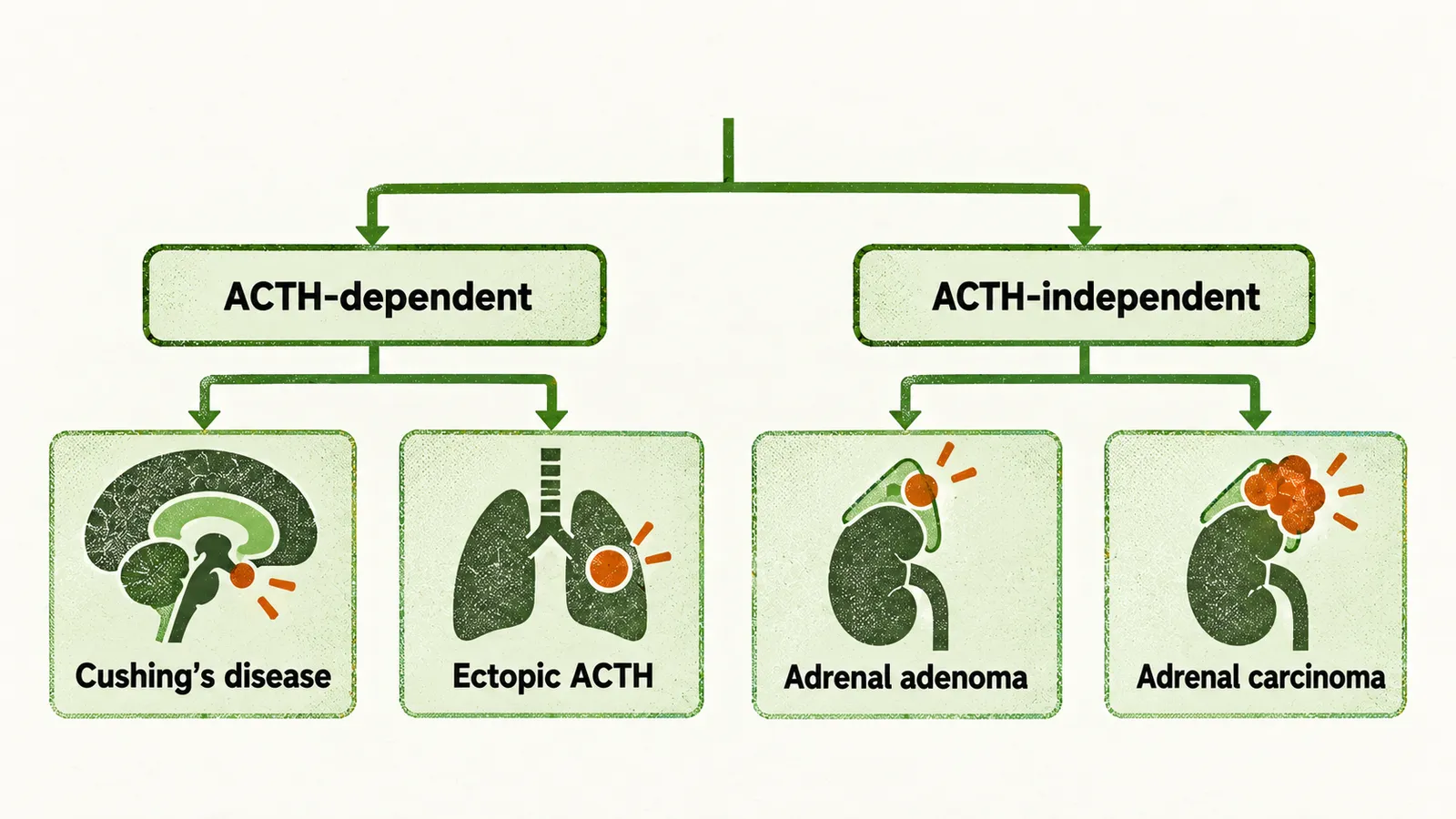
Cushing’s syndrome, the state of chronic glucocorticoid excess, arises either because the adrenal cortex is driven by excess ACTH (adrenocorticotropic hormone) or because the cortex itself overproduces cortisol. In the ACTH-dependent forms a tumour, pituitary or ectopic, makes the ACTH that drives the glands; in the ACTH-independent forms the adrenal cortex acts on its own and ACTH is suppressed. The distinction matters because it decides how each form is investigated and treated.
How excess ACTH drives the adrenal cortex
ACTH is physiologically secreted by the pituitary gland and acts on all three layers of the adrenal cortex. Excessive secretion of ACTH produces hyperplasia of the adrenal cortex and nodule formation in it, and the circulating glucocorticoids and androgens are often increased as well. The three ACTH-dependent forms below differ in where the ACTH comes from.
Cushing’s disease
Cushing’s disease is the pituitary form: it is almost always caused by one corticotroph adenoma, usually benign and restricted to the sella turcica, the bony hollow that holds the pituitary. Its main cause is still unknown, despite a large amount of information about the biochemical changes of the corticotroph tumour; among them are a reduced level of p27 protein, which is a CDK (cyclin-dependent kinase) inhibitor, and the presence of chromosomal aberrations. In patients who have familial syndromes such as MEN-1 (multiple endocrine neoplasia type 1) and McCune-Albright syndrome, predisposing mutations lead to the formation of pituitary adenomas.
Ectopic ACTH syndrome
ACTH and other pro-opiomelanocortin (POMC) products, POMC being the precursor molecule from which ACTH is made, can be produced by non-corticotroph tumours and cause Cushing’s syndrome. The most common cause of ectopic ACTH syndrome is neuroendocrine small cell lung carcinoma, which accounts for 60% of ectopic ACTH syndrome. The other main causes are pancreatic neuroendocrine tumours, pheochromocytoma, and medullary carcinoma of the thyroid gland.
Ectopic CRH syndrome
Ectopic corticotropin-releasing hormone (CRH) syndrome is a very rare form of Cushing’s syndrome. CRH is the hypothalamic hormone that normally drives pituitary ACTH release, and some tumours are able to make CRH and actively release it into the blood:
- bronchial neuroendocrine tumours
- thymic neuroendocrine tumours
- small cell lung cancer
- thymic medullary carcinomas
- prostate carcinoma
- pheochromocytoma
- ganglioneuroblastoma
Many, if not all, of the tumours that release CRH also release ACTH at the same time.
Primary adrenal disease
In primary adrenal disease the adrenal cortex overproduces cortisol on its own, so ACTH is suppressed. The main causes are not completely known, but some genetic mutations and aberrations are involved in its formation: over-expression of IGF-2, reduced expression of CDKN1C and H19, and mutation of p53, which has a role in a small subset of primary adrenal disease.
Three forms are usually distinguished:
- Adrenal adenoma is mostly encapsulated and weighs about 40 gram.
- Cortisol-secreting adrenal carcinoma is also mostly encapsulated and weighs about 100 gram.
- Primary pigmented nodular adrenal disease (PPNAD), also called micronodular adrenal disease, is a very rare form of Cushing’s syndrome characterised by the presence of micronodules in the cortex; it mostly occurs as a part of the Carney complex, in association with other abnormalities such as endocrine disorders.
McCune-Albright syndrome
Cushing’s syndrome due to bilateral adrenal dysfunction is characteristic of the McCune-Albright syndrome, in which patients manifest pigmentation of the skin, fibrous dysplasia of bone, and endocrine dysfunction.
Epidemiology
Iatrogenic causes, meaning cases due to glucocorticoid treatment given for other conditions, account for most cases of Cushing’s syndrome. Beyond that, the relative prevalence of the different forms of hypercortisolism is:
- Cushing’s disease: 68%
- adrenal adenoma: 8-19%
- adrenal carcinoma: 6-7%
- ectopic ACTH syndrome: 6-15%
- nodular adrenal hyperplasia: 2%
Generally speaking, the prevalence and incidence of Cushing’s disease, adrenal adenoma, and adrenal carcinoma are higher in women.
In ectopic ACTH syndrome the most common cause is neuroendocrine small cell lung cancer; among all the cases of neuroendocrine tumours of the lung, about 3-12% of them make ACTH. Because there is a slightly higher incidence of neuroendocrine tumours of the lung in men, ectopic ACTH syndrome has a higher prevalence in males.
Conditions that mimic Cushing’s syndrome
Pseudo-Cushing’s states are conditions in which patients have all the definitive clinical features of Cushing’s syndrome with some evidence of hypercortisolism. Stressful conditions such as depression or anorexia nervosa act on the CRH-producing neurons and drive excess ACTH secretion, leading to a pseudo-Cushing’s state. Because these states resemble true Cushing’s syndrome, telling the two apart becomes a diagnostic problem.