In full-blown Cushing’s syndrome, the chronic excess of glucocorticoids changes many tissues, and all the changes related to a high cortisol concentration are present. In practice the diagnosis is suspected from a mixture of findings: some are common in the general population and only raise the question, while others are specific enough to support it.
Non-specific clues
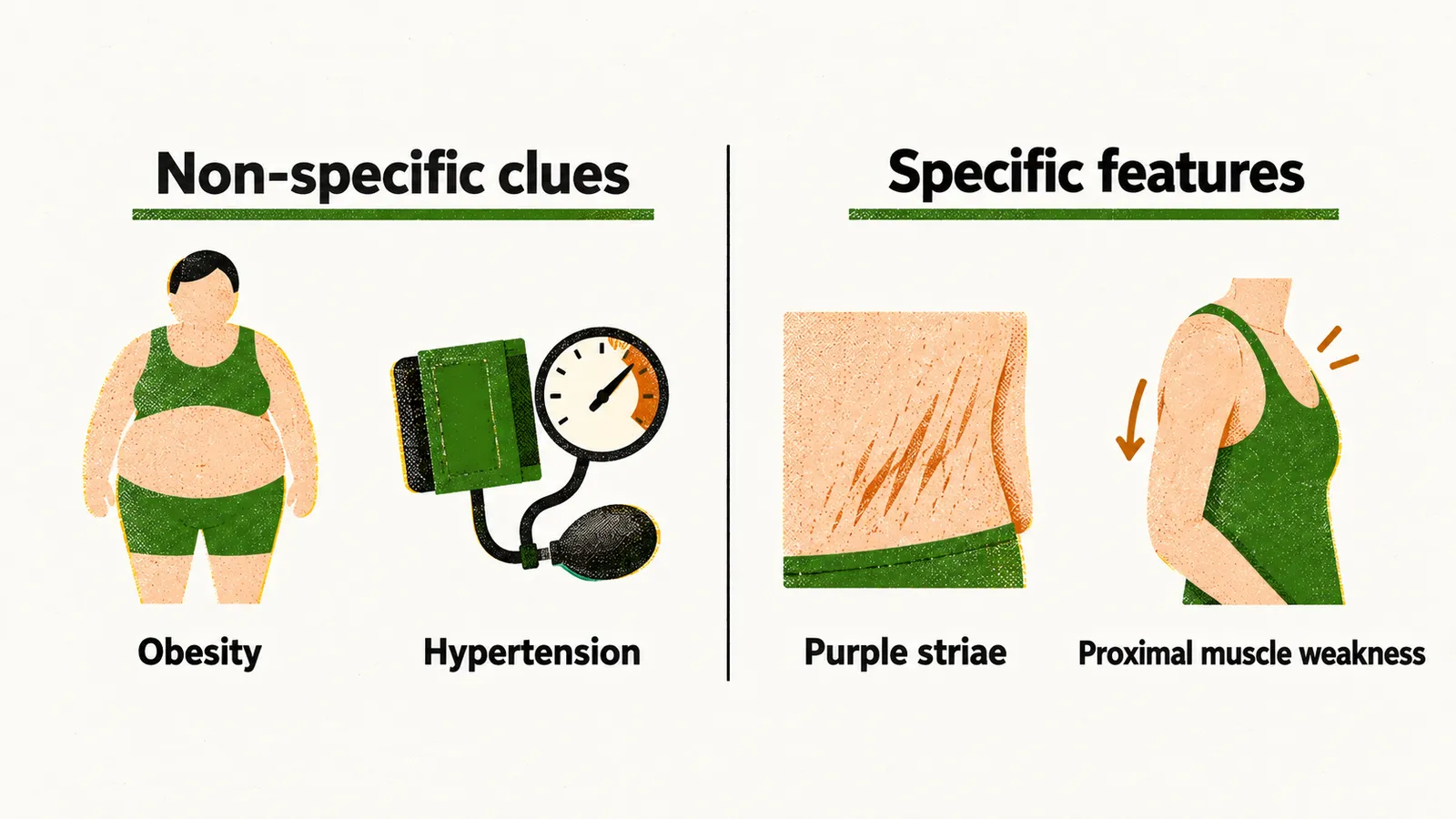
Besides the specific clinical manifestations of Cushing’s syndrome, there are some non-specific changes that are valuable clues to the diagnosis: obesity, irregular menstruation, and hypertension. Each is common in the general population, so on its own it only raises the question.
Specific clinical features
The specific changes seen in Cushing’s syndrome are truncal obesity, ecchymoses (easy bruising), plethora, proximal muscle weakness, and osteopenia. Together with the other features below, they are easiest to follow tissue by tissue: fat, skin, muscle, bone, and mood.
Fat deposition
One of the very first symptoms patients report is increased deposition of fat in the body, which is manifested as weight gain and an inability to control weight.
The filling of sites that are not normally filled with fat can be a good clue for the diagnosis of Cushing’s syndrome:
- the supraclavicular region, which is called buffalo hump
- the temporal fossa, which leads to instability of the position of the eye
- the epidural space, which can lead to neurological deficits
Skin and subcutaneous tissue
Another manifestation is loss of subcutaneous tissue, which can show itself as skin tenting.
Plethora is a red, flushed face. Facial plethora is common in patients who have loss of subcutaneous tissue. It may be under-diagnosed in patients with black skin, while exposure to wind and ultraviolet light can increase the erythema of the skin and cause over-diagnosis of plethora.
Purple striae wider than 1 cm are virtually pathognomonic of Cushing’s syndrome. The dermis thins because cortisol reduces collagen synthesis and increases collagen breakdown, so the skin becomes fragile and tears when it is stretched. Silvery striae and healing striae, however, are mostly seen due to obesity or in the postpartum period and are not related to Cushing’s syndrome. Striae can be seen in different regions such as the abdomen, buttocks, thigh, breast, and arm. The purple colour of the striae of Cushing’s syndrome does not depend on ACTH-dependent pigmentation, since it can also be seen in the primary adrenal causes.
Hirsutism is a possible symptom of Cushing’s syndrome. Vellus hypertrichosis, the presence of hair on the forehead and upper cheek of a woman’s face, could be a distinguishing symptom between Cushing’s syndrome and other common causes of hirsutism in women. The presence of acne is a sign of Cushing’s syndrome: mostly pustular acne is suggestive of androgenic acne, while papular acne is suggestive of glucocorticoid excess.
Muscle
Proximal muscle weakness with preservation of distal muscle strength is the hallmark of the diagnosis of Cushing’s syndrome. The weakness is proximal because glucocorticoid excess shifts muscle protein balance toward breakdown: it increases protein degradation and reduces protein synthesis, and the fast-twitch (type 2) fibres are preferentially affected. To assess proximal muscle weakness in patients with suspected Cushing’s syndrome, it is useful to ask whether there is any difficulty in climbing stairs or in getting up from the bed without using the hands, and to ask the patient to stand up from a chair without using the arms, which tests the hip flexor muscles. An inability to perform a squat manoeuvre could suggest Cushing’s syndrome, and also other myopathic disorders.
Bone
Osteopenia is a loss of bone mass, and a fracture could be the only sign of Cushing’s syndrome, especially in men; fractures of the foot, ribs, and vertebrae are the most common ones. Avascular necrosis of bone is a rare complication of iatrogenic hypercortisolism, mostly occurring at the hip bones.
Mood and behaviour
Most patients with Cushing’s syndrome experience psychological challenges such as irritability, which can be manifest as a decreased threshold for uncontrollable verbal outbursts and can be the very first symptom in these patients, as well as crying, fatigue, restlessness, depressed mood, decreased libido, insomnia, and anxiety.