
How body water is distributed
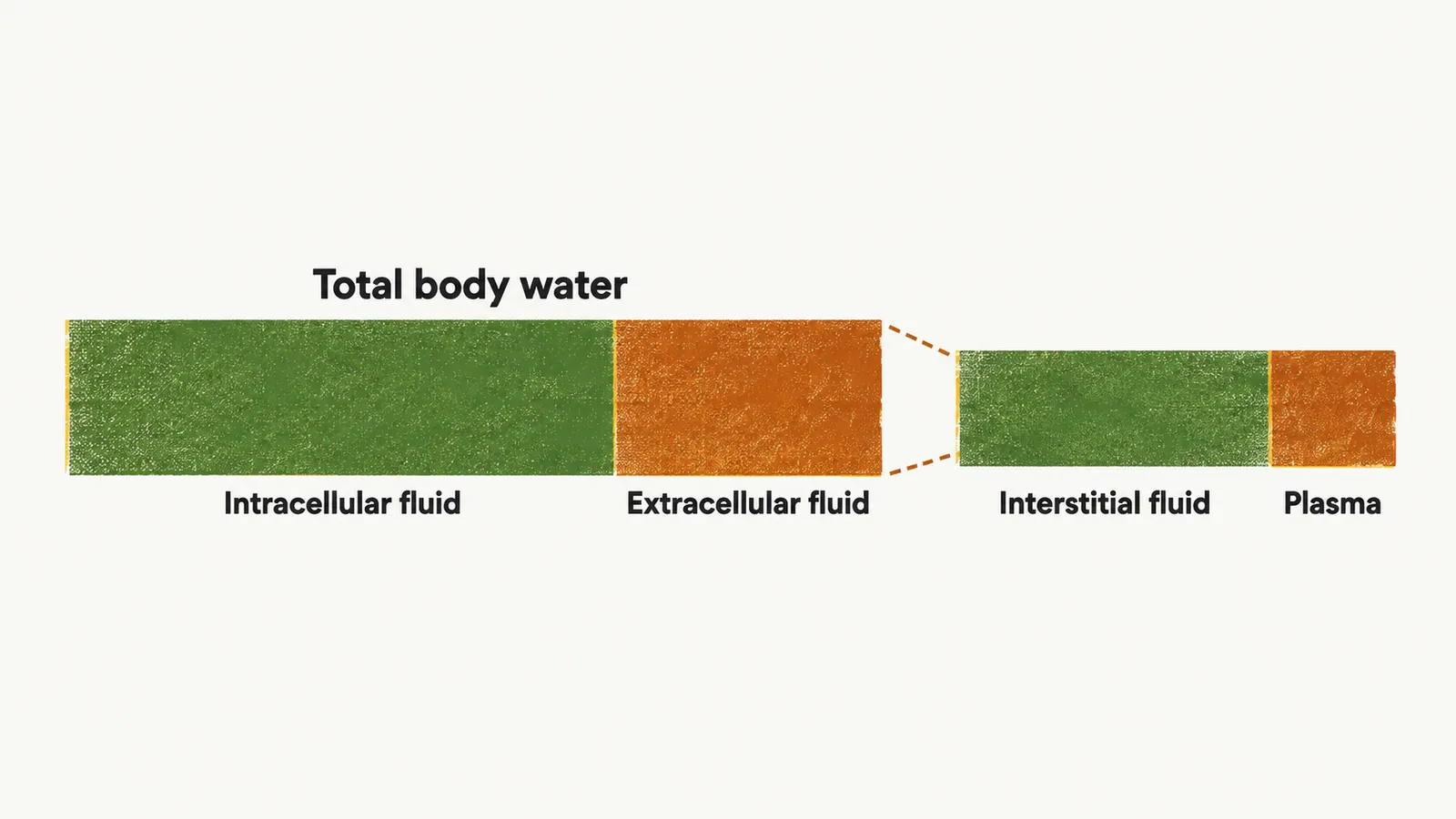
In a healthy adult man weighing 70 kg, total body water is about 60% of body weight, which is about 42 liters. That water is divided between two compartments. About two thirds, roughly 28 liters, lies inside the cells as the intracellular fluid (ICF). The remaining one third, roughly 14 liters, lies outside them as the extracellular fluid (ECF), the fluid that surrounds the cells.
The ECF is itself divided. About three quarters of it, roughly 10.5 liters, is interstitial fluid, the fluid between the cells, while the remaining quarter, roughly 3.5 liters, is the plasma, the fluid part of the blood.
The percentage of body weight that is water varies with age and sex, and with body composition. Muscle holds more water than fat, so the same body weight contains less water when fat mass is higher; this is why the total body water percentage is lower in obese individuals.
The electrolytes of the two compartments also differ. The main cation (positively charged ion) of the ECF is sodium, while in the ICF it is potassium, and the main anions (negatively charged ions) of the ECF are chloride and bicarbonate, while in the ICF they are phosphate and proteins.
Why ECF volume is not the same as tissue perfusion
The main harm of losing ECF is a fall in the perfusion of tissue, the flow of blood through it. This can happen by hypovolemia, in which water and sodium are lost together, or by hypernatremia, in which water is lost.
It would be natural to read the ECF volume as a measure of perfusion, but the two do not always move together. In cirrhosis, the ECF volume rises while tissue perfusion falls, because of the systemic vasodilation these patients develop. In heart failure, the ECF volume also rises while cardiac output is too low to perfuse the tissues properly.
To hold both of these facts together, the perfusion of tissue is described by a separate term, the effective intravascular volume: the part of the vascular volume that is actually perfusing tissue, which can fall even when the total ECF volume has risen.
Because sodium is the main cation of the ECF, the next question is what sets the plasma sodium concentration and how the body controls the amount of sodium the ECF holds.