
The general aim
Treating a sodium disorder means treating its cause and restoring the sodium concentration at a rate the brain can follow. The brain adapts to a changed sodium over about a day or more, and it needs a similar time to undo that adaptation. Correcting faster than the brain can adjust reverses the shift of water too quickly and injures it, and each direction has its own complication.
Treating hypernatremia
Treatment replaces the free-water deficit and corrects the underlying cause. Oral or enteral water is preferred when the patient can take it; otherwise hypotonic intravenous fluids are used.
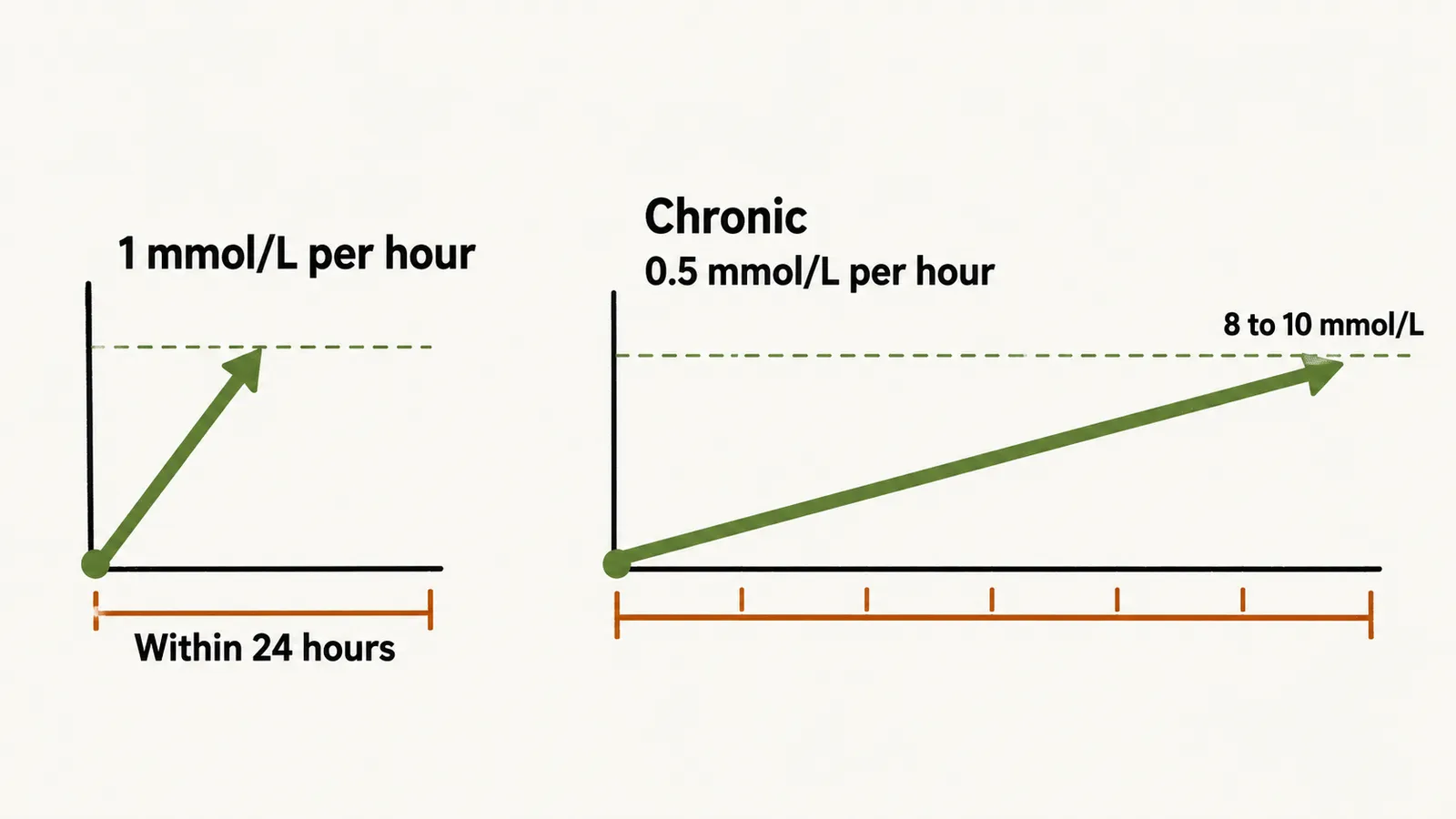
The safe rate depends on how long the hypernatremia has been present. If it developed within about 24 hours it can be corrected relatively quickly, up to about 1 mmol/L per hour. Hypernatremia that is chronic or of unknown duration must be corrected more slowly, no faster than 0.5 mmol/L per hour and no more than 8 to 10 mmol/L in 24 hours, because over time the brain cells have accumulated solutes that take days to disperse; lowering the sodium too fast lets water rush back into those cells and causes cerebral edema.
Treating hyponatremia
The choice of treatment follows the volume status and the severity of the symptoms.
- Hypovolemic hyponatremia is treated by restoring volume with isotonic (0.9%) saline.
- Euvolemic hyponatremia, most often SIADH, usually begins with fluid restriction, often to about 500 mL less than the daily urine volume, together with treatment of the cause.
- Hypervolemic hyponatremia is treated by treating the underlying heart failure, cirrhosis, or kidney injury, alongside sodium and fluid restriction and diuretics that remove the excess water.
Severe symptomatic hyponatremia — a reduced level of consciousness, seizures, or coma — is a medical emergency, because the brain swelling can progress to herniation and death. It is treated with hypertonic 3% saline given as small boluses, commonly 100 to 150 mL, repeated until the symptoms resolve; a rise of about 4 to 6 mmol/L is usually enough to relieve them.
After that, the sodium should rise by no more than 6 to 12 mmol/L in the first 24 hours and no more than 18 mmol/L in 48 hours. Correcting chronic hyponatremia too quickly can cause osmotic demyelination syndrome (ODS), a rare demyelinating brain injury; the risk is greater when the hyponatremia is chronic, and in patients who are malnourished or have alcoholism or liver disease.
Saline appears in these treatments, but in SIADH, where the urine is concentrated, the saline has to be judged against the urine rather than the plasma.