
Disorders of water balance
Hyponatremia and hypernatremia are disorders of water balance: the sodium concentration falls when the body holds too much water, and rises when it has lost too much. Hyponatremia is mostly caused by an excess of water in the body, and hypernatremia mostly by an excess of water loss from it.
Hyponatremia appears when water intake is higher than water excretion, and there are two main routes to it. The first is reduced water excretion by the kidney because of hypoperfusion of the kidney, which happens in cirrhosis and heart failure, where the effective intravascular volume is low despite a raised extracellular fluid volume. The second is SIADH, the syndrome of inappropriate antidiuretic hormone (ADH) secretion, in which ADH, the hormone that makes the kidney retain water, is released despite a low plasma osmolality; it is the most common cause of euvolemic hyponatremia, meaning hyponatremia with a normal volume of body fluid.
Hypernatremia appears when water loss is not matched by water intake. It mainly develops in patients who lack the thirst mechanism or lack access to water, because a working thirst and free access to water are what normally prevent it.
Disorders of sodium balance
Disorders of sodium balance are conditions in which water and sodium are lost together or retained together. Edema is the retention of water and sodium, which expands the extracellular fluid (ECF). Hypovolemia is the loss of sodium and water from the body. Depending on its severity it can lead to hypotension, or even shock and organ hypoperfusion. It arises from diarrhea, vomiting, diuretic therapy, bleeding, and the third-space sequestration of blood.
What happens to the osmolality of the ECF depends on the osmolality of the fluid that has been retained or lost, and that osmolality is set by the sodium and potassium the fluid contains. For hypovolemia, the final effect on the ECF osmolality depends on the osmolality of the fluid that has been lost. Here hyperosmolar, iso-osmolar and hypo-osmolar describe the lost fluid as more concentrated than, equal to, or more dilute than the body fluids:
- If the fluid lost is hyperosmolar, more solute than water is lost, so the body fluids become more dilute; this is a hypo-osmolar effect. It happens with diuretics such as thiazide, because the urine these drugs produce is hyperosmolar.
- If the fluid lost is iso-osmolar, the effect is iso-osmolar, as in bleeding.
- If the fluid lost is hypo-osmolar, relatively less solute is lost, so the body fluids become more concentrated; this is a hyper-osmolar effect. It happens in diarrhea, where the total osmolality of the sodium and potassium in the lost fluid is below that of body fluid.
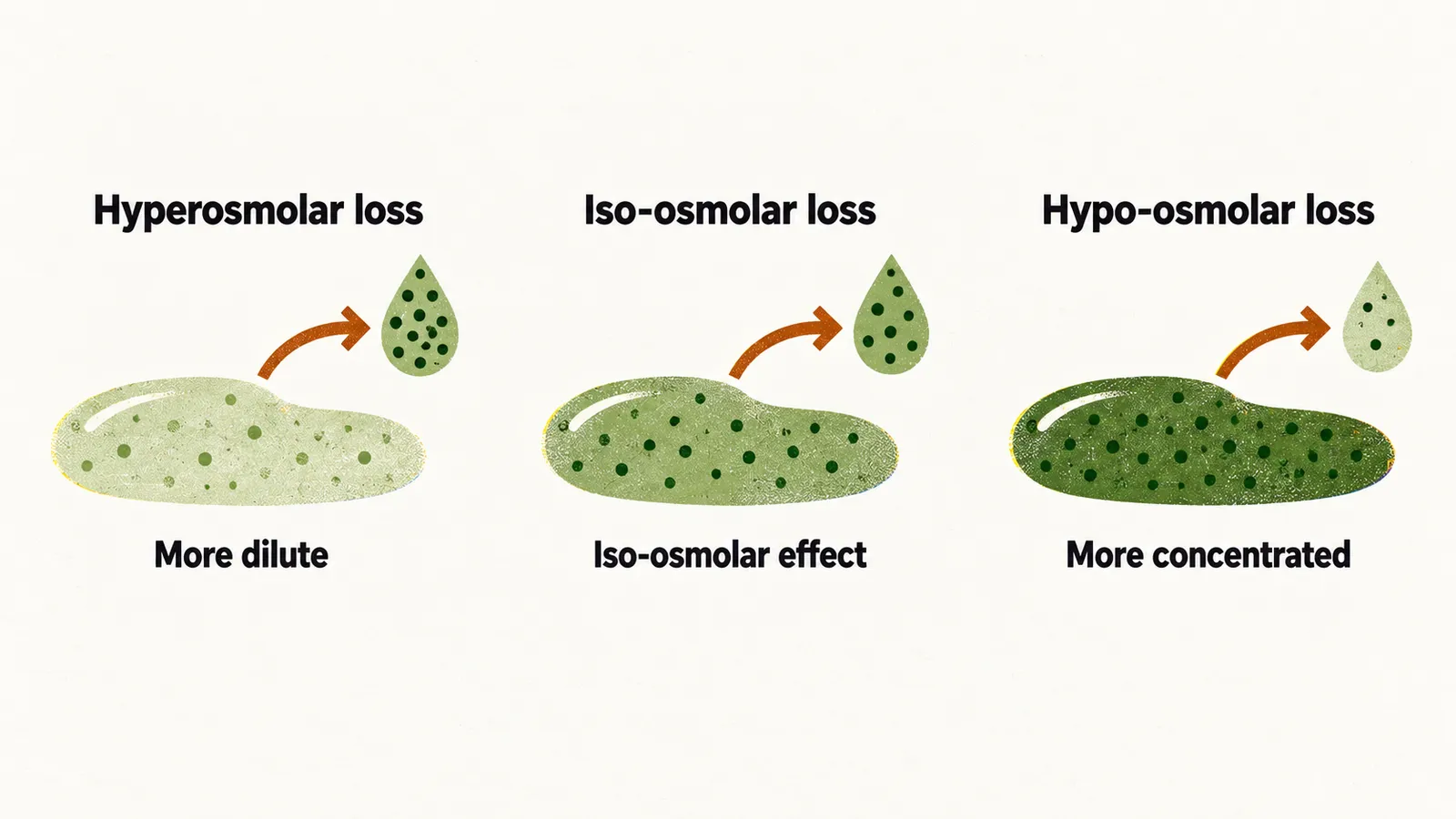
One caveat limits all of this. The effect of hypovolemia on the osmolality of the body fluids is not always predictable from the osmolality of the fluid that was lost, because in some patients frank hypotension follows the hypovolemia and activates ADH secretion, which retains water and produces hyponatremia regardless of the fluid that was lost.
Whichever way the osmolality of the body fluids shifts, the cells respond to it, and the brain cells are the ones that show it clinically.