
Saline judged against the blood, or against the urine?
SIADH, the syndrome of inappropriate antidiuretic hormone (ADH) secretion, is the most common cause of euvolemic hyponatremia, and it is the one condition in which the choice of saline follows a different rule. When a patient has an abnormal osmolality of the extracellular fluid (ECF), counter-osmolar saline is usually given with respect to the plasma, and this holds in almost every condition. In SIADH the saline has to be judged against the urine rather than the plasma.
A saline is hyperosmolar with respect to a fluid when its osmolality is higher than that fluid’s, and hypo-osmolar when it is lower. In SIADH there is excessive secretion of ADH, which produces hyponatremia and a concentrated urine. The urine osmolality is almost always higher than the plasma osmolality.
A saline that is hyperosmolar to plasma can still make things worse
The first example shows why the plasma is the wrong reference. Consider a patient with SIADH whose plasma osmolality is 120 and whose urine osmolality is 300. A saline with an osmolality below that of the urine, say 200, is infused as 1 liter. Because sodium excretion is intact, all the sodium in the saline is excreted into the urine. The sodium is excreted at the osmolality of the urine rather than that of the saline, so about 670 ml of the saline is excreted with all the sodium that corresponds to a urine osmolality of 300. The remaining 333 ml of water is not excreted. It stays in the plasma, and it worsens the hyponatremia. Even though this saline is hyperosmolar with respect to the plasma, it makes the condition worse, because it is hypo-osmolar with respect to the urine.
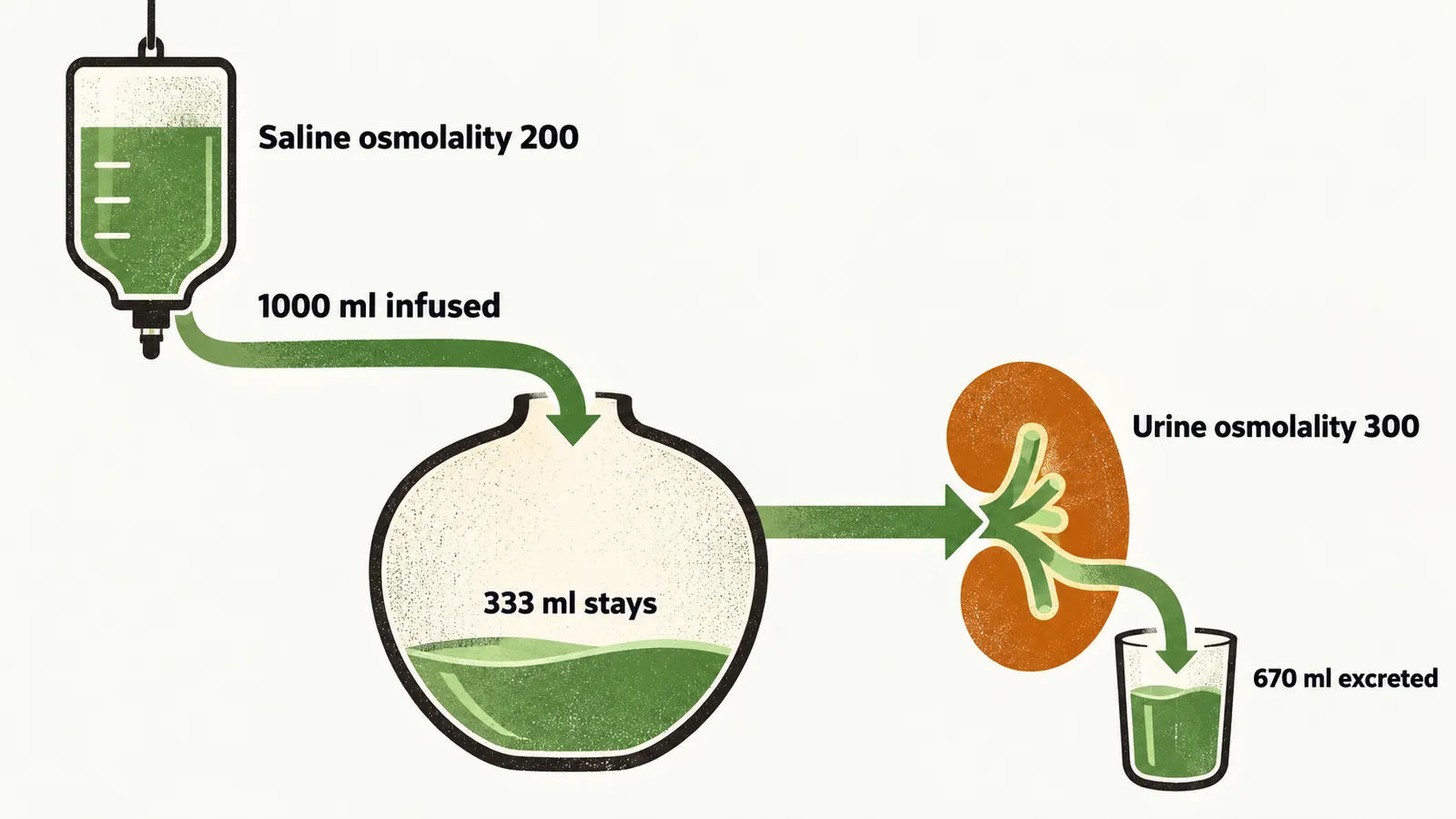
A saline hyperosmolar to the urine removes free water
The second example shows the other direction. Suppose 1000 ml of a saline with an osmolality of 600 is infused, which is hyperosmolar with respect to the urine as well. Sodium excretion is still intact, so all the sodium is again excreted, and the osmolality of the excreted fluid has to be brought down to the urine osmolality of 300. To bring 600 down to 300, the excreted volume must double. Not only is the 1000 ml of infused saline excreted, but a further 1000 ml of body water is drawn in with it to dilute the excreted fluid from 600 to 300. The ECF is therefore reduced, which is the intended effect.
So, in patients with SIADH, the saline that has to be chosen should be hyperosmolar with respect to the urine, and not the plasma.