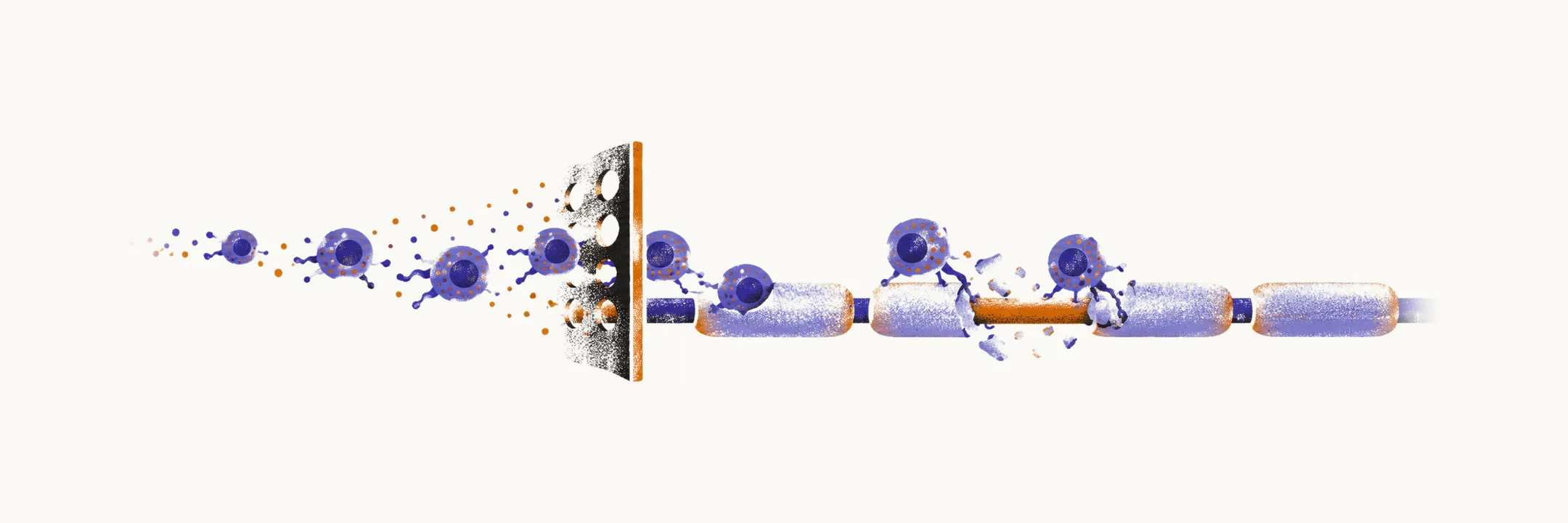
Multiple sclerosis (MS) is an inflammatory disease of the central nervous system in which the immune system damages normally formed myelin, the insulating sheath around axons (the long fibers of nerve cells), with secondary injury to the axons themselves. This definition separates MS from two lookalikes. In leukodystrophies, inherited disorders of white matter, myelin is built incorrectly from the start rather than destroyed after normal formation. In vascular, toxic, or compressive white matter injury, the trigger is not primary autoimmune demyelination. The phrase “primary and predominant damage of the myelin sheath, secondary to an inflammatory and autoimmune process” captures the distinction.
Epidemiology
MS preferentially affects young adults, with typical onset between 20 and 40 years and a median around 30. Roughly 5% of cases present before age 18 or after age 50. Women are affected about 3 times more often than men, and this female preponderance appears to be increasing. Worldwide, an estimated 2.8 million people live with MS. Geography also carries a signal.
Prevalence rises with distance from the equator: Italian figures report roughly 176 per 100,000 in continental Italy and Sicily, rising to about 299 per 100,000 in Sardinia. Migration studies narrow the timing. People who move from a high-risk to a low-risk region before about age 15 acquire the lower risk, while those who move later keep their original risk, which points to an environmental exposure acting in childhood or adolescence on a susceptible host.
Risk factors
Risk factors fall into those a person cannot change and those that can in principle be modified. Non-modifiable factors include age, sex, place of birth and residence, and genetics. The strongest single genetic association is with the HLA-DRB1*15:01 allele, a variant of a gene in the human leukocyte antigen (HLA) region, which helps present antigens to T cells. Beyond the HLA region, genome-wide studies have identified over 200 additional risk variants that together explain roughly half of the heritability (the share of risk attributable to inherited differences), so MS is polygenic rather than single-gene. About 11% of people with MS report a family history of MS, and recurrence risk in families rises with relatedness. About 9% report a family history of another autoimmune disease. The most frequent coexisting autoimmune conditions in the same individual are psoriasis, thyroid disorders, and inflammatory bowel disease, and a fraction of MS risk variants is shared with these conditions.
Modifiable factors include low vitamin D, low sun exposure, smoking (including passive smoking), adolescent obesity, night-shift work, low physical activity, organic solvent exposure, and Epstein-Barr virus infection. The Epstein-Barr association is strong: in a large longitudinal cohort of young adults, MS risk rose about 32-fold after Epstein-Barr seroconversion (the appearance of antibodies showing new infection), and nearly all individuals who later developed MS had seroconverted first. Smoking also interacts with genetic risk, multiplying it beyond either factor alone.
Pathogenesis: the outside-in model
The working model describes immune activation outside the nervous system that then moves inward. Self-reactive T cells (lymphocytes that recognize the body’s own antigens) expand in lymph nodes, differentiate into subsets including Th1 and Th17, recirculate in blood, and are reactivated near leptomeningeal vessels, the vessels of the membranes covering the brain. They cross the blood-brain barrier, the selective vascular barrier between blood and nervous tissue, where local antigen-presenting cells reactivate them again, amplifying inflammation that destroys myelin and injures axons.
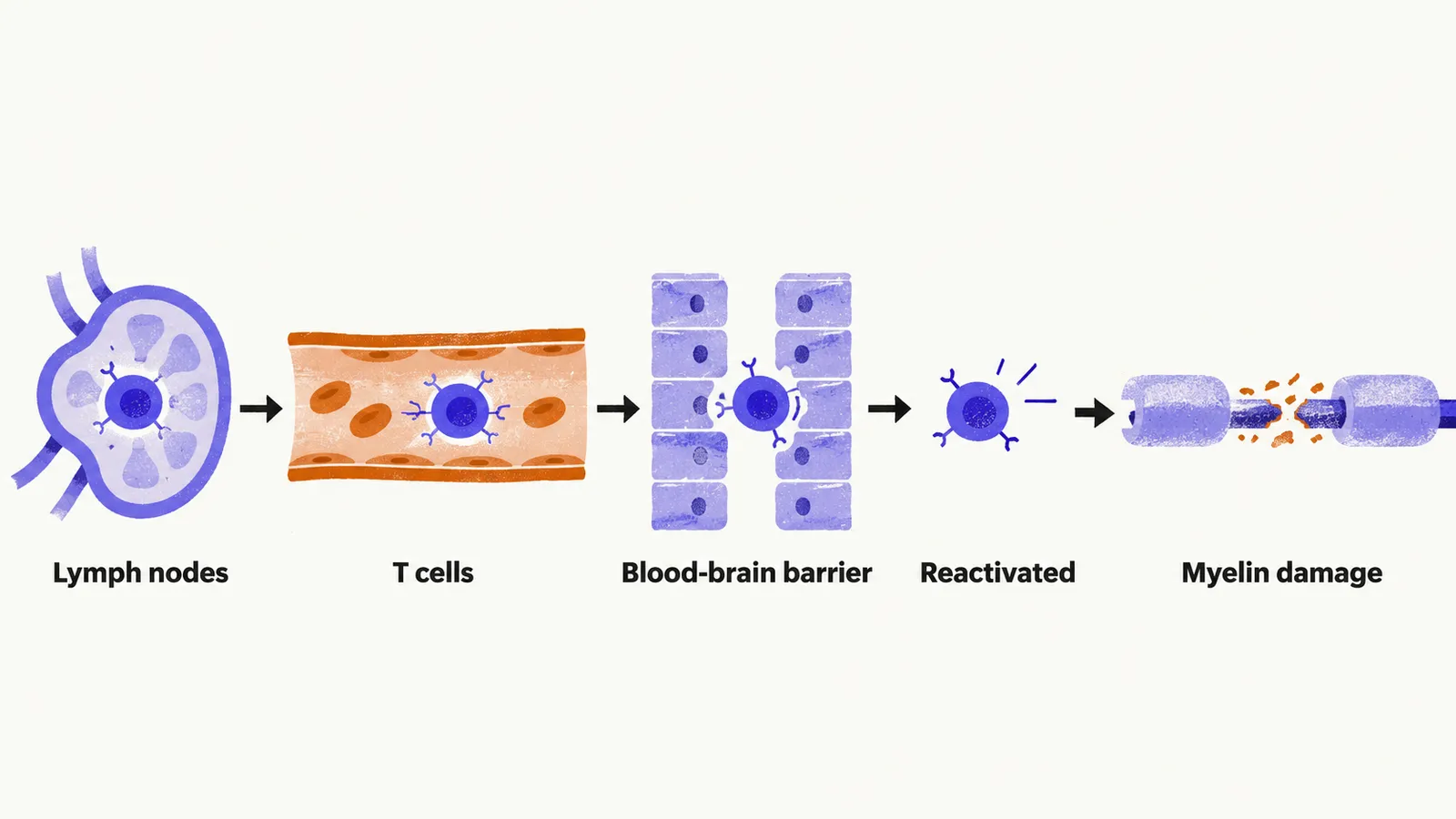
A neurodegenerative component runs in parallel. Chronic inflammation generates reactive oxygen species, glutamate excitotoxicity (neuronal injury from excess glutamate signaling), and sustained cytokine release that damage neurons and axons even outside visible plaques. Normal-appearing white matter frequently shows microglial activation (activation of the brain’s resident immune cells) and perivascular lymphocytic cuffing (lymphocytes clustered around small vessels), so the true disease burden extends beyond what conventional MRI displays. Neurodegeneration appears to begin before the first clinical episode, which is one reason early treatment is emphasized.
MS is heterogeneous rather than uniform. The spectrum runs from mild to aggressive disease and from relapsing-remitting to progressive courses, with different patterns of immune-mediated injury underlying different trajectories. What that injury looks like in tissue is the next question.