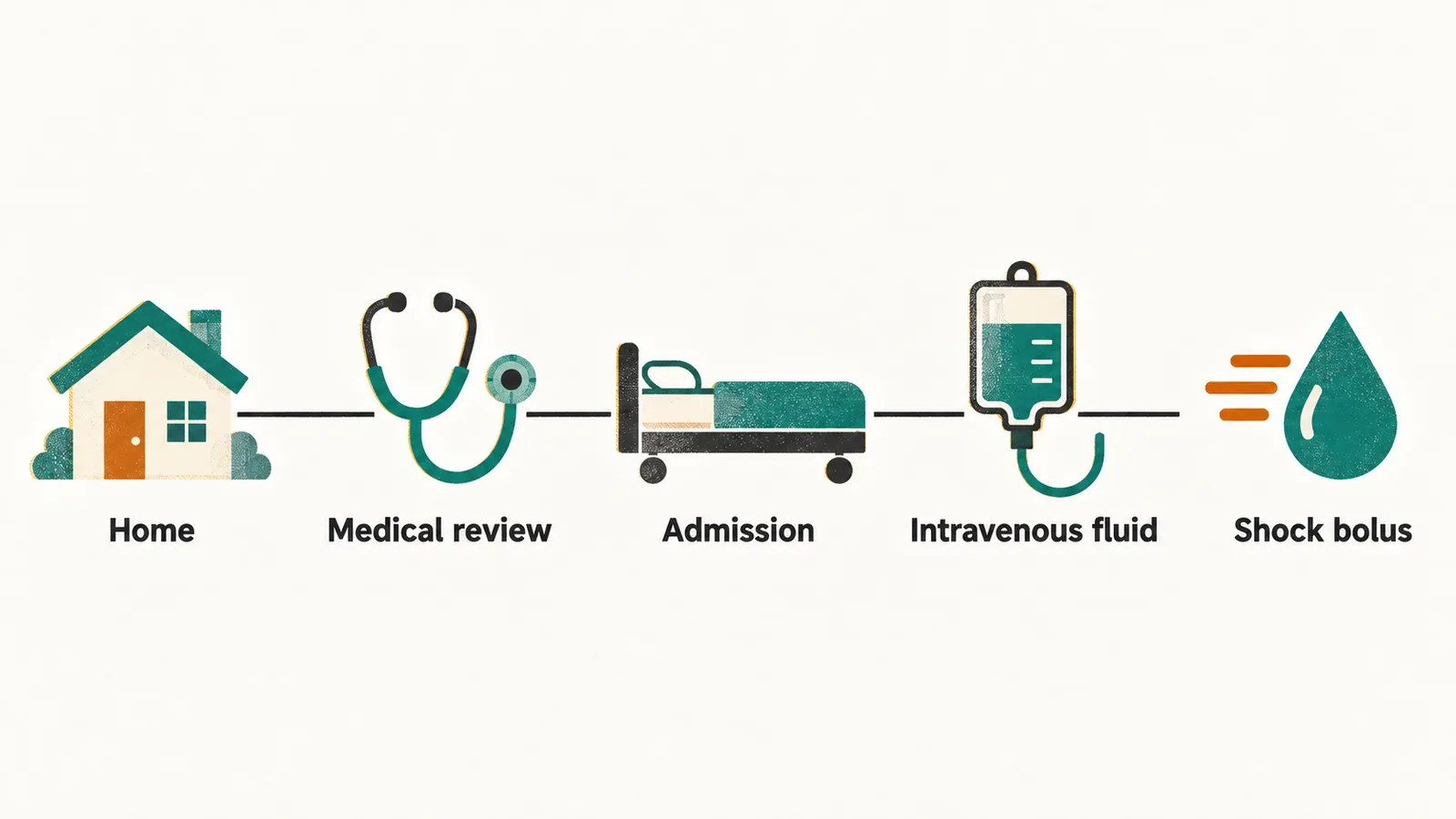
Most children with acute gastroenteritis are managed at home. Care escalates from there in steps — medical review, hospital admission, intravenous fluid — and each step has its own criteria. At the far end is shock, where the first minutes of treatment follow a set protocol.
When to seek medical review
The first step is deciding when a child being cared for at home needs to be seen. For infants and toddlers, the ESPGHAN/ESPID guideline — the 2014 European guideline on acute gastroenteritis in children, from the paediatric gastroenterology and infectious diseases societies — recommends referral for medical evaluation when any of the following is present:
- age under 2 months;
- a severe underlying disease such as diabetes or renal failure;
- persistent vomiting;
- high-output diarrhea with more than 8 episodes a day;
- family-reported signs of severe dehydration.
Each is a strong recommendation, made on low or very low quality evidence. Several of them — young age, frequent stools, repeated vomiting — also appear among the risk factors for severe dehydration.
When to admit
Hospital admission is the next step, and here the evidence is thinner. Admission decisions are consensus-based, and the guideline states plainly that there are no formally established admission criteria for acute gastroenteritis — case-controlled studies cannot be done for ethical reasons. The consensus list includes:
- shock;
- severe dehydration (more than 9% of body weight);
- neurological abnormalities such as lethargy or seizures;
- intractable or bilious (bile-stained) vomiting;
- failure of oral rehydration;
- a suspected surgical condition;
- conditions for safe follow-up and home management not met.
The last criterion is the one most often missed: a child with a modest deficit whose caregivers cannot reliably give oral rehydration solution at home is not a safe discharge. The guideline also records social and logistical concerns as a questionable indication for admission, so this criterion is a judgement call rather than a rule.
When intravenous fluid is required
The route of rehydration is chosen in steps as well. Oral rehydration is first-line. When oral intake is not feasible, enteral rehydration through a nasogastric tube — a tube passed through the nose into the stomach — should be proposed before intravenous rehydration: it has significantly fewer major adverse events and a shorter hospital stay, and it succeeds in most children. Rapid nasogastric rehydration — 40 to 50 mL/kg over 3 to 6 hours — is as effective as the standard 24-hour regimen.
Escalation to intravenous therapy therefore has its own list, again consensus-based:
- shock;
- dehydration with altered level of consciousness;
- severe acidosis;
- worsening dehydration, or lack of improvement despite oral or enteral rehydration;
- persistent vomiting despite appropriate fluid administration orally or via a nasogastric tube;
- severe abdominal distension and ileus, in which the bowel stops propelling its contents.
Recognising shock
Shock is the point at which intravascular volume has fallen far enough that tissue perfusion fails. It is recognised in stages:
- Compensated shock. Heart rate rises and peripheral vasoconstriction maintains blood pressure. The child is tachycardic with cool extremities and may look restless or agitated. Blood pressure is still normal.
- Worsening perfusion. Urine output falls, tachypnea appears, the level of consciousness changes, and the periphery stays cold and mottled.
- Decompensated shock. Blood pressure falls. Hypotension is a late sign in most types of pediatric shock, which is why a normal blood pressure does not exclude it.
A slow heart rate in a dehydrated, poorly perfused child is a peri-arrest finding rather than a reassuring one — pediatric resuscitation algorithms treat bradycardia with poor perfusion as impending arrest. Equally, tachycardia in a child with diarrhea is not specific: fever, pain and agitation all produce it, so it is read together with perfusion rather than on its own.
The shock bolus
Children presenting with shock secondary to acute gastroenteritis should receive a rapid intravenous infusion of an isotonic crystalloid — 0.9% saline or lactated Ringer’s solution — as a 20 mL/kg bolus. A crystalloid is a solution of salts in water, and an isotonic one matches the concentration of plasma. If blood pressure has not improved after the first bolus, a second, or even a third, bolus of 20 mL/kg should be given over 10 to 15 minutes, and other possible causes of shock should be considered. This is a strong recommendation on very low quality evidence.
Three details carry the clinical weight:
- Isotonic, not glucose-containing. The aim is intravascular volume expansion, and both fluids named above serve that aim.
- Genuinely rapid. Ten to fifteen minutes is the stated window. A slow infusion does not achieve the same preload effect, the filling of the heart that the bolus is meant to restore.
- Beyond three boluses, reconsider the diagnosis. In a child with diarrhea and vomiting the cause is usually hypovolemic, but failure to respond should prompt a search for septic, cardiogenic, anaphylactic, adrenal or obstructive causes.
What the bolus does not do
The bolus is resuscitation, not restoration. It does not replace the full fluid deficit, does not replace ongoing stool and vomit losses, does not correct electrolyte or acid-base abnormalities, and does not treat the underlying infection. Each of those is handled in the phases that follow, set out in Rehydration Management in Acute Diarrhea. The severity grade and sodium pattern that decide those phases come from Clinical Assessment of Acute Diarrhea and Dehydration.