
Rehydration management means replacing the water and salts a child with acute diarrhea has lost, and continuing to replace them while the illness runs its course. It starts from two findings of the bedside assessment: the severity of dehydration — no or minimal, mild-to-moderate, or severe — and the serum sodium. Once the child is out of shock, management becomes arithmetic. Three separate volumes have to be estimated, each with its own time window, and the serum sodium decides how fast one of them may be given.
Route comes before arithmetic
Oral rehydration is the treatment of choice and should start as soon as possible; it is superior to intravenous rehydration. When oral intake is not feasible, nasogastric rehydration, through a tube passed through the nose into the stomach, comes next, and intravenous therapy is reserved for the situations listed in Admission and Shock Management in Acute Diarrhea.
The route does not change what has to be calculated. A child managed enterally (through the gut, by mouth or nasogastric tube) never has an intravenous phase at all — the same three volumes still have to be worked out; they are simply delivered by a different route.
The three volumes
The three volumes answer different questions: what was lost, what is needed to keep going, and what is being lost right now.
The deficit
The deficit is what has already been lost, and it is estimated from weight loss. A child who weighed 8 kg before the illness and weighs 7.5 kg now has lost 500 g, and 500 mL of fluid has to be replaced:
deficit in mL = percentage lost × weight in kg × 10
A 5% deficit in a 10 kg child is 5 × 10 × 10 = 500 mL; a 9% deficit in the same child is 900 mL. When the pre-illness weight is unknown — which is common — the deficit is estimated from the clinical severity grade instead, with reassessment during the replacement period rather than blind adherence to a calculated figure.
Maintenance
Maintenance is the fluid a child needs each day regardless of the illness. Daily maintenance follows the standard weight-banded scheme:
| Weight | Daily maintenance |
|---|---|
| First 10 kg | 100 mL/kg |
| Next 10 kg | 1000 mL + 50 mL/kg for each kg above 10 |
| Each kg above 20 | 1500 mL + 20 mL/kg for each kg above 20 |
An 8 kg child therefore needs 800 mL a day, a 12 kg child 1100 mL, and a 25 kg child 1600 mL, spread over 24 hours.
Ongoing losses
Stool and vomit losses continue while the deficit is being replaced, and they are replaced as they occur rather than predicted. Oral rehydration solution — a measured solution of salts and glucose — of roughly 10 mL/kg, up to 240 mL, after each diarrheal stool is the conventional figure. Fever raises insensible loss, so fluid needs rise with it, but there is no single validated multiplier for that.
The three volumes are added rather than merged. Their time windows, not their sum, determine the prescription.
The four phases
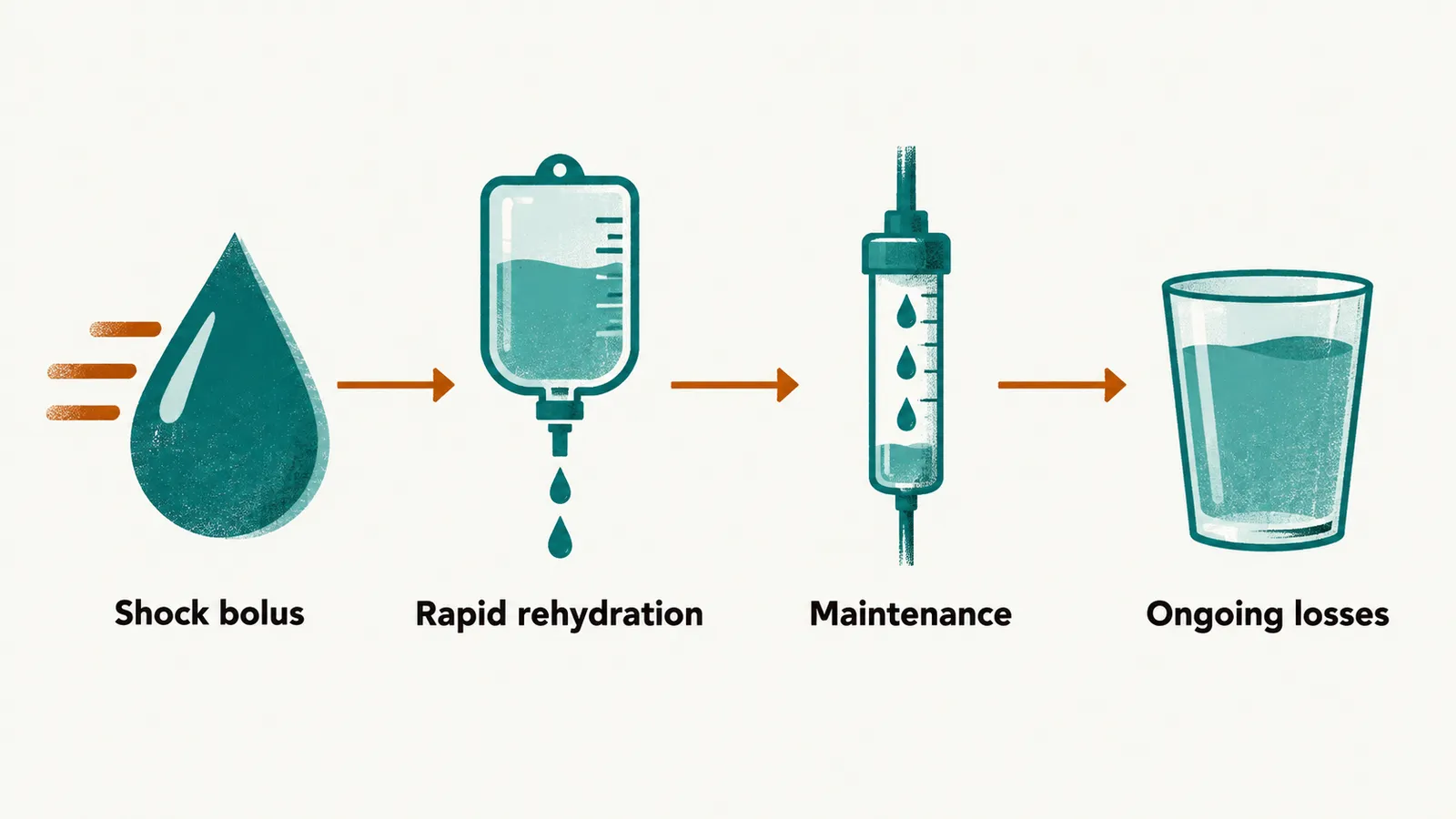
Placed in time order, the volumes become phases of treatment, and a child in shock has a resuscitation bolus in front of them:
| Phase | Goal | Timing | Solution |
|---|---|---|---|
| Shock bolus, 1–3 doses | Restore intravascular volume | 10–15 minutes each | 0.9% saline or lactated Ringer’s, 20 mL/kg |
| Rapid rehydration | Replace the deficit already lost | About 20 mL/kg/h for 2–4 hours | 0.9% saline |
| Maintenance | Cover normal daily needs | 24 hours | Dextrose-containing solution once volume is restored |
| Ongoing losses | Replace continuing stool and vomit | After each episode | Oral rehydration solution where the child can drink |
A child who is not in shock has no bolus phase.
Worked example
An 8 kg child with a clinical picture consistent with a 5% deficit:
- Deficit: 5% × 8 × 10 = 400 mL, replaced during the rapid phase.
- Maintenance: 100 × 8 = 800 mL over 24 hours, about 33 mL/h if given continuously.
- Ongoing losses: about 10 mL/kg of oral rehydration solution after each stool.
The first-day target is the deficit plus maintenance — here roughly 1200 mL — with ongoing losses added on top and replaced as they occur. If the child can drink, oral solution given in divided amounts over the replacement window is preferred; if vomiting prevents it, the same volumes are given intravenously, following the composition rules for intravenous solutions.
Oral rehydration solution
Reduced-osmolarity oral rehydration solution — less concentrated than the original full-strength formula — with sodium of 50 to 60 mmol/L, should be used as first-line therapy, a strong recommendation on moderate-quality evidence. It is more effective than full-strength solution as measured by stool output, vomiting and the need for supplemental intravenous therapy, and the ESPGHAN solution, named after the European Society for Paediatric Gastroenterology, Hepatology and Nutrition, may be used in children with acute gastroenteritis.
The reason the composition matters is the sodium-glucose cotransporter in the small intestine: sodium and glucose are carried across together, and water follows osmotically. Change the ratio and the transport loses efficiency. This is also why beverages with a high sugar content should not be used — a strong recommendation — because excess unabsorbed sugar adds to the osmotic load rather than relieving it.
Intravenous solutions
Isotonic 0.9% saline — a salt solution matched in concentration to plasma — effectively reduces the risk of hyponatremia and is recommended for initial rehydration in most cases. Lactated Ringer’s solution is recommended in the rare but extremely severe cases of shock. There is no standard intravenous composition for acute gastroenteritis, and most reported schemes rest on historical recommendation rather than trial evidence.
Once fluid volume has been restored, glucose may be added to the saline solution for the maintenance phase — this is a weak recommendation on low-quality evidence, and it marks the boundary between replacing volume and sustaining metabolism. Two further composition rules apply during the first 24 hours of intravenous therapy: the solution should contain not less than 0.45% saline (at least 77 mEq/L sodium) to prevent hyponatremia, and once the child is passing urine and electrolytes are known, 20 mEq/L potassium chloride may be added.
Schemes more rapid than the regimen described above are not recommended: they are associated with electrolyte abnormalities and with longer time to hospital discharge, and ultrarapid schemes are not superior to standard ones and may raise readmission rates.
Correcting sodium safely
Hypernatremic dehydration, a serum sodium above 145 mmol/L, is uncommon in acute gastroenteritis and is treated more cautiously than the rest. If intravenous therapy is needed, an isotonic solution is used for both deficit replacement and maintenance, and the deficit is replaced slowly, typically over 48 hours, aiming to bring the serum sodium down by less than 0.5 mmol/L per hour, with frequent monitoring of plasma sodium.
That hourly ceiling is the whole safety rule expressed in the units a monitor displays; over a day it corresponds to no more than 12 mmol/L. Correcting faster risks shifting water into brain cells faster than the brain can adapt. Oral or nasogastric rehydration with hypoosmolar solution, one less concentrated than plasma, is effective and safe in hypernatremia and has fewer adverse effects than intravenous rehydration, so the caution applies chiefly to the intravenous route.
Sodium also matters in the opposite direction, which is one reason isotonic rather than hypotonic fluid is used to start. Sodium is measured in every child on intravenous therapy precisely because hyper- and hyponatremia alter the rate at which fluid is given.
Switching back to oral
Enteral and oral routes should be resumed as soon as the indications for parenteral therapy are gone. Ongoing losses are then replaced orally, and the child is fed again; when feeding starts, what it contains, and whether any drug adds to rehydration are set out in Refeeding and Drug Therapy in Acute Diarrhea.