Pediatric oncohematology is the part of pediatrics that deals with cancers of the blood and lymphoid system in children and adolescents. Childhood cancer is not adult cancer on a smaller scale: these tumors are more often embryonal (built from immature precursor cells rather than from mature tissue), they arise from different cell populations, they carry different recurrent genetic lesions, and they respond to treatment that adults tolerate far less well.
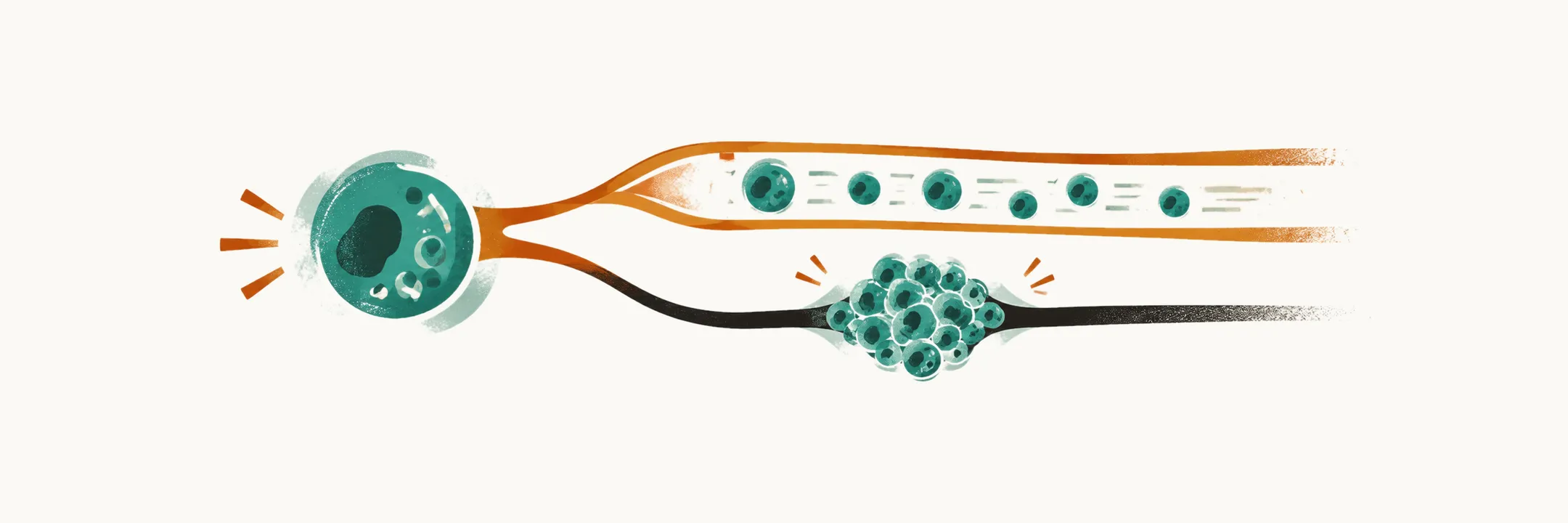
Two disease families carry most of the teaching in the subject, and they are opposites. Leukemia is a clonal disease of the bone marrow — its cells all descend from one transformed cell — in which immature precursor cells called blasts multiply and displace normal blood-cell production. The embryonal solid tumors form the other family, and neuroblastoma, a tumor of the developing sympathetic nervous system, is the clearest example in early childhood.
The family
Leukemia takes up most of the subject, and its commonest form in children, acute lymphoblastic leukemia (ALL), takes up most of leukemia. The leukemia notes therefore start with the disease itself, follow the treatment of ALL to what it leaves behind and to the newer agents designed to reduce that burden, and end with the myeloid leukemias:
- Leukemia in Children: Definitions, Presentation, Diagnosis, and Prognosis — what leukemia is, how the acute leukemias are classified, why the presenting signs come from the marrow, how the diagnostic workup is built, and why the prognosis is so much better than in adults.
- Treating Childhood ALL — the BFM Backbone, Risk Stratification, and Measurable Residual Disease — the four phases of the standard Berlin-Frankfurt-Münster (BFM) chemotherapy backbone, how risk groups are assigned, what measurable residual disease (leukemia still detectable below the level microscopy can see) measures, and what the current protocol generation is trying to change.
- Late Effects of Childhood ALL Therapy — the four drug-class associations that appear years after treatment, how common they are, and why survivorship is clinical care rather than a follow-up appointment.
- Novel Therapies in Childhood ALL — why blinatumomab, CAR-T cells and bortezomib were introduced, how each works, and what their shared side-effect profile reveals about redirecting the immune system against leukemia.
- Childhood Acute Myeloid Leukemia — how acute myeloid leukemia (AML) is told apart from ALL, the AML treatment backbone, and why Down syndrome changes the treatment a child can be given.
- Acute Promyelocytic Leukemia in Children — the subtype defined by a single fusion protein, the product of two genes joined by a chromosomal translocation, treated by making the leukemic cells mature, and dangerous through bleeding before treatment starts.
Neuroblastoma stands outside that sequence, because it is a solid tumor with a biology of its own:
- Neuroblastoma — the embryonal sympathetic-nervous-system tumor, its age-dependent behavior, the MYCN oncogene, the staging systems, and the clinical signs that point to the diagnosis.
Both families, and their treatment, can also produce acute complications that become life-threatening within hours:
- Oncologic Emergencies in Children — tumor lysis syndrome, leukostasis, mediastinal mass compression, spinal cord compression, the coagulopathy of acute promyelocytic leukemia, and febrile neutropenia.
Where to start
If the subject is new to you, start with leukemia in children: it establishes the vocabulary — acute versus chronic, lymphoblastic versus myeloid, blasts and marrow failure — that every other leukemia note assumes. The leukemia strand then reads in order, from the treatment backbone and what it leaves behind, through the newer agents that are displacing part of it, to AML and to acute promyelocytic leukemia, which is treated by a different logic altogether. Neuroblastoma depends on none of that and can be read at any point. The emergencies note works as a destination rather than a starting point: it gathers the acute complications that any of these diseases can produce.
Where this family stops
Leukemia and neuroblastoma are the core of the subject, but they are only part of pediatric oncology. Pediatric lymphoma, although a cancer of the lymphoid system, is not covered here, and neither are the other solid tumors of childhood: Wilms tumor and other renal tumors, retinoblastoma, bone and soft tissue sarcomas, and the pediatric brain tumors. Each has its own diagnostic pathway and treatment framework. The non-malignant blood disorders that present with similar findings — iron-deficiency and other anemias, thalassemia, sickle cell disease, immune thrombocytopenia, bone marrow failure syndromes — are also left out, as is the general supportive and palliative care framework, including transfusion practice for immunocompromised children.