
Childhood acute lymphoblastic leukemia (ALL) is a cancer of immature lymphoid precursor cells; when those precursors belong to the B-cell lineage it is called B-ALL. It is treated with a conventional chemotherapy backbone — a fixed sequence of combination-chemotherapy phases lasting about 2 years. That backbone cures most children, but it does so at a cost measured in osteonecrosis, cardiomyopathy, secondary malignancy and thrombosis — the late effects that survivors carry for decades. Blinatumomab, CAR-T cells and bortezomib exist for a specific reason: to replace part of the cytotoxic backbone with something that kills the leukemic clone by a different mechanism, so that cumulative exposure to anthracyclines, alkylating agents and corticosteroids can come down without giving up on the cure rate.
Most of these agents work by recruiting the immune system rather than by damaging DNA or interfering with cell division, and the side effects they produce are mostly consequences of that recruitment. Two of them, blinatumomab and CAR-T cells, redirect the patient’s T cells against the leukemia; bortezomib is the exception, acting on the leukemic cell directly.
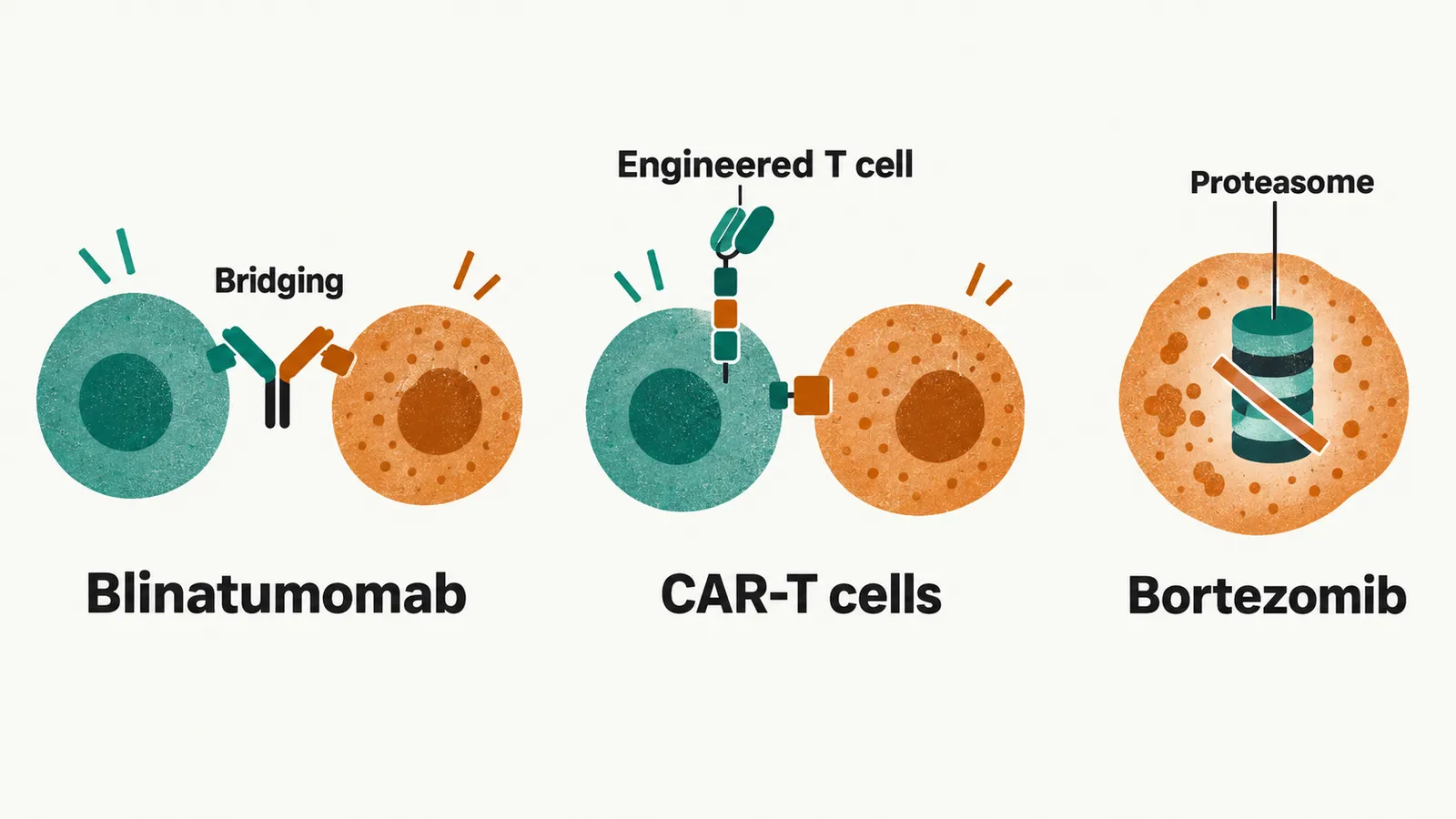
Blinatumomab — the bispecific T-cell engager
Blinatumomab is an engineered antibody construct built from two single-chain variable fragments — the antigen-binding parts of two different antibodies, each reduced to a single protein chain — joined by a flexible linker. One arm binds CD3 on a T cell; the other binds CD19 on the leukemic cell.
Why CD19 is the target. It appears from early B-cell precursors onward and is present on the great majority of B-ALL blasts. It is a lineage marker rather than a tumor-specific one, which is also why normal B cells are affected.
Why bringing the two arms together is enough. Normally a T cell recognizes a tumor only when its receptor sees a tumor peptide presented on an MHC class I molecule. Bridging a T cell to a tumor cell triggers killing without that step: the T cell does not need to recognize a presented peptide, its receptor specificity is bypassed, and MHC class I presentation is not required. That is the immunological point of the design.
Pharmacology follows from the structure. The construct has no Fc portion — the constant tail of a normal antibody — and therefore no Fc-receptor–mediated recycling, so its half-life is short, a matter of hours. It is given as a continuous infusion, in 28-day cycles, with the dose escalated in a step-up phase at the start of a cycle to limit early reactions. In the high-risk arm of the AIEOP-BFM ALL 2017 treatment protocol the drug is given at 15 µg/m²/day by continuous infusion over 28 days.
Side effects. Blinatumomab shares the profile of the whole class of redirected T-cell immunotherapies:
| Category | What it looks like |
|---|---|
| Cytokine release syndrome | Fever, hypotension, hypoxia and capillary leak from cytokines released by activated lymphocytes. Managed with supportive care, and with tocilizumab (an anti-interleukin-6-receptor antibody) or corticosteroids for severe cases. |
| Neurotoxicity | Encephalopathy, confusion, speech disturbance, tremor, seizures. Graded through the immune effector cell-associated neurotoxicity syndrome (ICANS) framework. |
| Liver derangement | Transaminase and bilirubin elevation, which can require treatment interruption. |
| Hypogammaglobulinemia | Loss of normal B cells alongside the leukemic clone, with low immunoglobulin and increased infection risk; may need immunoglobulin replacement. |
What the four have in common is that they follow from the mechanism rather than from an idiosyncratic drug reaction: three reflect an immune system switched on more strongly than intended, and the fourth reflects the target being a lineage marker rather than a tumor-specific one.
CAR-T cells
Chimeric antigen receptor (CAR) T-cell therapy takes redirected immunity one step further: instead of a bridging drug, the T cell itself is engineered.
The process is autologous — it uses the patient’s own cells — and takes weeks. T cells are collected from the patient, transduced with a viral vector carrying the CAR gene, expanded outside the body, and reinfused after lymphodepleting chemotherapy, which empties the niche the infused cells need to expand into.
The receptor has three functional parts worth being able to name:
- an extracellular antigen-binding domain, usually a single-chain variable fragment (scFv) derived from an antibody — for B-ALL, almost always anti-CD19;
- a transmembrane region anchoring it in the membrane;
- an intracellular signaling domain, typically CD3ζ to provide the activation signal, plus one or more costimulatory domains (CD28 or 4-1BB). The costimulatory domain is the defining addition of second- and third-generation constructs; without it, cells do not persist or expand well in the patient.
Like a bispecific engager, a CAR bypasses MHC presentation. Unlike one, the effect is cellular and self-renewing: it persists as long as the engineered T cells survive, which is months to years, whereas an engager works only while the infusion runs.
Clinical status. Tisagenlecleucel was the first CAR-T product approved for pediatric B-ALL — anti-CD19, for children and young adults up to 25 years with B-cell precursor ALL that is refractory or in second or later relapse. The pivotal trial (ELIANA) reported high remission rates in a population that had exhausted conventional options. Since then, CAR-T has moved earlier in treatment for some high-risk and poor-response children, and the field is now testing it against intensive chemotherapy rather than only in the relapsed setting.
Side effects. Cytokine release syndrome and neurotoxicity (ICANS) are the same problems as with blinatumomab, and are managed the same way. Two additions are specific to the persistence of the engineered cells:
- B-cell aplasia with hypogammaglobulinemia is expected rather than incidental, because CD19 is on normal B cells as well. It can last for months to years while the CAR-T cells survive, and requires immunoglobulin replacement.
- Secondary T-cell malignancy from insertional mutagenesis — disruption of the cell’s own genes where the vector inserts into its DNA — is rare but has been reported following CD19- and BCMA-directed (B-cell maturation antigen) CAR-T products. After an FDA safety review in late 2023, regulators required a class-wide boxed warning for these products in January 2024 — a reminder that permanent genetic modification carries a long-term risk that a bridging antibody does not.
Bortezomib — proteasome inhibition
Bortezomib pursues the same goal as the immunotherapies, a different way of killing the clone, but without recruiting any immune cell: it acts inside the leukemic cell. It is a proteasome inhibitor, developed and approved for multiple myeloma and used in ALL off-label, usually in relapsed or refractory disease or within a trial combination.
Mechanism. The 26S proteasome is the cell’s machinery for degrading regulatory proteins, among them cyclins, cell-cycle checkpoint proteins, and IκB, the inhibitor of NF-κB (a transcription factor that drives a survival program). Inhibiting degradation lets these proteins accumulate; cells lose the ability to progress through the cell cycle and to sustain the NF-κB-driven survival program.
Why it is used in ALL. In vitro, bortezomib is synergistic with dexamethasone against ALL cell lines and additive with cytarabine, vincristine, doxorubicin and PEG-asparaginase. The hypothesis is sensitization: adding bortezomib to chemotherapy may deepen the remission in disease that responds poorly to the standard backbone. Whether the synergy seen in the laboratory translates into better event-free survival in children remains a trial question.
Side effects. The principal side effect is neurotoxicity, specifically peripheral, dose-limiting and cumulative neuropathy; the subcutaneous formulation produces less of it than the intravenous one, so route and dose reduction are the standard mitigations.
A parallel route: antibody-drug conjugates
Bortezomib and the immunotherapies are not the only ways to spare the backbone. An antibody can also be used as a carrier: conjugating a cytotoxic drug to an antibody against a B-lineage surface antigen delivers a selective hit to the cells that carry that antigen. Inotuzumab ozogamicin, which targets CD22, is used in relapsed B-cell ALL along these lines. It is not the same as redirecting T cells — there is no immune effector involved — but it belongs to the same movement away from blanket cytotoxic exposure.
Conjugation is not confined to the lymphoid lineage either: gemtuzumab ozogamicin carries its payload to CD33 on myeloid blasts. Acute myeloid leukemia is nevertheless a different disease, with a backbone of its own and a biology that decides intensity in a different way.