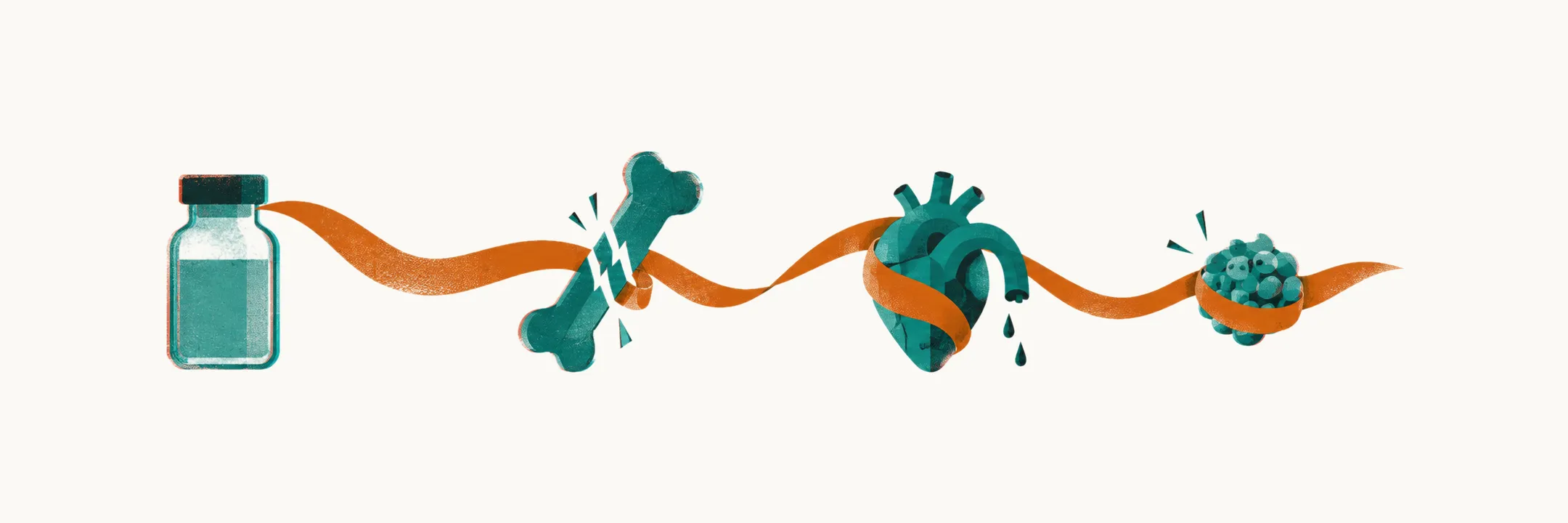
Childhood acute lymphoblastic leukemia (ALL) is treated with cure as the goal, and contemporary protocols reach it in most children. The treatment itself leaves a mark that outlasts the therapy. Late effects are health problems caused by cancer treatment that appear months to years after it ends. They are not complications of the leukemia, and they do not follow the same timetable as the treatment: a child who finishes chemotherapy at 6 years of age may meet them in adolescence or in adult life.
Why survivors differ from one another
Which late effects a person faces depends less on the diagnosis than on the exposure. The drugs used, the cumulative dose of each, whether the brain or chest was irradiated, and whether the disease relapsed or needed a stem cell transplant all change the profile. Follow-up after childhood ALL is therefore organized around the treatment the child actually received, and it continues for life rather than ending when the chemotherapy stops.
Four drug-class associations stand out.
| Drug class | Late effect |
|---|---|
| Corticosteroids (dexamethasone, prednisone) | Osteonecrosis (avascular necrosis), especially of the hip and knee. Risk is strongly age-dependent: uncommon in young children and much higher from about age 10 years, with adolescents the highest-risk group and females at additional risk. |
| Anthracyclines (doxorubicin, daunorubicin) | Dilated cardiomyopathy, dose-dependent, with risk rising as cumulative dose rises. Survivors need long-term echocardiographic surveillance rather than a single end-of-treatment scan. |
| Alkylating agents (cyclophosphamide, ifosfamide) | Secondary malignancy, particularly myeloid, and gonadal dysfunction. |
| Asparaginase | Pancreatitis and thrombosis, including sinus venous, cerebral and peripheral events, during and shortly after treatment. |
Cranial irradiation, where it is still used, adds neurocognitive, endocrine and second-tumor risk to the list.
How common late effects are
A chronic health problem is common rather than exceptional among long-term survivors. In the Childhood Cancer Survivor Study, the 25-year cumulative incidence of a severe, life-threatening or fatal condition after childhood ALL was about 21% for children treated in the 1970s and 1980s. Survivors treated on more recent risk-stratified protocols have lower rates of severe chronic conditions than those earlier cohorts, but the burden has not disappeared: contemporary treatment has reduced cranial irradiation and anthracycline exposure without removing either.
Survivorship as clinical care
Taken together these are the reason survivorship care is a distinct part of pediatric oncology rather than a follow-up appointment: a teenager who finished ALL therapy five years ago still carries a risk of hip osteonecrosis, anthracycline cardiomyopathy, secondary malignancy and asparaginase-related thrombosis. Surveillance follows the exposure record — echocardiography for a child who received anthracyclines, for example — and it is lifelong, because the gap between treatment and the first sign of a late effect can be measured in decades.
Reducing that burden has become one of the aims of treatment design, and the newest agents in the field are judged on it as well as on the cure rate: how much anthracycline, alkylating agent and corticosteroid they allow to be left out of a child’s treatment.