
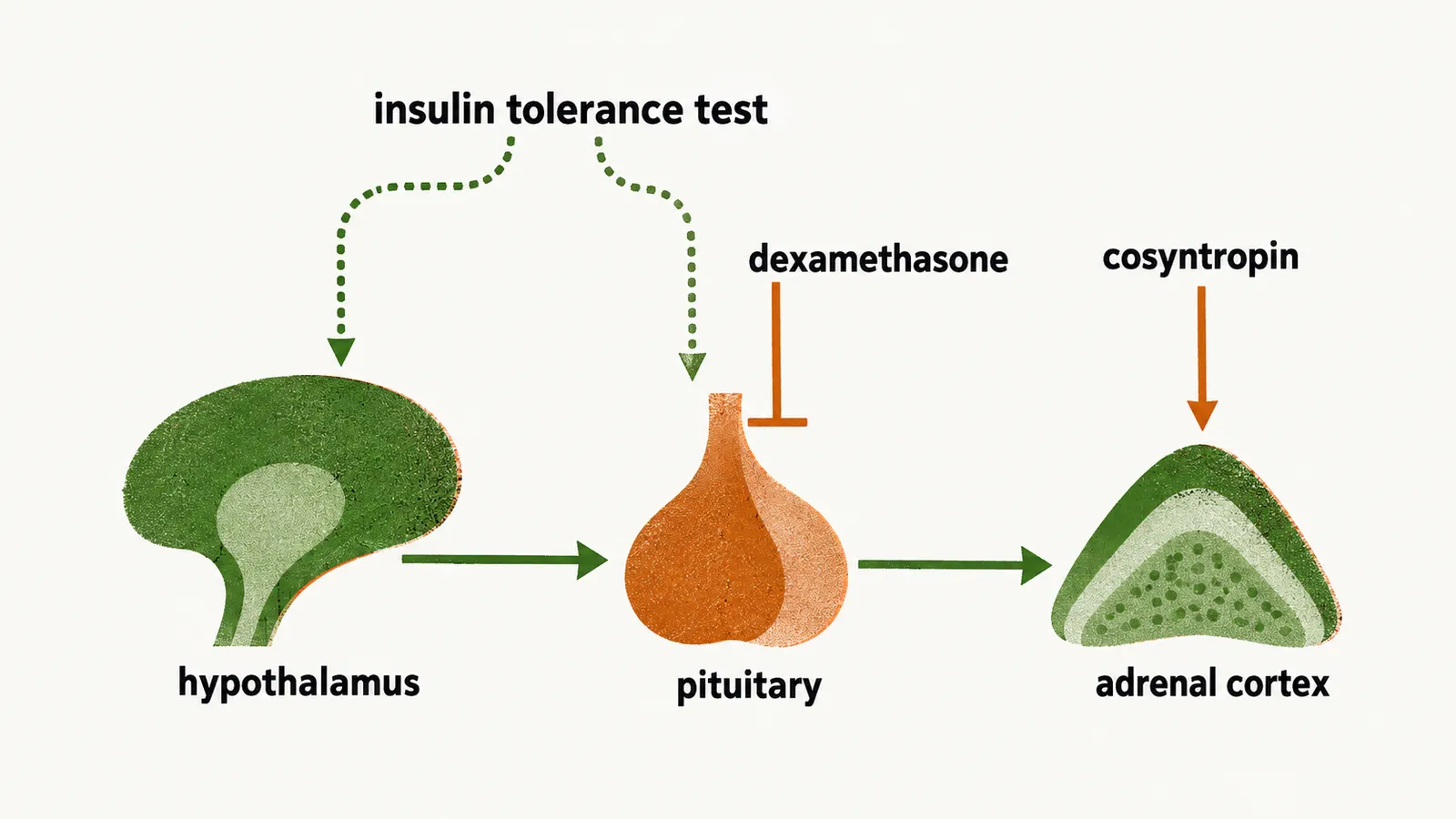
Adrenal function can be tested because the hypothalamus-pituitary-adrenal (HPA) axis is a closed loop. Cortisol restrains the release of corticotropin-releasing hormone (CRH) and adrenocorticotropic hormone (ACTH), so a glucocorticoid given from outside the body suppresses ACTH in the same way that the patient’s own cortisol does. Each test asks a different question of that loop: whether ACTH can be suppressed, whether the adrenal gland can respond to ACTH, and whether the whole axis can be driven by stress.
The dexamethasone suppression test
Dexamethasone is a synthetic glucocorticoid that acts on the negative feedback of the axis. Because the feedback loop reads it as cortisol, it suppresses CRH and ACTH release, and the fall in ACTH is judged by the resulting fall in cortisol. Whether the axis responds to dexamethasone, and how much dexamethasone is needed, localises where the excess cortisol is coming from:
| Where the excess cortisol comes from | What happens after dexamethasone |
|---|---|
| The adrenal gland itself | The high endogenous cortisol already suppresses CRH and ACTH, so there is little ACTH to suppress and the test changes nothing. |
| The pituitary gland | The ACTH-secreting corticotroph cells are relatively resistant to feedback, so a low dose does not suppress ACTH; a higher dose does, and ACTH falls. |
| An ectopic ACTH source | The ectopic neuroendocrine tissue is mostly resistant to feedback even at high doses, so the ACTH level does not change. |
Cosyntropin stimulation
Cosyntropin is the first 24 amino acids of ACTH, which is the part that carries its biological activity, so giving it reproduces what ACTH does. The cosyntropin stimulation test asks whether the adrenal gland can mount a cortisol response to that signal. Cosyntropin is given intramuscularly or intravenously, and cortisol is measured afterwards: a normal response is a cortisol level greater than 15–20 microgram/dL at 30–60 minutes after administration. The test is the usual first-line method for assessing glucocorticoid deficiency, because the alternative, the insulin tolerance test, is contraindicated in cerebrovascular disease, coronary artery disease and seizure.
The insulin tolerance test
The insulin tolerance test (ITT) drives the whole axis from above. A high dose of insulin produces hypoglycaemia, which the body treats as a severe form of endogenous stress, so it releases CRH and ACTH and, at the same time, growth hormone (GH). Glucose, cortisol and GH are then measured at 0, 30, 60 and 120 minutes after the injection. A normal physiological response is defined as cortisol greater than 20 microgram/dL plus GH greater than 5.1 microgram/L.