
The adrenal cortex is the outer layer of the adrenal gland, and it works as a steroid-producing factory: it takes cholesterol and builds three families of hormones from it. Each family has its own controlling signal and its own actions, which is why understanding the structure of the gland explains a great deal about how its hormones behave.
The adrenal glands are a pair of endocrine glands that sit on top of the kidneys, which is why they are also called the suprarenal glands. Each gland weighs about 4 to 6 grams. Arterial blood reaches the gland through several small arteries that open into a network of capillaries beneath the capsule, and these capillaries run inward through the cortex towards the medulla. The cortical cells are therefore bathed by blood that flows from the outside inward, cortex before medulla. Venous blood leaves the gland by a single central vein, and its destination differs between the two sides: on the right the adrenal vein drains directly into the inferior vena cava, while on the left it drains into the left renal vein.
Three zones, three products
The cortex is arranged as three concentric zones, and each zone produces a different class of steroid hormone:
- the zona glomerulosa, the outermost zone, produces the mineralocorticoid aldosterone;
- the zona fasciculata, the middle zone, produces the glucocorticoid cortisol;
- the zona reticularis, the innermost zone, produces the adrenal androgen precursors.
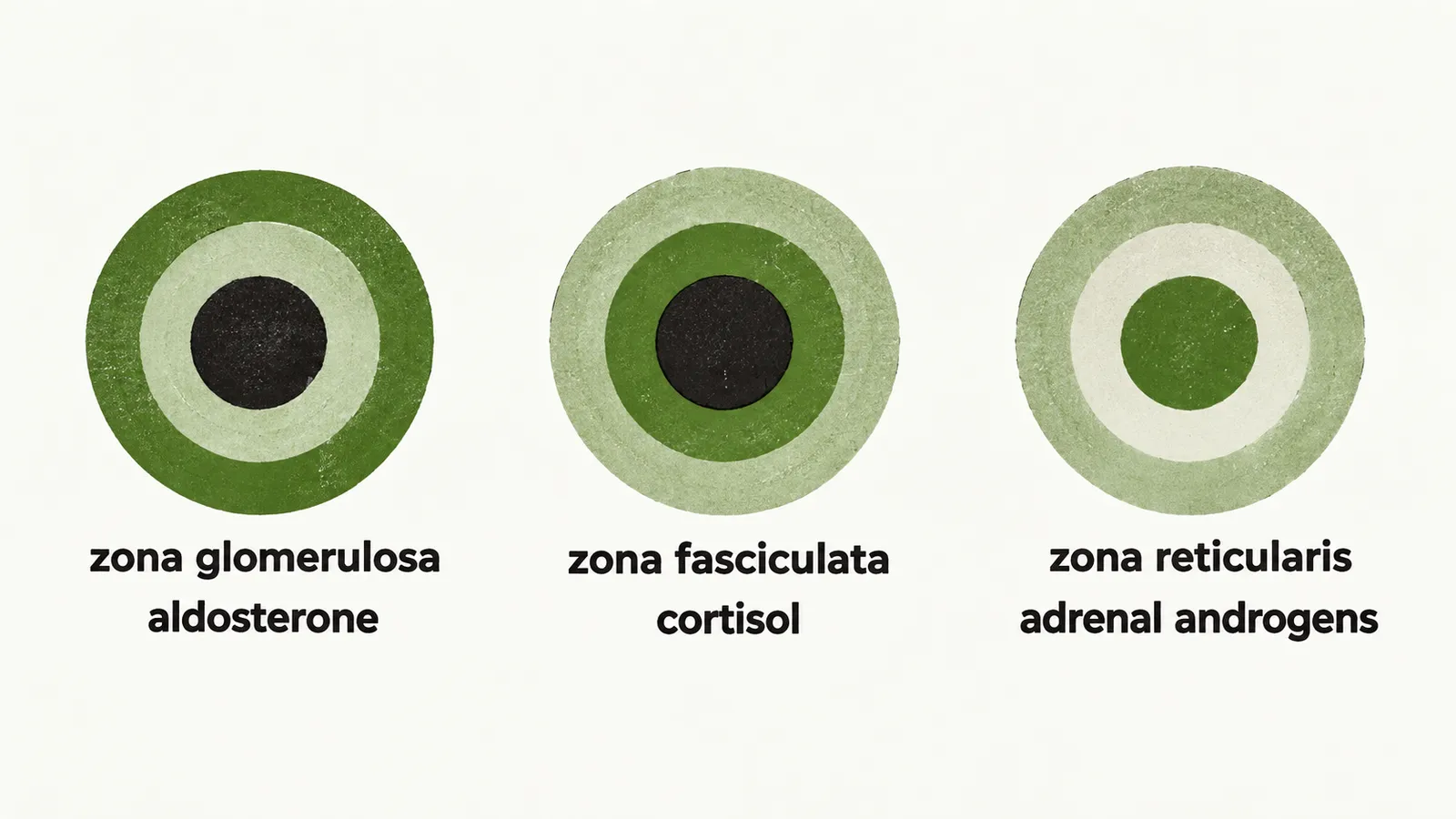
Why the zones make different hormones
The division of labour between the zones follows from the enzymes each one expresses, because a steroid pathway can only be built from the enzymes that a cell happens to carry. The zona glomerulosa lacks 17α-hydroxylase (CYP17A1), the enzyme needed to enter the cortisol and androgen routes, so it is confined to the mineralocorticoid pathway. The fasciculata and the reticularis do express CYP17A1, so they can make cortisol and androgens, but they lack aldosterone synthase (CYP11B2), the enzyme that performs the final steps of aldosterone synthesis. Only the zona glomerulosa expresses CYP11B2. This single partition of enzymes is the reason that producing too little aldosterone and producing too little cortisol can occur independently: the loss of one enzyme can remove one family’s output while leaving the other intact.
What the three families do
Because each zone makes its own class of hormone, the three products reach different targets and do different work.
Mineralocorticoids. Aldosterone is the main mineralocorticoid. It acts on the distal nephron to increase sodium reabsorption and potassium excretion, and it is therefore the body’s main regulator of extracellular fluid volume and, through it, of blood pressure.
Glucocorticoids. Cortisol is the main glucocorticoid. It raises blood glucose by promoting gluconeogenesis (the making of glucose from non-carbohydrate sources) and by limiting glucose use in some tissues, and it maintains the responsiveness of blood vessels to catecholamines. It is also central to the response to stress, and it suppresses immune and inflammatory responses.
Adrenal androgens. The adrenal androgen precursors, chiefly DHEA, its sulfated form DHEAS, and androstenedione, are weak androgens on their own. They are released into the blood and converted in peripheral tissues, including the gonads, into more potent androgens and into estrogens, so they contribute to the androgen and estrogen economy of the body outside the gonads.
Aldosterone and cortisol are each governed by their own controlling signal, which is why the control of glucocorticoid production is the natural next question.