Steroidogenesis in the adrenal cortex starts with adrenocorticotropic hormone (ACTH), the pituitary signal that drives cortisol production, acting on the glucocorticoid-producing cells, and from a single precursor, cholesterol, the cortex builds cortisol, the mineralocorticoids and the adrenal androgen precursors along overlapping enzymatic routes.
ACTH and the start of steroidogenesis
For steroidogenesis, ACTH is needed. ACTH stimulates the glucocorticoid-producing cells of the adrenal gland by attaching to the melanocortin 2 receptor (MC2R), a G protein-coupled receptor (GPCR) that produces cAMP and finally activates PKA inside these cells. PKA then changes the cell in two ways at once. It increases the import of cholesterol ester into the cell and increases hormone-sensitive lipase, which releases free cholesterol from stored cholesteryl esters, so more substrate is available. At the same time it phosphorylates and makes available CREB, a transcription factor that drives the production of CYP11A1, the enzyme crucial for steroidogenesis. ACTH therefore acts both immediately, by increasing the supply of cholesterol, and over hours, by increasing the amount of enzyme the cell carries.
From cholesterol to pregnenolone
The very first step of steroid hormone biosynthesis is the transfer of cholesterol into the mitochondria by a shuttle called steroidogenic acute regulatory protein (StAR), which moves cholesterol from the outer to the inner mitochondrial membrane. There, the cholesterol side chain cleavage enzyme (CYP11A1) removes the side chain to produce pregnenolone, the precursor from which all the adrenal steroids are made. The reactions that build those steroids from pregnenolone are catalysed mainly by CYP proteins, which are coupled with an oxidase-reductase system, and they are located mainly in the mitochondria or the endoplasmic reticulum. Pregnenolone can also be converted to progesterone by 3β-hydroxysteroid dehydrogenase (HSD3B2), and progesterone is a precursor for the production of mineralocorticoids and also glucocorticoids.
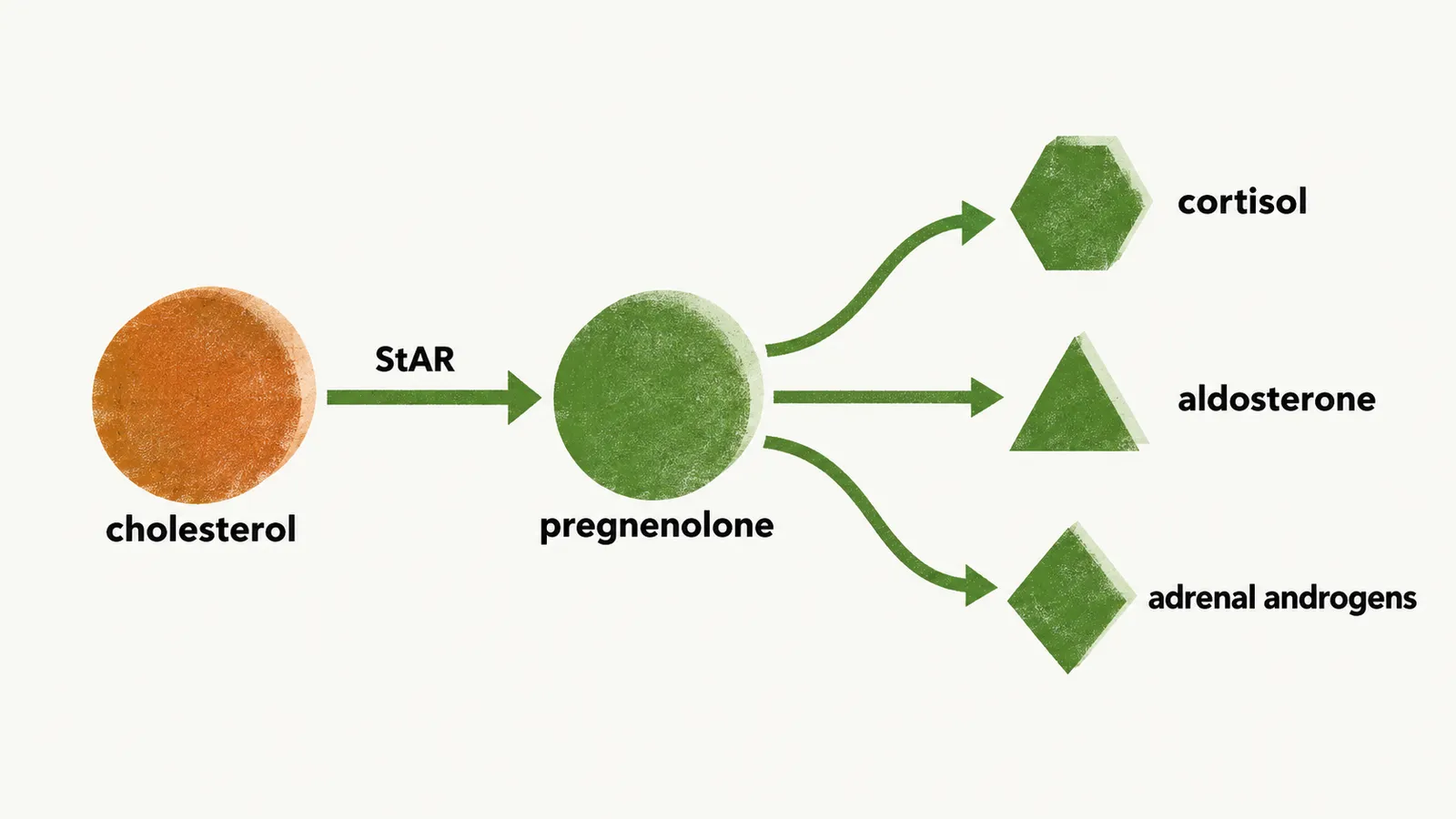
Biosynthesis of cortisol
For the biosynthesis of cortisol from pregnenolone, the molecule is built up in a sequence of four steps:
- HSD3B2 converts pregnenolone to progesterone.
- CYP17A1 hydroxylates progesterone at carbon 17 to give 17-hydroxyprogesterone.
- CYP21A2 hydroxylates carbon 21 to give 11-deoxycortisol.
- CYP11B1 hydroxylates carbon 11 to give cortisol.
Biosynthesis of mineralocorticoids
For the biosynthesis of mineralocorticoids from pregnenolone, the route leaves the cortisol route after progesterone and likewise takes four steps:
- HSD3B2 converts pregnenolone to progesterone.
- CYP21A2 hydroxylates progesterone at carbon 21 to give deoxycorticosterone.
- CYP11B1 hydroxylates carbon 11 to give corticosterone.
- Aldosterone synthase (CYP11B2) hydroxylates and then oxidises carbon 18 to give aldosterone.
Angiotensin II, by attaching to the AT1 receptors of the zona glomerulosa, increases the synthesis of CYP11B2, or aldosterone synthase enzyme.
The difference between the production of aldosterone and cortisol lies in two steps. For cortisol, carbon 17 is hydroxylated once progesterone has been formed; for aldosterone it is not, because the zona glomerulosa does not express CYP17A1. And for aldosterone, the final step needs CYP11B2 in addition to CYP11B1, because only aldosterone synthase carries the 18-hydroxylase and 18-oxidase activities that complete the molecule.
Biosynthesis of adrenal androgens
The adrenal androgen route depends on a single enzyme that has two catalytic activities. CYP17A1 has a 17-hydroxylase activity, which converts pregnenolone to 17-hydroxypregnenolone, and a 20-lyase activity, which converts 17-hydroxypregnenolone to DHEA. The majority of DHEA is secreted in the sulfated form, or DHEAS, while a portion of it enters the pathway of androstenedione, which can produce testosterone at the end. Because these androgens are made in the inner zones, they are the products that disappear first when the inner cortex is lost, while the glomerulosa can keep making aldosterone.
The androgen and cortisol routes share their early enzymes, whereas aldosterone synthesis depends on CYP11B2, an enzyme driven by angiotensin II and potassium rather than mainly by ACTH.