
Vitamin D
Vitamin D is more a hormone than simply a vitamin and co-factor.
The term vitamin D is devoted to two fat-soluble compounds: vitamin D3, or cholecalciferol, and vitamin D2, or ergocalciferol. The two differ less in what their active metabolites do than in how the body handles them: vitamin D3 binds the carrier protein vitamin D binding globulin more tightly and has a longer half-life, which is why it raises the circulating 25-hydroxy level more effectively than vitamin D2, while the active metabolites of the two forms have comparable biological activity at the vitamin D receptor.
The precursor of cholecalciferol is produced by the skin and is called 7-dehydrocholesterol; it is converted to cholecalciferol in response to the exposure of the skin to light. That is the step that makes vitamin D unusual, because the compound can be made rather than only absorbed.
Regarding the pharmacokinetics of vitamin D, some important points are:
- bile is needed for the absorption and also the excretion of vitamin D
- inflammation of the intestine can reduce the level of vitamin D absorption
- hepatic and biliary disorders cause lower absorption of vitamin D
Activation
Vitamin D requires activation during successive steps of hydroxylation. The first happens in the liver, forming 25-hydroxy cholecalciferol, or calcifediol: forming calcifediol from cholecalciferol requires a 25-hydroxylation in the liver, and calcifediol is the major circulating form of vitamin D, with a half-life of about 19 days, mainly carried by vitamin D binding globulin.
The second happens in the kidney, forming 1α,25-(OH)2-cholecalciferol, or calcitriol: forming calcitriol from 25-hydroxy cholecalciferol requires a 1α-hydroxylation in the kidney, in the proximal convoluted tubule (PCT). Calcitriol is the most potent and biologically active form of vitamin D, with a half-life of about 4 to 6 hours.
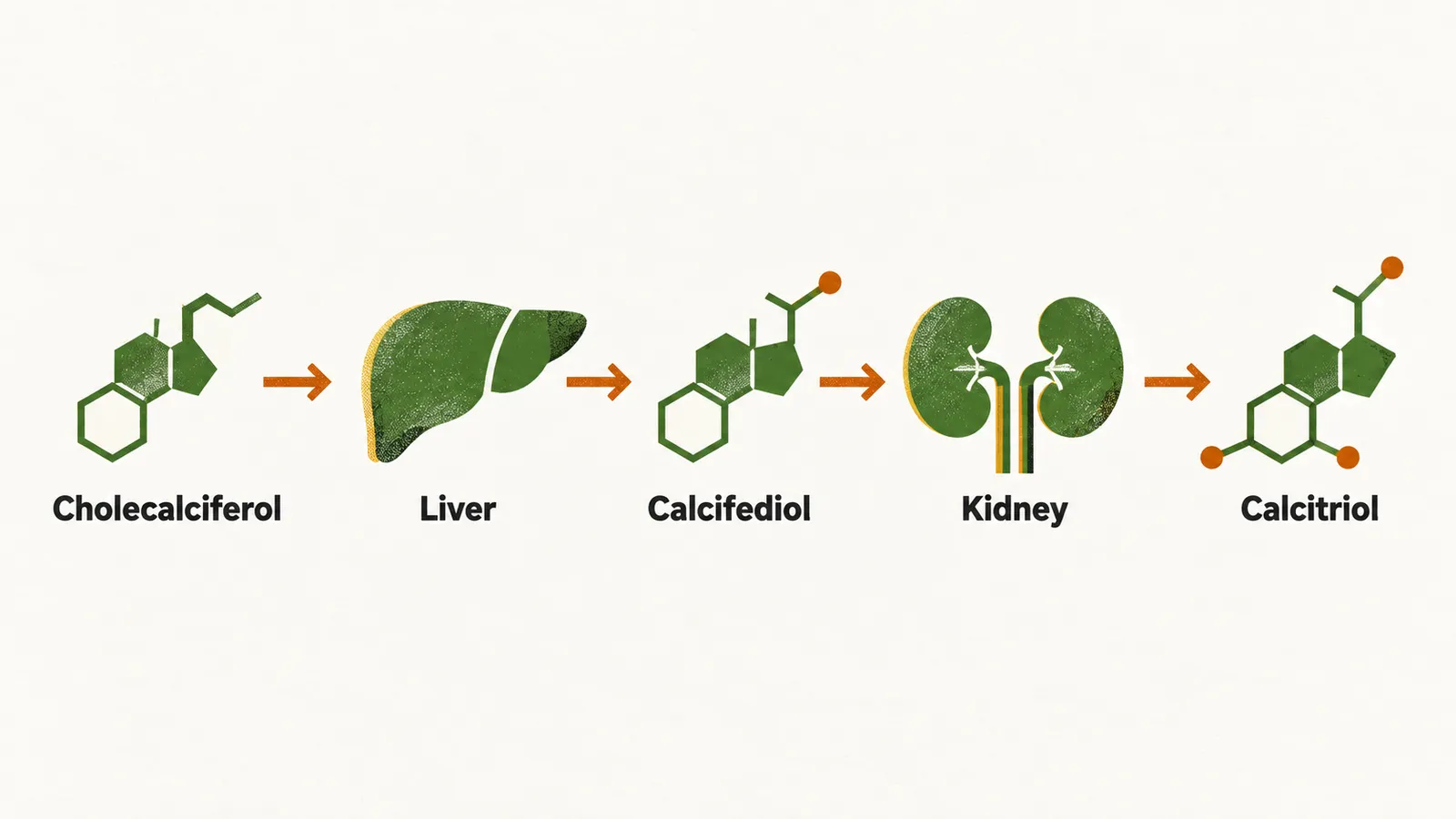
The production of calcitriol is highly regulated by different factors such as:
- dietary calcium intake
- calcium level
- phosphate level
- FGF23 level
- calcitriol level
The 24-hydroxylation of calcifediol leads to the formation of 24,25-(OH)2-cholecalciferol, which is an inactive metabolite. The 24-hydroxylation is made by the CYP24A1 enzyme, which is regulated by:
- upregulation of CYP24A1: FGF23 and calcitriol
- down-regulation of CYP24A1: PTH
In some certain diseases there is over-expression of 1α-hydroxylase by macrophages, such as in sarcoidosis, or by lymphocytes, such as in lymphoma, which leads to hypercalcemia in the patient.
Effects of calcitriol
The physiological effects of calcitriol are increased absorption and retention of calcium and phosphate in the kidney and intestine:
- decreased renal excretion
- increased intestinal absorption, by augmenting the active vitamin-D dependent calcium absorption in the proximal duodenum
- enhanced bone mobilization
Bone mobilization needs a closer look, because calcitriol is a bone-mobilizing hormone, not a bone-forming hormone. It has a receptor in the osteoblast that promotes the formation of some mediators: osteocalcin, which promotes bone formation, and IL-1, which promotes bone resorption. Because IL-1 and osteocalcin have opposite effects on bone remodeling, calcitriol is better described as a bone-mobilizing hormone than a bone-forming hormone.
Calcitonin
Calcitonin is the counterpart that lowers calcium: a hypocalcemic hormone that is released when the concentration of calcium in the plasma is high. It is the most potent peptide inhibitor of the osteoclast-mediated bone resorption.
Calcitonin is released by the parafollicular cells of the thyroid gland in response to a high level of calcium. Normal values are less than 25 pg/mL in men and less than 20 pg/mL in women, so the two sexes have different normal ranges.
An abnormally high level of calcitonin can be seen in medullary thyroid carcinoma, or MTC.
The hormones so far act on bone, kidney and intestine to raise or lower calcium in response to the plasma level. Calcium can also rise when a tissue makes a peptide that acts on the PTH receptor, whatever the state of the parathyroid glands.