
Laboratory testing in hypothyroidism starts with TSH (thyroid-stimulating hormone), because its change is much larger than the change in the thyroid hormone itself.
TSH first, then free T4
The main laboratory evaluation for suspected hypothyroidism is:
- TSH — the gold standard test; if it is increased, the diagnosis needs to be confirmed by testing the free T4 level
- Free T4 (thyroxine) level — not the first test, because in subclinical hypothyroidism it is normal; it is done after a raised TSH to confirm the diagnosis and to separate subclinical from overt disease
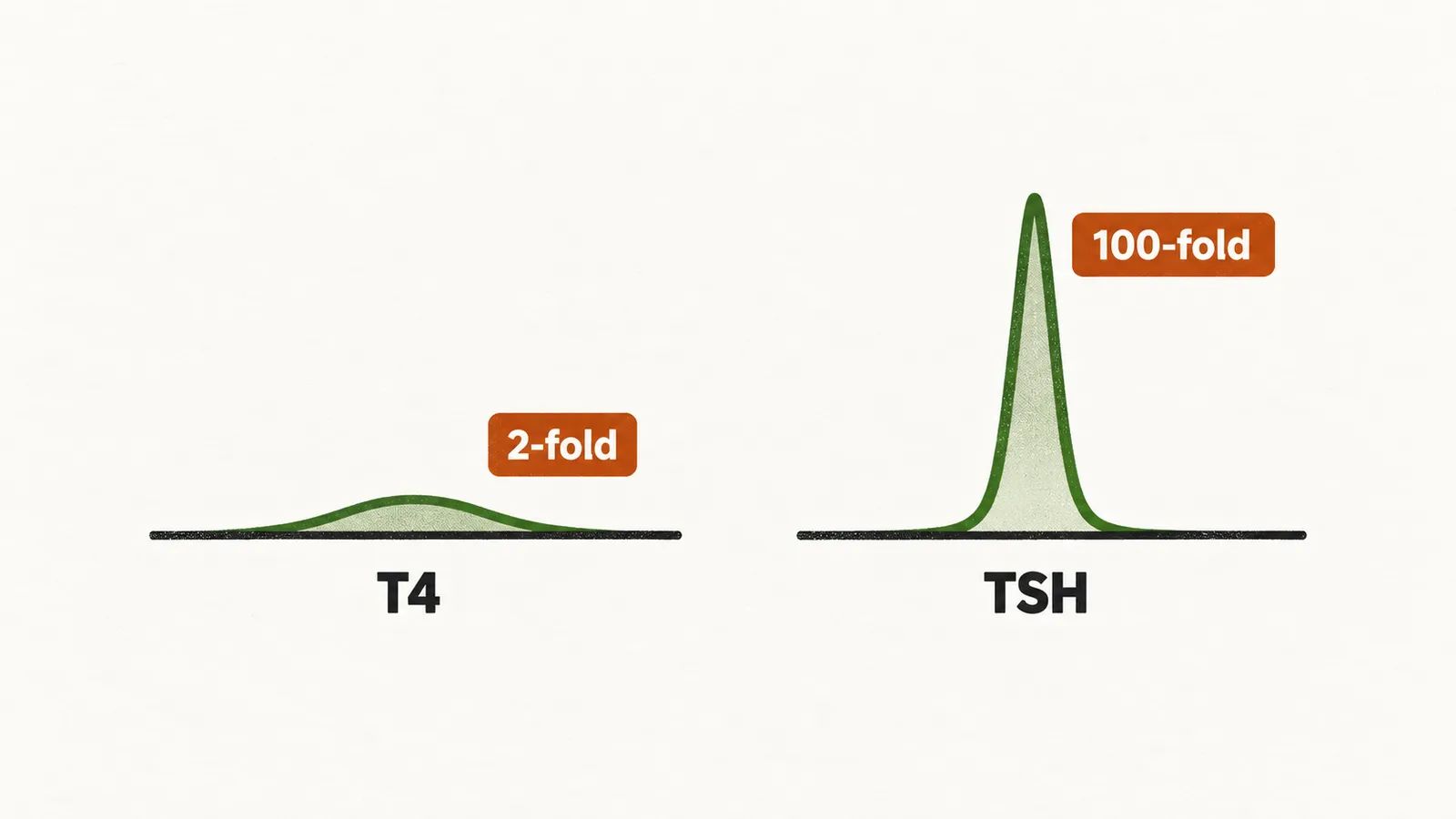
The reason TSH is measured first, and not T4, is that the changes in TSH are amplified relative to the hormone: a 2-fold change in the T4 level is associated with an up-to-100-fold change in TSH. That amplification makes the TSH assay far more sensitive, and it means the TSH becomes recognizably abnormal long before T4 falls outside its reference range. The same logic is what makes TSH unreliable when the problem is central rather than in the gland, because then the pituitary cannot raise it.
T3 is not used in routine investigation
The T3 (triiodothyronine) level is within the normal range in more than 25% of cases, because the activity of deiodinase increases as a compensatory mechanism and converts more T4 into the active T3. Because the level is often normal even when hypothyroidism is significant, T3 is not used in the usual clinical investigation.
Antibody testing
Once clinical or subclinical hypothyroidism is suspected and confirmed by the TSH and free T4 levels, immunoassays for the antibodies against TPO (thyroid peroxidase) and Tg (thyroglobulin) show whether the cause is autoimmune. TPO antibodies are the more useful of the two, being found in about 90-95% of people with Hashimoto’s thyroiditis, while Tg antibodies are found less often.
Other laboratory abnormalities
Beyond the thyroid tests themselves, other laboratory findings are abnormal in hypothyroidism:
- elevated creatine phosphokinase
- elevated cholesterol profile, especially LDL (low-density lipoprotein)
- elevated triglyceride
- anemia
- hyponatremia (low blood sodium)