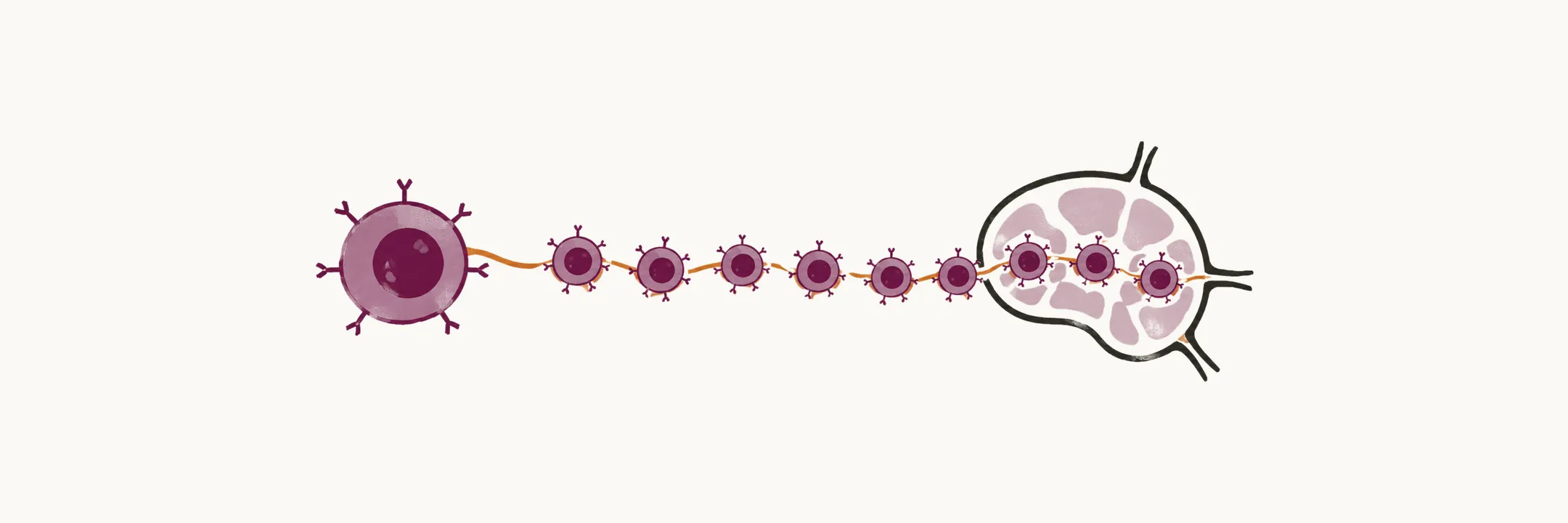
Chronic lymphocytic leukemia (CLL) is a clonal proliferation of mature B cells, and the most common leukemia in adults in Western countries. Clonal means that all the cells descend from a single original cell, and B cells are the lymphocytes that make antibodies. The same clone confined to the lymph nodes or the spleen, and sparing the peripheral blood, is called small lymphocytic lymphoma (SLL).
What organises the topic is the way the disease unfolds. A clonal B-cell population appears first, usually as a rise in the lymphocyte count (lymphocytosis), and it does not behave as an aggressive cancer from the start: it can remain below the diagnostic threshold as monoclonal B-cell lymphocytosis, meet the criteria for CLL while still causing no symptoms, and only later produce the complications that bring the patient to treatment. Where a patient sits on that sequence, and how the clone’s biology will move it forward, is what determines the diagnosis, the prognosis and the need for treatment.
Choose a route through the topic
A reader new to the topic can begin with the lymphocyte background, which explains how the lymphocyte count is interpreted and how clonality is confirmed, and then move to the earliest clonal stage; a reader who already knows how lymphocyte subsets are identified can begin with the earliest clonal stage. The remaining notes take the established disease in turn: its biology, its diagnosis and presentation, its staging and prognosis, and its treatment.
- Lymphocyte subsets and the approach to lymphocytosis — how B, T and NK cells are told apart by their surface markers, which reactive conditions raise the lymphocyte count, which findings point to leukemia instead, and how flow cytometry and molecular studies confirm clonality.
- Monoclonal B-cell lymphocytosis and the indolent precursor stage — why a clonal B-cell population is not automatically cancer, the definition of monoclonal B-cell lymphocytosis with its low- and high-count forms, and the sequence that leads towards symptomatic disease.
- Pathophysiology and immunophenotype of CLL and SLL — what the CLL cell is, why the clone accumulates, the surface markers that identify it, and the cytogenetic and molecular abnormalities that shape how the disease behaves.
- Diagnosis and clinical presentation of CLL and SLL — who the disease affects, the count and clonality criteria for CLL, why bone marrow aspiration is not required, what patients present with, and the variants that spare the peripheral blood, including SLL.
- Staging and prognostic factors in CLL and SLL — the Rai and Binet staging systems, the prognostic weight of del(17p), del(11q), del(13q) and CD38 expression, and Richter transformation as the terminal aggressive event.
- Treatment of CLL and SLL — when watch and wait is enough, the criteria that define active disease, the targeted drugs that have replaced chemoimmunotherapy, and the complications that shape supportive care.