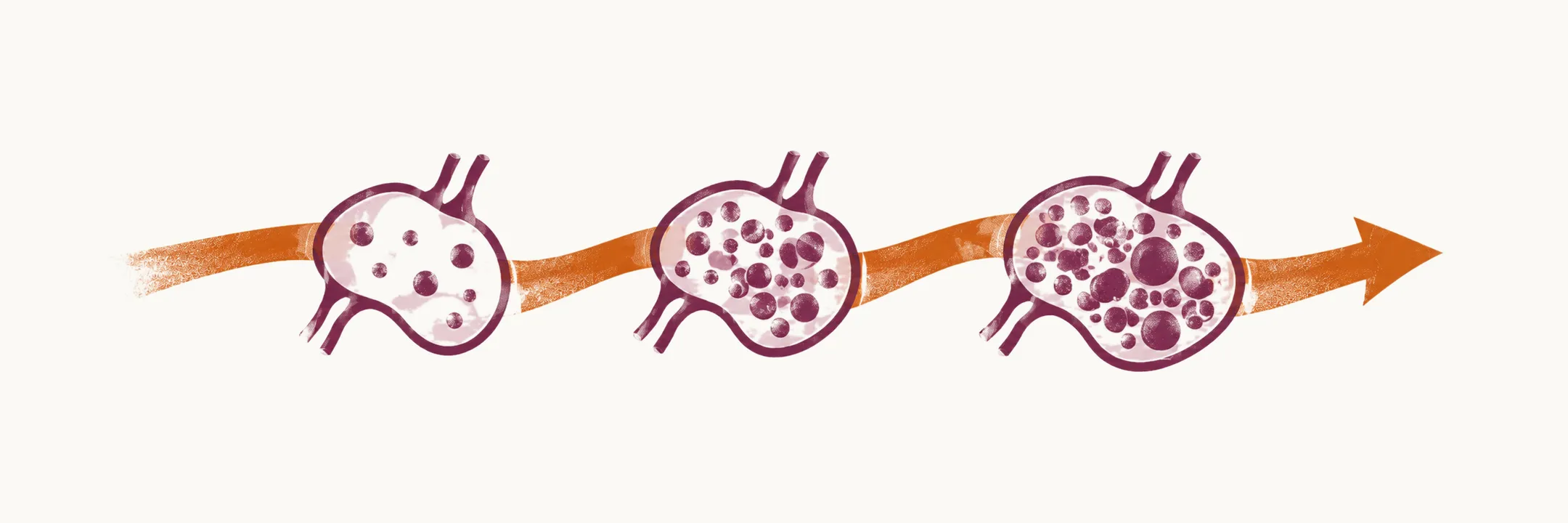
Once the diagnosis of chronic lymphocytic leukemia (CLL) or small lymphocytic lymphoma (SLL) has been established, the questions are how far the disease has advanced, which staging answers, and what its biology suggests about the years ahead, which prognostic factors answer. A further question is the aggressive transformation that can end the disease.
Staging: the Rai and Binet systems
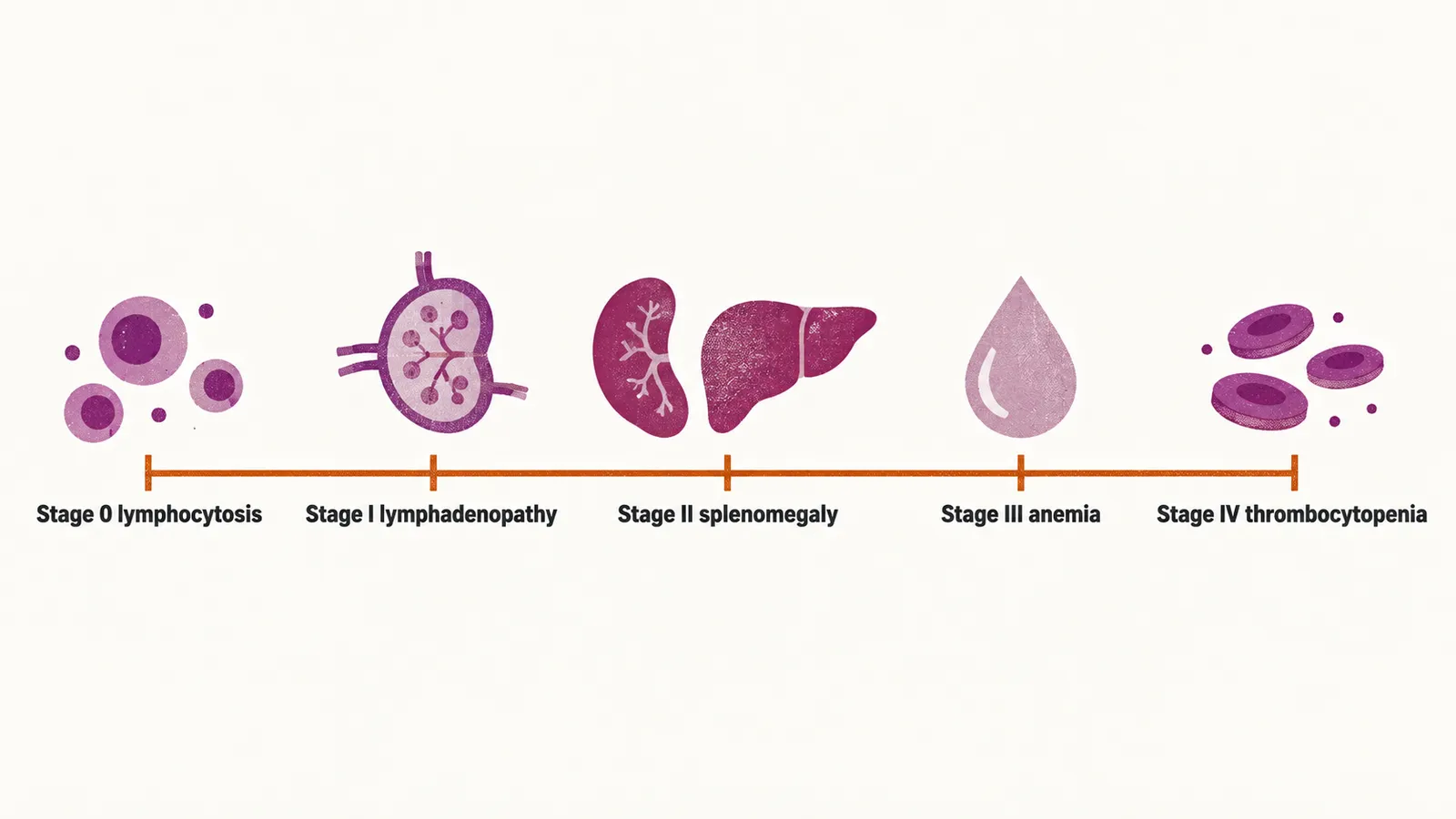
Two systems are in use, and they describe the same disease from different angles. The Rai staging system follows the spread of the disease and its effect on the blood counts:
- stage 0 — lymphocytosis only, in the blood and bone marrow
- stage I — lymphadenopathy (enlarged lymph nodes)
- stage II — splenomegaly and/or hepatomegaly (an enlarged spleen and/or liver), with or without lymphadenopathy
- stage III — anemia (hemoglobin below 11 g/dL)
- stage IV — thrombocytopenia (platelets below 100 × 10⁹/L)
The Binet staging system is mainly focused on the changes in the lymph nodes, and counts the involved lymphoid areas, which are the cervical, axillary and inguinal nodes on either side, the spleen and the liver. Stage A has fewer than three involved areas, stage B has three or more, and stage C adds anemia (hemoglobin below 10 g/dL) or thrombocytopenia (platelets below 100 × 10⁹/L). For the cases in which the CLL is asymptomatic, without any cytopenia and without lymphadenopathy, which is not rare at all, the Binet system still applies and places these patients in stage A, its earliest stage.
Prognostic factors
Stage says how much disease is present; the biology says how fast it is likely to move. The recurring chromosome abnormalities are also prognostic markers, and the most useful are:
- deletion of 17p and deletion of 11q, which are adverse prognostic factors; deletion of 17p removes TP53 and predicts a poor response to treatments that depend on the DNA-damage response
- deletion of 13q, which is a favourable prognostic factor
Cell surface markers add information as well: expression of CD38 in more than 30% of the cells is an adverse factor, and expression in less than 30% of the cells is a favourable one. Richter transformation, described next, is the event at the far end of the disease.
Richter transformation
The very last stage of the disease related to CLL/SLL is Richter transformation, the development of an aggressive large-cell lymphoma in the context of an underlying CLL/SLL. It is based on histological confirmation that is obtained from the lymph node of the patient. When the diagnosis has been made and treatment is given where it is needed, that is, in the case of active CLL, Richter transformation is not seen very often. Its clinical features are:
- elevated lactate dehydrogenase (LDH)
- progressive lymphadenopathy
- systemic symptoms
- cytopenia
Stage, prognostic markers and the possibility of transformation all bear on the practical question of whether the disease needs treatment, and when.