Chronic lymphocytic leukemia (CLL) is diagnosed from the blood count together with confirmation that the B cells are clonal, and many patients have no symptoms at the time the disease is found.
Who CLL affects
CLL is mainly a disease of older adults: the median age at diagnosis is around 70 years, it is about twice as common in men as in women, and it is rare before the age of 45. That age distribution is part of why the diagnosis is often incidental, because a routine blood count in an older person is a common way the disease first appears.
Criteria for the diagnosis of CLL
The criteria for CLL are that the number of B cells in the peripheral blood is more than 5000 cells per microliter, sustained for at least three months, and that those cells are mature; they should certainly not be blasts, which are immature cells. Clonality of the B cells then has to be confirmed by flow cytometry, where the most common findings are:
- an abnormal kappa:lambda ratio (light-chain restriction) — in CLL the cells are restricted to one of the light chains and do not express both of them, whereas in reactive lymphocytosis both are expressed
- expression of B-cell antigens such as CD19, CD20 and CD23
- up-regulation of the T-cell antigen CD5 on the clonal B cells
Bone marrow aspiration is not required for the diagnosis of CLL, because the count and the immunophenotype (the pattern of surface markers) in the peripheral blood already establish it.
Clinical presentation
In many patients there are no symptoms that the patient reports, but the common signs and symptoms are lymphocytosis, a raised lymphocyte count, and enlarged lymph nodes (lymphadenopathy). The lymph node swelling is painless, and the nodes are firm, rounded, mobile and non-tender.
The liver and spleen may also be enlarged (hepatosplenomegaly), and the skin may be involved. Some patients have B symptoms, which are weight loss, fever and night sweats. Cytopenia, a reduced count of one or more types of blood cell, can also occur; it is important to mention that thrombocytopenia (low platelets) and anemia in CLL can be autoimmune in nature, although bone marrow infiltration by the leukemic cells is a more common cause.
Involvement outside the peripheral blood
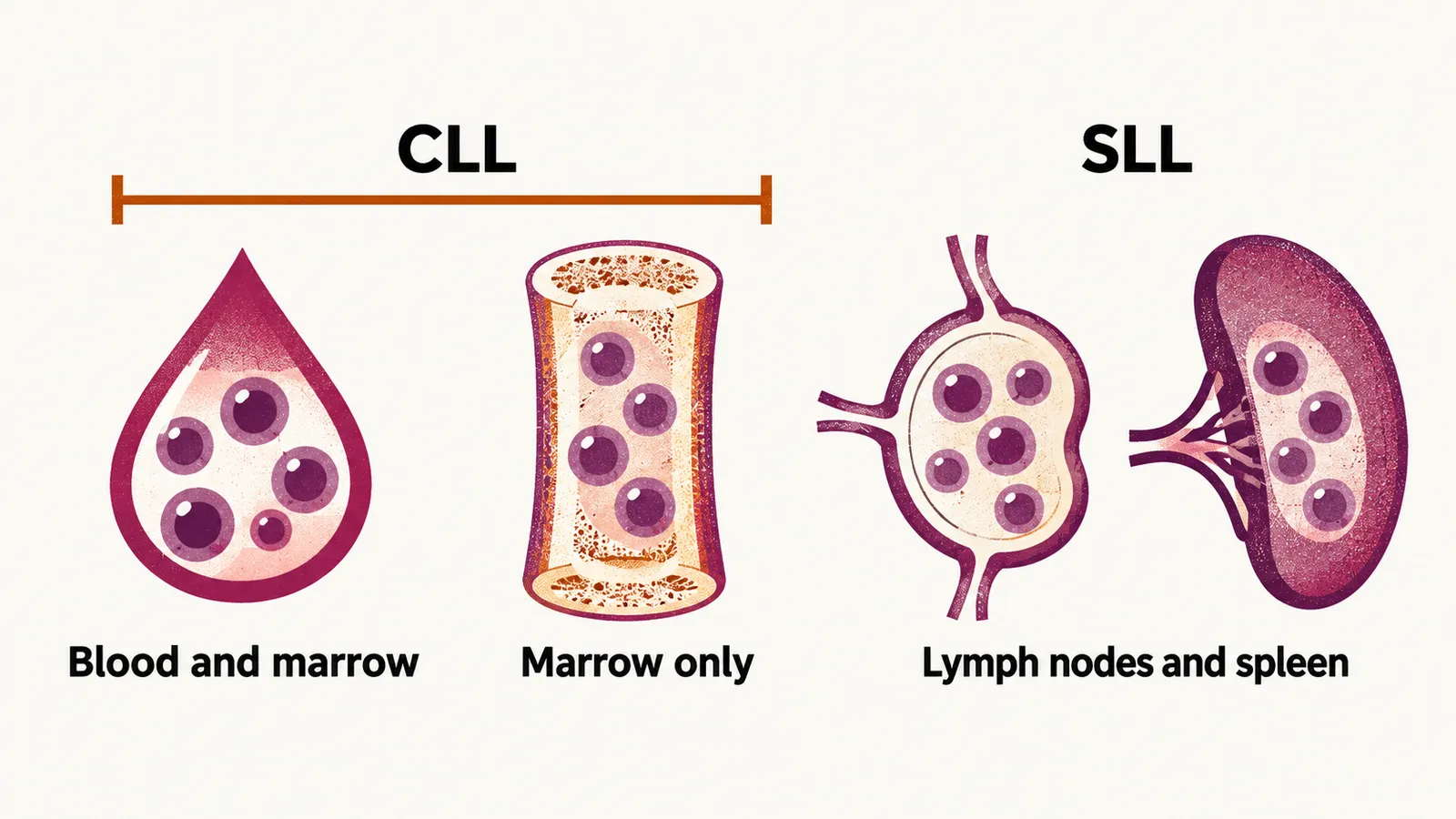
CLL is thought of as a disease with involvement of the peripheral blood and of the bone marrow, which is not examined quite often, but it can show itself in other ways. In a rare form, CLL is present without involvement of the peripheral blood, and the clonal cells are found only in the bone marrow; the marrow is infiltrated by typical clonal mature B cells together with at least one cytopenia, and the disease is still considered CLL even without a significant peripheral count of CLL cells. In another form there is neither bone marrow involvement nor peripheral blood involvement, and the clonal mature B cells are found in the lymph nodes or the spleen; this is called small lymphocytic lymphoma, or SLL. Whichever form is found, the next question is how far the disease has advanced and what its biology suggests about the years ahead.