
Chronic lymphocytic leukemia (CLL) is not curable with its standard treatment, so management aims to control a disease that can remain quiet for years. That is why the first decision is often not which drug to use, but whether to treat at all.
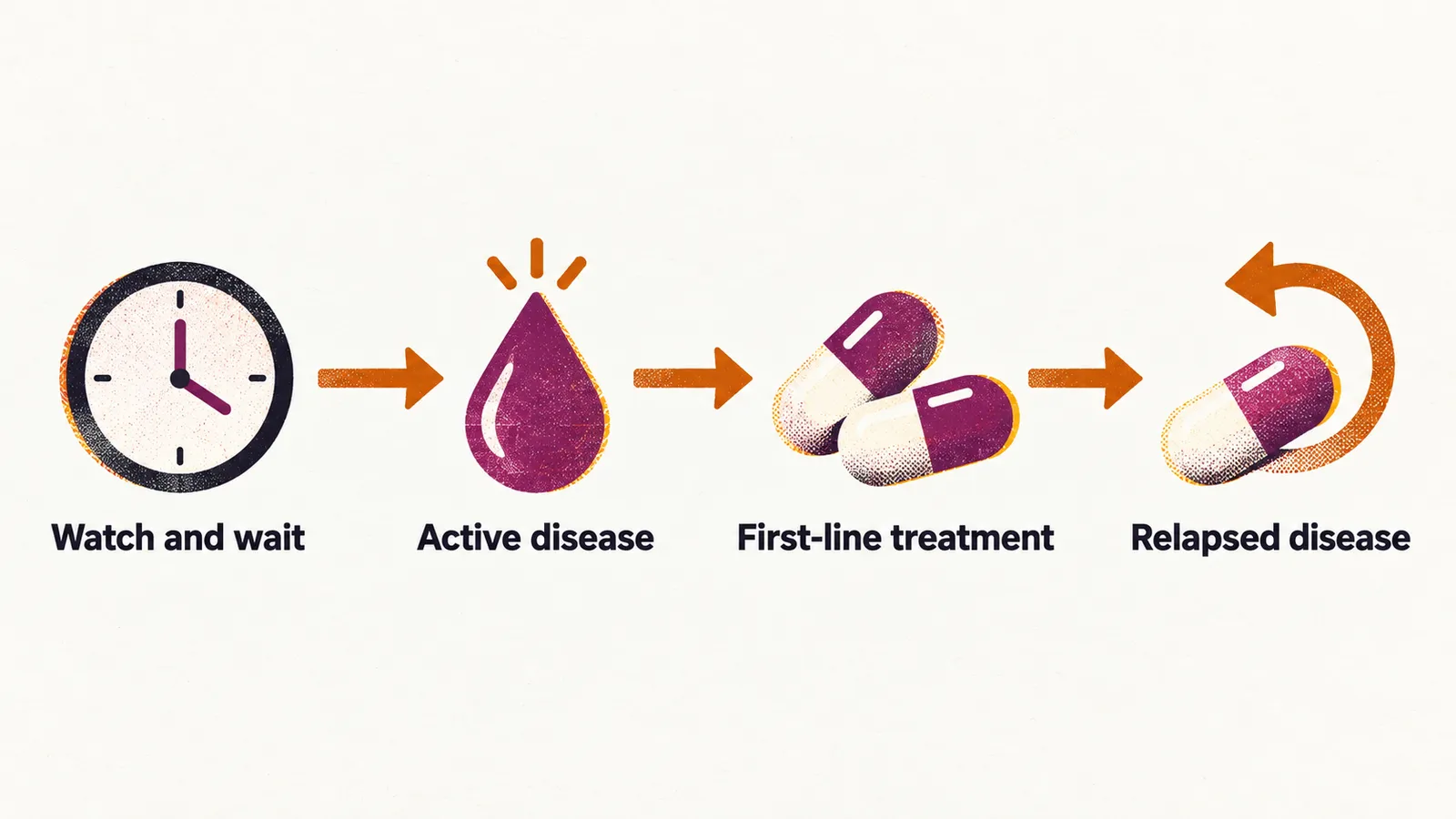
Watch and wait
A patient who is asymptomatic, with no cytopenia and no lymphadenopathy, needs no treatment when the diagnosis is made. About one third of patients with asymptomatic CLL may never need treatment, and among those managed with watch and wait up to 40% do not require CLL-directed treatment during their lifetime. Observation rather than early treatment is therefore the standard, and it spares these patients the harms of therapy they do not yet need.
When treatment has to be started
Treatment begins when the disease is active, not simply when it is present. Active disease can be shown by the blood counts, by the size of the disease, by the speed of the lymphocyte rise or by the symptoms it causes. The International Workshop on Chronic Lymphocytic Leukemia (iwCLL) criteria define it as at least one of the following:
- progressive marrow failure, with worsening anemia or thrombocytopenia (hemoglobin below 10 g/dL or platelets below 100 × 10⁹/L are generally taken as indications for treatment, although platelets that stay stable below that level over a long period do not by themselves require treatment)
- massive (at least 6 cm below the left costal margin), progressive or symptomatic splenomegaly
- massive (at least 10 cm in the longest diameter), progressive or symptomatic lymphadenopathy
- progressive lymphocytosis, with an increase of at least 50% over 2 months or a lymphocyte doubling time of less than 6 months
- autoimmune cytopenias that respond poorly to corticosteroids
- constitutional symptoms attributable to CLL: unintentional weight loss of at least 10% in 6 months, significant fatigue, fever of at least 38 °C for 2 weeks or more without infection, or night sweats for 1 month or more without infection
- symptomatic or functional extranodal involvement (for example, skin, kidney, lung or spine)
The staging systems give a shorter route to the same decision: treatment is started in Rai stage III to IV or Binet stage C disease. As in multiple myeloma, where the SLiM-CRAB criteria define active disease by the organ damage the neoplastic cells cause, CLL and SLL have their own criteria for what makes the disease active.
First-line treatment
First-line treatment has moved from chemotherapy to targeted drugs, which act on the biology of the disease. The two classes in current use are the BTK inhibitors — ibrutinib, acalabrutinib and zanubrutinib — given continuously, and the BCL2 inhibitor venetoclax, usually combined with the anti-CD20 antibody obinutuzumab as a fixed-duration course. The BTK inhibitors interrupt Bruton tyrosine kinase in the B-cell receptor signalling the clone depends on, and venetoclax restores apoptosis, the programmed cell death, by inhibiting BCL2.
Chemoimmunotherapy, chemotherapy given together with an antibody, has not disappeared, but its place has narrowed. A regimen such as FCR — fludarabine, cyclophosphamide and rituximab — is now considered mainly for fit patients with mutated IGHV (immunoglobulin heavy-chain variable genes that have undergone somatic hypermutation) and no TP53 abnormality, and above all where the targeted drugs are not available. When there is deletion of 17p or a TP53 mutation, chemoimmunotherapy is avoided, because it depends on the DNA-damage response those cells have lost.
Relapsed disease
When the disease returns, the aim is to use a class the patient has not yet had — a BTK inhibitor after venetoclax, or the reverse — and allogeneic stem-cell transplantation, transplantation of stem cells from a donor, remains an option for selected younger, fit patients.
Complications and supportive care
The disease itself produces complications that shape care. Autoimmune cytopenias, chiefly autoimmune hemolytic anemia and immune thrombocytopenia, affect 4% to 7% of patients. The immune dysfunction of CLL makes infections frequent, and the risk of a second malignancy is raised.
Supportive care runs alongside treatment: preventing and treating infection, which is a leading cause of death in CLL; replacing immunoglobulins when hypogammaglobulinemia, a low level of antibodies, causes recurrent infection; vaccination where it is safe; and preventing tumour lysis, the breakdown of tumour cells, when venetoclax is started.